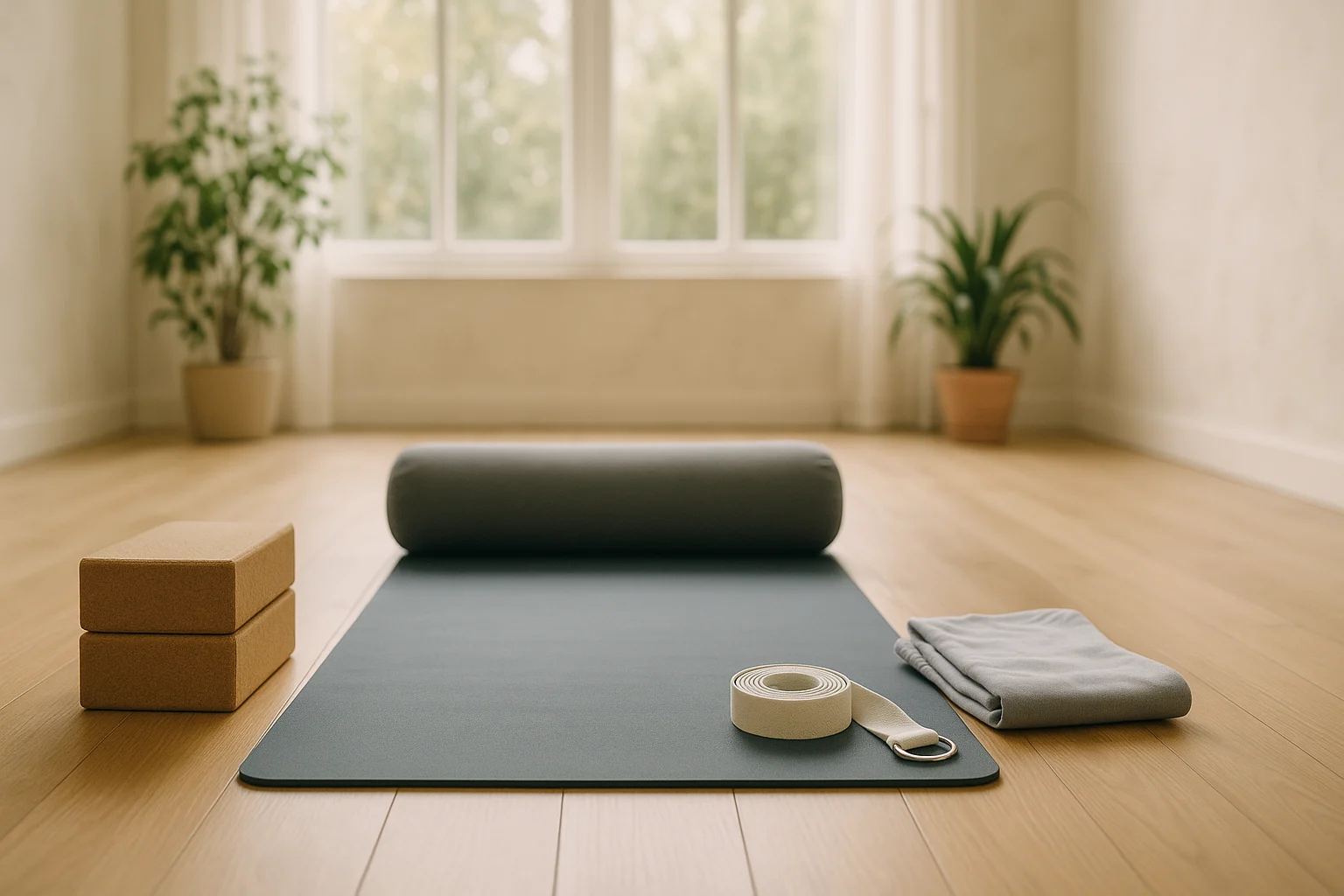
You do not need a room full of equipment to start yoga. For many beginners, a stable mat and clothes you can move in are enough.
Blocks, a strap, extra cushioning, or a towel earn their place when they solve a specific problem such as reach, balance, pressure, sweat, or getting down to the floor. The useful question is not “What should every yogi own?” but “What is making practice harder than it needs to be?” This yoga gear guide helps you choose by need instead of buying a generic checklist.
Find Gear That Fits Your PracticeThis page contains affiliate links. As an Amazon Associate, I earn from qualifying purchases. Links marked with ‘#ad’ are Amazon affiliate links. Learn more.
Table of Contents
- Essential Yoga Tools for Beginners
- Find the Yoga Gear That Fits Your Practice
- Choose a Gear Guide by Need
- Yoga Props: What Each One Changes
- Optional Yoga Accessories
- Materials, Budget & Environmental Claims
- Care for Mats, Clothes & Props
- FAQ
- Try a Chair-Based Practice
- Start With the Problem You’re Solving
Essential Yoga Tools for Beginners
Start with the items that solve the most common barriers: a stable surface, clothes you can move in, and only the prop or support your practice actually needs.
Choose Mat Thickness, Grip, and Material
Your mat should give you a predictable surface without creating a new comfort or stability problem. Start with the trade-off that matters most to you—cushioning, grip, portability, or material sensitivity—then compare the rest.
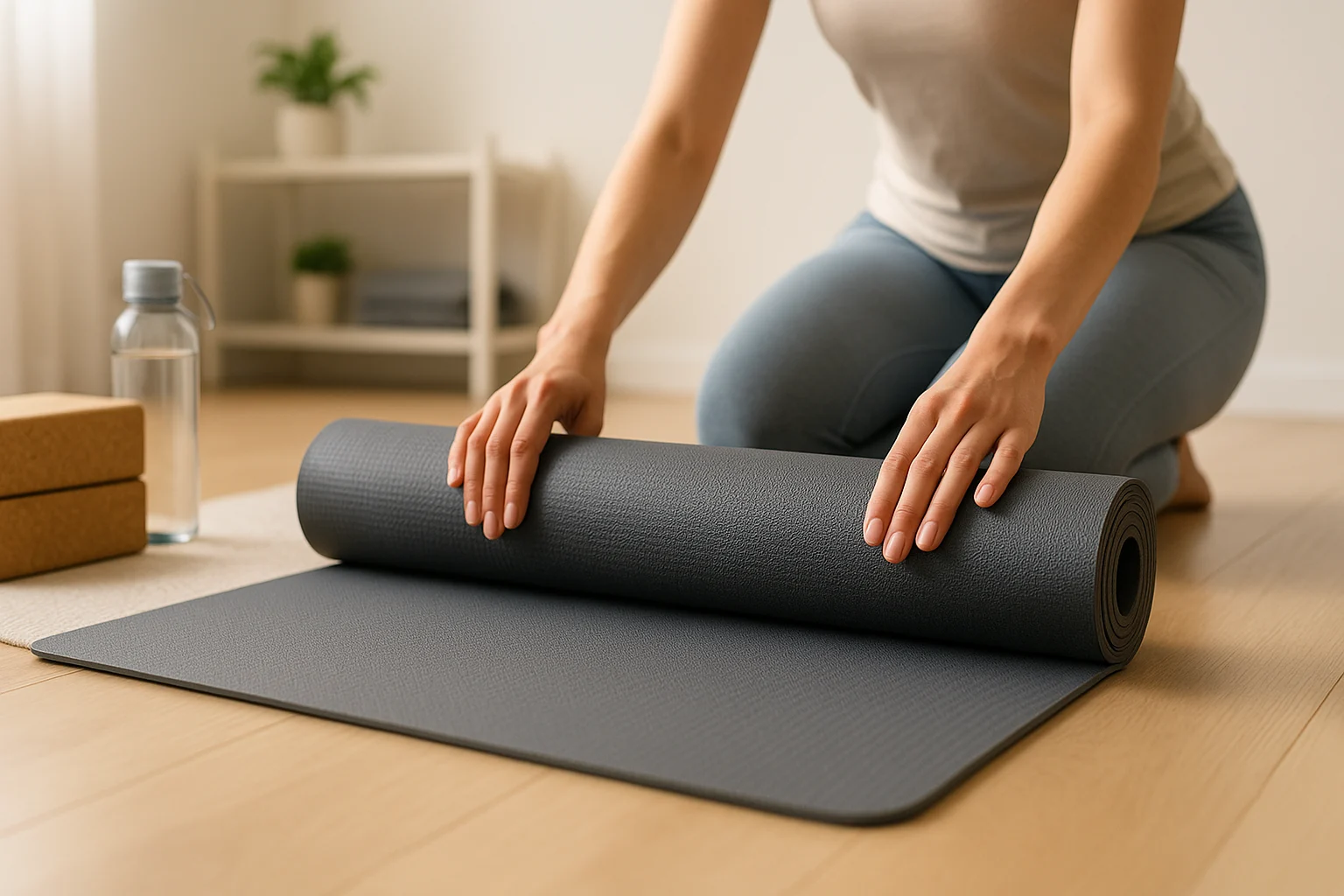
A 4–5 mm mat is a practical all-round starting range for many people: enough cushioning for floor work without feeling especially thick under standing poses. Thinner 1–3 mm mats pack more easily for travel, while thicker mats trade some firm floor feedback for extra padding. Grip matters more if your hands get sweaty; see our non-slip mat guide for sweaty hands or hot-yoga mat guide if heat is the main problem. Material labels also matter: if you know you react to natural rubber latex, avoid natural-rubber mats and verify the maker’s material disclosure. The FDA lists natural rubber among common allergens. TPE, PVC, cork, jute, cotton, and PU-topped mats all have different trade-offs, so treat “eco,” “non-toxic,” and “hypoallergenic” as claims to verify on the specific product rather than guarantees attached to a whole material category. Use these yoga equipment tips as filters, not a shopping list: choose around your actual practice.
Natural-rubber mat option: Manduka eKO (5 mm) — choose it if you want more cushioning than a travel mat; skip natural rubber if you are latex-sensitive.
If Latex Is a Concern
If latex is a concern, do not rely on “hypoallergenic” shorthand alone. Check the exact material statement for the mat and its backing. Our hypoallergenic yoga mat guide compares options through that sensitivity-first lens.
Before buying, check the maker’s care instructions too. Different surfaces tolerate cleaners differently; the mat-care section below explains why the material-specific instructions should come first.
Clothes That Move With You
Choose clothing that lets you move without constant adjustment. Stretchy bottoms and a top that stays in place when you hinge or invert are usually easier to practice in than anything you have to keep pulling back into position. Layers are useful for warm-ups, cool-downs, and cooler studios.
If several of those needs sound familiar, use the selector to decide which one to solve first.
Find the Yoga Gear That Fits Your Practice
Answer three quick questions to identify the gear problem worth solving first. You’ll get a focused guide or section—not a shopping list.
0 of 3 answered
Answer all three questions to get a focused starting point.
Choose a Gear Guide by Need
If you used the selector, the matching guide is the next place to go. Otherwise, browse by the problem you want to solve instead of comparing every category at once.
Mats and Grip
- Hot-yoga mats — for heat, sweat, and grip.
- Non-slip mats for sweaty hands — when slipping is the main issue.
- Hypoallergenic yoga mats — for material-sensitivity questions.
Props and Support
- Beginner yoga prop sets — when you want blocks and a strap together.
- Yoga straps for beginners — for extra reach without forcing.
- Yoga wrist supports — for comparing wedges, braces, and grip aids.
- Essential yoga props — the broader blocks, straps, bolsters, and blankets guide.
- Yoga block exercises — practical ways to use blocks once you own them.
Rest and Meditation
- Meditation cushions under $50 — for seated comfort on a budget.
Yoga Props: What Each One Changes
Props are not beginner-only. Their real value is giving you another height, distance, angle, or support option when the floor or the full pose is not the best fit. For the deeper how-and-why treatment, see our essential yoga props guide.
Yoga Blocks: Bring the Floor Closer
Foam blocks are lighter and softer, cork blocks feel firmer, and wood blocks are rigid. A standard 9×6×4-inch block gives you three usable heights for bringing the floor closer in poses such as Half Moon or seated folds. Our yoga block exercise guide shows practical ways to use that extra height and support.
Yoga Straps: Extend Your Reach
Straps extend reach without requiring you to pull yourself into the end range of a pose. A 6-ft strap can cover many basic uses, while 8–10 ft gives more room for taller bodies, larger loops, and shoulder work. In a seated forward fold, use the strap to keep the spine organized rather than to drag the torso lower. New to straps? Our beginner yoga strap guide walks through the basics.
Starter-set option: Syntus block + strap set — two 9×6×4-inch blocks plus an 8-ft D-ring strap in one kit.
If you specifically want cork blocks, compare a separate cork-block option.
Bolsters: Broad Support for Restorative Poses
Bolsters are most useful when you want broad, comfortable support rather than a small point of contact. Rectangular shapes work well under the torso, knees, or hips; round bolsters create a different curve for supported backbends and reclining positions. The Gaiam Rectangular Yoga Bolster is one rectangular option for that job, but bolsters are optional rather than a universal must-have.
Blankets: Adjustable Cushioning and Warmth
Blankets are a flexible multi-tool: fold one for knee cushioning, use it to lift the hips in seated work, or keep it nearby for warmth in Savasana. The more height you need, the more important it is that the folds stay firm and even.
Wrist Supports: When a Different Wrist Angle Helps
Wedges change the angle between the hand and forearm; padded gloves add grip or cushioning; braces restrict movement to varying degrees. None is a universal fix for wrist pain. If weight-bearing on the hands hurts, reduce or stop the load rather than pushing through it, and use our yoga wrist support guide to compare the options.
Yoga Wheels: Optional Curved Support
Yoga wheels are optional. They can act as a curved support in some backbends or mobility drills, but they also introduce movement and instability. Start slowly, keep the range modest, and skip the wheel if it makes a position feel less controlled.
Yoga Props at a Glance
| Prop | What It Changes | Useful When | Common Materials |
|---|---|---|---|
| Yoga Blocks | Adds stable height | You need the floor closer or a steadier intermediate position | Foam, Cork, Wood |
| Yoga Strap | Extends reach | You need more reach without pulling deeper into a pose | Cotton |
| Bolster | Adds broad support | Restorative or seated positions need more support | Cotton, Kapok, Foam |
| Blanket | Adds adjustable height, padding, or warmth | You want flexible cushioning that can be folded to different heights | Wool, Cotton |
| Wrist Supports | Changes wrist angle or cushioning | You are comparing ways to alter hand-loading comfort | Foam, Fabric |
| Yoga Wheel | Adds curved, moving support | You want optional support for controlled backbend or mobility work | Plastic, Cushion |
If you already know you want both blocks and a strap, our beginner yoga prop set guide compares kits that package those tools together.
Optional Yoga Accessories: Add Them for a Specific Job
Once the basics are working, extras should solve a narrower problem: sweat, transport, seated comfort, or relaxation. If you cannot name the problem an accessory solves, you can probably skip it for now.
Practical Extras for Sweat and Transport
A mat towel can help when sweat reduces grip, while a small hand towel handles wiping without becoming a loose layer on the mat. A water bottle is useful when you want water nearby, but it does not need to be yoga-specific. A mat bag or sling earns its place only if you regularly carry gear to class; prioritize a comfortable strap and only the storage you will actually use.
Comfort and Relaxation Extras
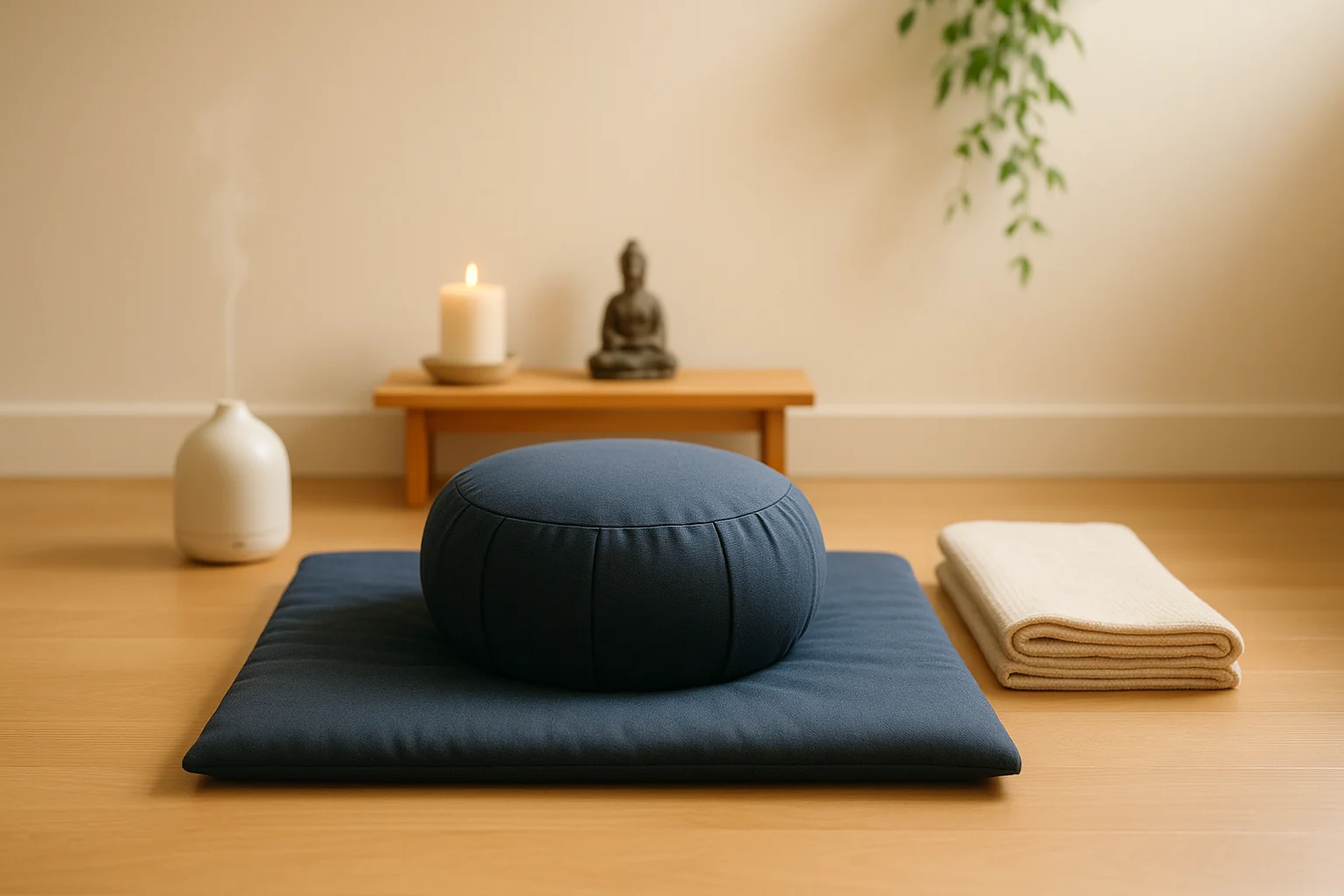
A zafu adds seat height, while a zabuton adds broader padding under the knees and ankles; our budget meditation cushion guide compares focused options. An eye pillow can block light or add gentle weight in Savasana; choose unscented if fragrance bothers you. A diffuser is atmosphere rather than yoga equipment, so keep scent subtle and ventilate the room—or skip it entirely if fragrance is a concern.
Before You Buy: Materials, Budget, and Environmental Claims
Use these checks when material sensitivity, environmental priorities, or budget changes what a sensible choice looks like for you.
Material Sensitivities
Material disclosure matters more than broad labels such as “hypoallergenic” or “non-toxic.” If you know you react to latex, avoid natural-rubber mats; if dyes, odors, or fragrances bother you, compare simpler material lists and manufacturer disclosures.
Environmental Priorities
No single material is automatically the “green” choice in every product. Compare durability, how often you expect to replace the item, the material mix, manufacturing claims, and packaging rather than relying on one eco label.
Budget-Smart Choices
Buy after you know what you will actually use. Borrowing studio props, using a folded household blanket for cushioning, or starting with one block before buying a full set can tell you more than a long shopping list.
Care for Yoga Mats, Clothes, and Props
Care depends on material and construction, so use the maker’s instructions as the default and keep each item clean and fully dry before storing it.
Yoga Mat Care: Follow the Material-Specific Instructions
Use the maker’s care instructions for your specific mat and material instead of one wash schedule for every surface. Wipe away sweat and dirt as needed, use only cleaners the maker allows, let the mat dry fully before rolling it, and do not soak it unless the manufacturer specifically says you can.
Washing Your Yoga Clothes
Follow the care label on each garment rather than using one wash routine for every fabric. Stretch blends can respond differently to heat, detergents, and softeners, so use the instructions for the item you actually own.
Storing Props
Follow the maker’s instructions for blocks, straps, bolsters, and blankets too. Keep props clean and fully dry before storing them, and wash removable covers only as their care labels allow.
Frequently Asked Questions
If a stable chair is the way you’re starting, use the 10-minute chair-yoga routine as your next practice.
Get the 10-Minute Chair Yoga Routine
Confirm to get the routine and yoga tips. Unsubscribe anytime.
Something went wrong. Please check your email address and try again.
Start With the Problem You’re Solving
For most beginners, the best setup is small: a stable mat, clothes you can move in, and one extra tool only when it solves a real problem. If reach is the issue, try a block or strap. If sweat is the issue, solve grip. If floor work is uncomfortable, start with a stable chair or broader support around the version of the practice you can do comfortably.
Once that problem is easier, stop shopping and practice. If you are still not sure where to start, use the gear selector to narrow your next step.