If your hips, hamstrings, shoulders, or back feel stiff, you do not need to force a deeper stretch. These gentle yoga sequences give you a few places to start, with support options when getting to the floor or moving through a larger range does not feel workable today.
If you want a quick starting point, use the sequence finder just after the table of contents. For help choosing props, building range gradually, and putting a routine together, see my Yoga Flexibility Guide.
This post contains affiliate links. If you purchase through them, I may earn a commission at no extra cost to you. As an Amazon Associate, I earn from qualifying purchases. Learn more.
Table of Contents
- Find Your Gentle Starting Sequence
- How to Keep These Sequences Gentle
- Props and Household Substitutes for Gentle Yoga
- Gentle Yoga Sequences for Hips, Hamstrings, Shoulders, and Spine
- A Sample Full Gentle Yoga Routine for Flexibility
- How to Progress Without Forcing
- Questions About Gentle Yoga Sequences
- Start Where Your Body Is Today
Find Your Gentle Starting Sequence
Answer two quick questions. I’ll point you to a gentle place to begin in this guide based on what feels stiff and how much floor work feels realistic today.
Answer both questions to see your starting point.
How to Keep These Sequences Gentle
In this guide, gentle is less about a special pose list and more about how you practice it. Move slowly enough to notice what changes, use support before strain, and stop before depth becomes the goal.
- Slower transitions: Give yourself time to settle before changing shape.
- Comfortable range: Stop where you can keep breathing normally instead of treating depth as the goal.
- Support before strain: Use a chair, block, strap, pillow, or blanket when it makes the pose fit your body better.
- Breath as feedback: If you start bracing or holding your breath, reduce the range or come out of the pose.
Think of gentle yoga as a conversation with your body, not a contest: aim for ease and skip the forcing.
Think in usable range, not maximum depth
For this guide, usable range means movement you can enter, breathe in, and leave with control. Your hands do not need to reach the floor for a stretch to be useful.
If you’re new, a beginner yoga flow can make the pace and setup easier to learn. If getting to the floor or standing balance is difficult, chair yoga can be a gentler starting format. Older adults and anyone with medical issues or significant mobility limitations should prioritize safety and get individualized guidance when needed. For a current research overview, see NCCIH’s yoga effectiveness and safety guidance.
Your breath is a simple check on effort: if you start bracing, holding your breath, or straining to keep the shape, reduce the range or come out. If you want a separate breathing practice, try this calming breathwork guide.
Props and Household Substitutes for Gentle Yoga
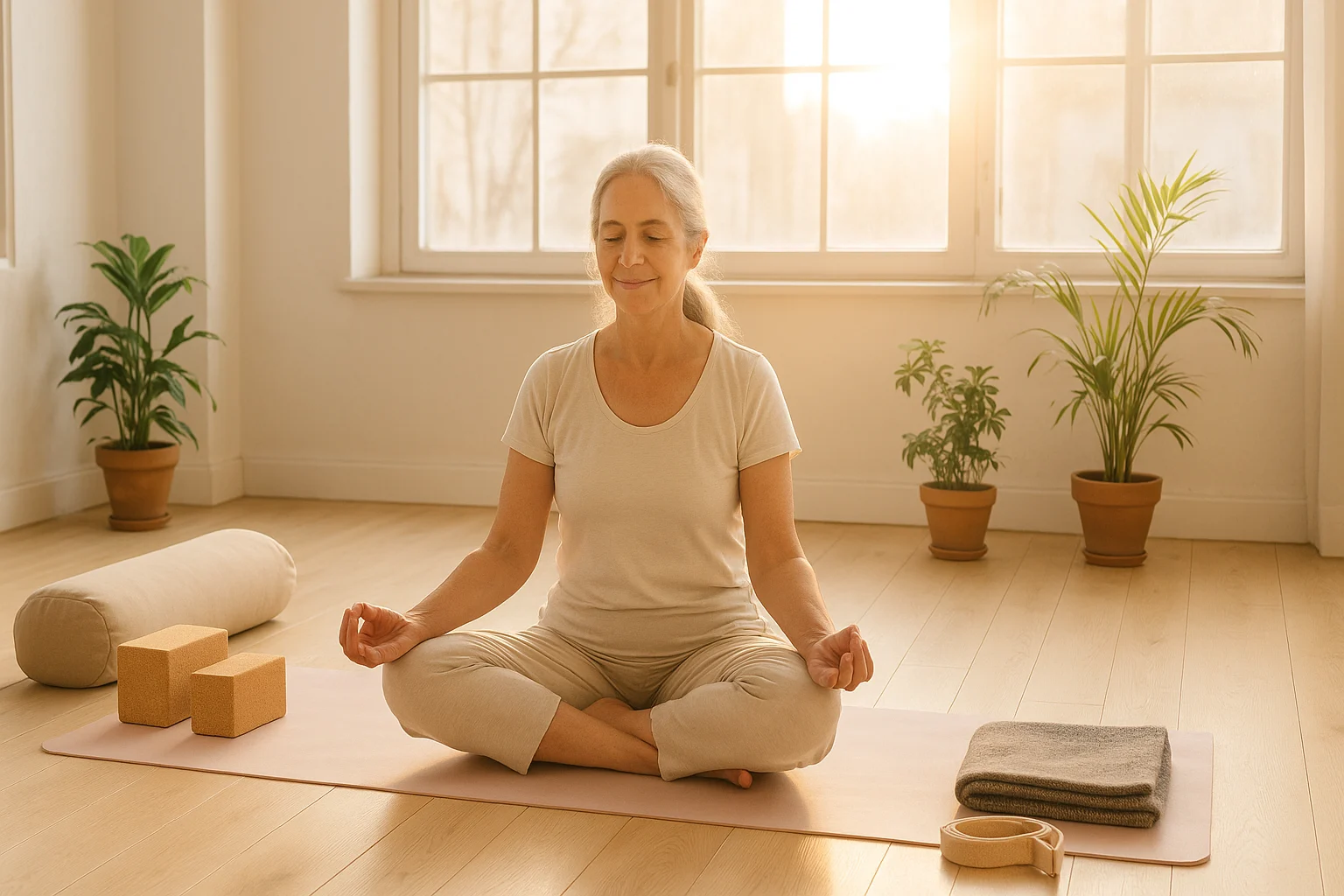
You don’t need a full set of yoga props to start. Pillows, a folded blanket, and a belt can cover a lot of the same jobs. If the same limitation keeps showing up, choose the prop that solves that specific problem. If grip is the issue rather than reach, this non-slip yoga mat guide goes deeper.
| Prop | What it helps with | Easy substitute | What to use |
|---|---|---|---|
| Yoga mat | Grip and cushioning on hard floors. | Use the mat you already trust. | No special upgrade needed for this sequence. |
| Yoga block | Brings the floor closer when reaching down feels like too much. | For seated or reclined poses, a folded blanket can add height. For weight-bearing support, use a stable yoga block rather than an improvised stack. | Gaiam EVA Foam Yoga Block |
| Yoga strap | Extends your reach when you can’t comfortably hold a foot or leg. | A sturdy belt can work when it can be held securely. | Manduka Align 8-ft Yoga Strap |
| Bolster | Supports restorative poses and takes effort out of longer holds. | Use one or two firm pillows. | Household substitute is usually enough. |
| Blanket | Cushions knees or hips and supports the head. | Fold a regular blanket to the height you need. | Household substitute works well. |
Gentle Yoga Sequences for Hips, Hamstrings, Shoulders, and Spine
Treat these as modules, not a checklist. Pick the area that feels most relevant today; you do not need to do all four. Move slowly and skip anything that hurts.
Hip Release Yoga Flow: Gentle Sequence 1
If your hips feel stiff, this sequence focuses on the hip flexors and outer hips without asking you to force a deeper range. For related hip-focused practice, explore yoga for piriformis relief.
Supine Figure-Four Stretch (Eye of the Needle Pose)
Benefit: Stretches outer hip and glutes.
How-To:
- Lie on your back, knees bent, feet flat, hip-width apart.
- Place your right ankle on your left thigh, knee pointing out.
- Stay here or lift your left foot, interlacing fingers behind your left thigh or shin.
- Draw your left knee toward your chest, right foot flexed.
- Breathe deeply, feeling the stretch in your right hip.
- Hold for 5-10 breaths. Switch sides.
Props: Use a strap around the left thigh if needed.
If lifting the leg feels like too much: Keep both feet on the floor and stay with the ankle-crossed position.
Supported Butterfly Pose (Baddha Konasana)
Benefit: Opens the inner thighs and hips while the supported position keeps the pose restful.
How-To:
- Sit with soles together, knees out like a butterfly.
- Place heels close or far from your groin as comfortable.
- Recline onto a lengthwise bolster or pillows, supporting your spine.
- Place blocks or pillows under knees if needed.
- Rest hands on thighs or sides, palms up.
- Breathe deeply, letting hips open.
- Hold for 2-5 minutes.
Props: Bolster/pillows for spine, blocks/blankets for knees.
For sensitive knees or hips: Add support under the knees and reduce the range if needed.
Low Lunge with Bolster (Anjaneyasana Variation)
Benefit: Stretches hip flexor and quadriceps.
How-To:
- Start on hands and knees. Step right foot forward.
- Slide left knee back, feeling a stretch in the left hip flexor. Pad with a blanket if needed.
- Place a bolster or blocks under hands or rest hands on your thigh.
- Keep front knee over ankle.
- Lean forward gently, stretching the left hip.
- Hold for 5-8 breaths. Switch sides.
Props: Blanket for knee, bolster/blocks for hands.
If the hands-and-knees setup is difficult: Skip this pose and stay with the Supported Butterfly above.
Beginner Yoga Flow for Hamstrings and Calves (Sequence 2)
If the backs of your legs feel especially tight, this gentle yoga sequence gives them a little more room without asking for a deep fold. If hamstrings are your main limiter, the hamstring stretch guide has more targeted options.
Supported Forward Fold (Paschimottanasana Variation)
Benefit: Stretches the backs of the legs and gives you a supported forward-fold option.
How-To:
- Sit with legs extended. Sit on a folded blanket or block if hamstrings are tight.
- Place a bolster or pillows on your thighs.
- Fold forward from hips, resting torso on the bolster.
- Rest forehead on the bolster or stacked blocks.
- Keep knees slightly bent if needed.
- Rest arms by sides or hold feet gently.
- Breathe deeply, feeling the stretch.
- Hold for 1-3 minutes.
Props: Blanket/block to sit on, bolster/pillows for torso, blocks for head.
If sitting tall is already a stretch: Sit higher on a folded blanket and keep the knees bent.
Legs Up the Wall (Viparita Karani)
Benefit: Gently stretches the backs of the legs while giving you a supported resting position.
How-To:
- Sit with one hip against a wall.
- Swing legs up the wall, lying back, buttocks close to the wall.
- Place a blanket or bolster under hips for comfort.
- Feel a gentle hamstring stretch. Move hips further if intense.
- Rest arms by sides, palms up, or hands on belly/heart.
- Breathe deeply, eyes closed.
- Hold for 5-10 minutes.
Props: Blanket or bolster for hips.
If the position feels too intense: Move your hips farther from the wall or bend the knees slightly.
Gentle Shoulder & Chest Opening Flow (Sequence 3)
If sitting or reaching forward leaves your shoulders and chest feeling tight, this flow focuses on supported upper-body opening.
Supported Fish Pose (Matsyasana Variation)
Benefit: Opens the chest, shoulders, and upper back in a supported position.
How-To:
- Place a bolster or pillows horizontally across your mat at shoulder blade level.
- Sit in front, lie back over the bolster, head gently falling back.
- Place a blanket or block under head if needed.
- Extend arms out in a “T” or “V” shape, palms up.
- Extend legs or bend knees (feet flat) if lower back is sensitive.
- Breathe deeply, expanding your chest.
- Hold for 2-5 minutes.
Props: Bolster/pillows for back, blanket/block for head.
If your lower back feels compressed: Bend the knees, keep the feet on the floor, and use less height under the upper back.
Eagle Arms (Garudasana Arms Only)
Benefit: Stretches outer shoulders and upper back.
How-To:
- Sit cross-legged or on a chair.
- Extend arms forward.
- Cross right arm under left, bending elbows.
- Bring backs of hands together or wrap right hand to grab left palm.
- Lift elbows, feeling a stretch in shoulders and upper back.
- Take 5–8 slow breaths, then switch sides.
Props: Place a folded blanket under your hips for comfort.
If floor sitting is uncomfortable: Sit in a chair and keep both feet supported.
Gentle Spine-Mobilizing Routine (Sequence 4)
If your back feels stiff, this short flow uses easy flexion, extension, and rotation to explore comfortable spinal movement.
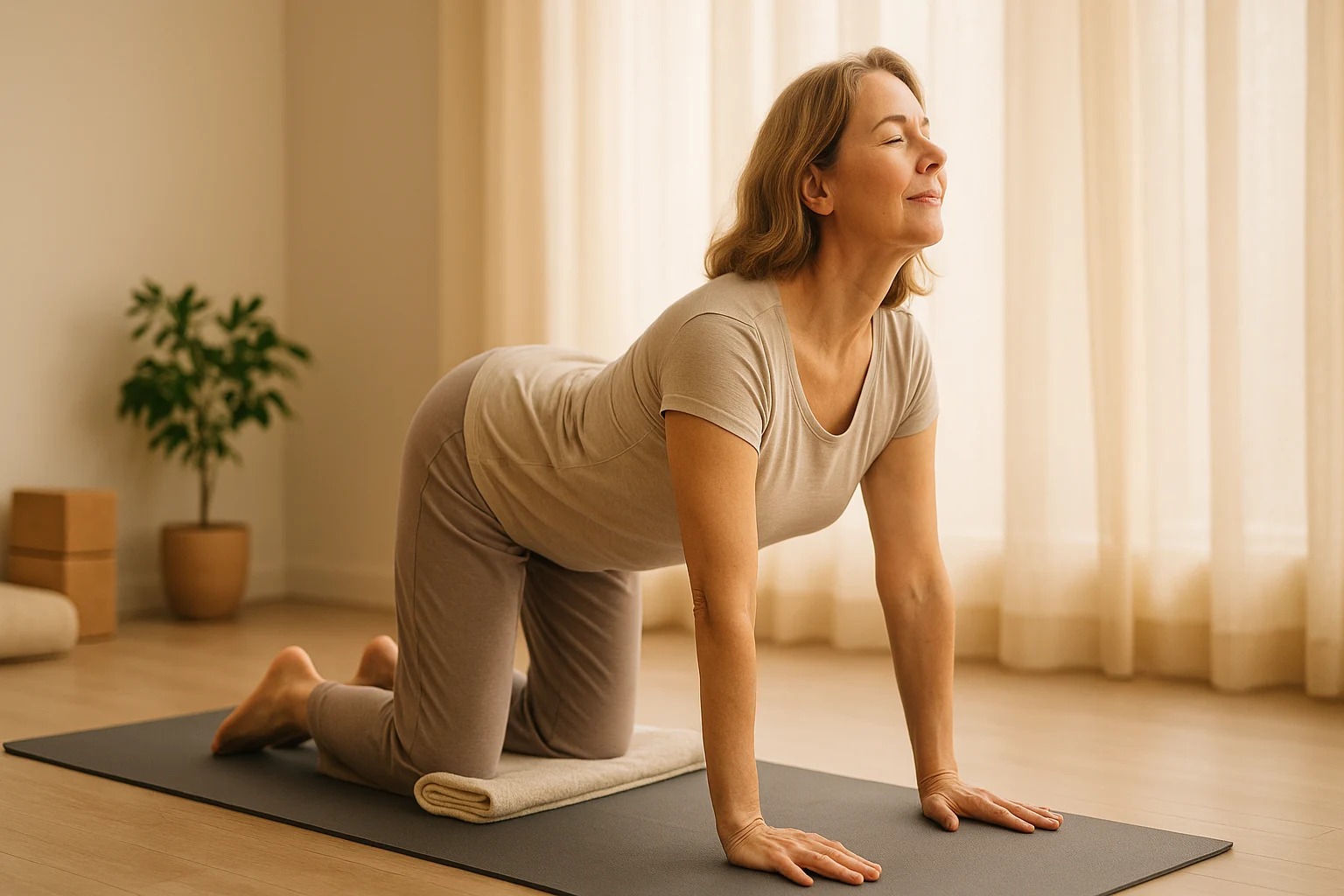
If kneeling feels uncomfortable, fold a blanket under your knees or practice Cat-Cow from a chair. If the floor feels slick, move to a surface where your hands and feet feel secure rather than trying to hold the pose through slipping.
Cat-Cow Flow (Marjaryasana-Bitilasana)
Benefit: Moves the spine through gentle flexion and extension while linking breath with movement.
How-To:
- Start on hands and knees, wrists under shoulders, knees under hips.
- Inhale: Drop belly, lift chest and tailbone, look forward (Cow).
- Exhale: Round spine, tuck chin, draw navel in (Cat).
- Move at a comfortable pace, matching each breath.
- Repeat for 8-10 rounds.
Props: Blanket under knees.
For sensitive wrists or knees: Add padding or use a smaller range of motion.
Gentle Supine Spinal Twist
Benefit: Gently rotates the spine and stretches the outer hip.
How-To:
- Lie on your back, knees bent, feet flat, hip-width apart.
- Extend arms in a “T” shape, palms up.
- Let knees fall to the right, keeping left shoulder down.
- Place a block or pillow between or under knees for support.
- Turn head left if comfortable.
- Breathe deeply into your belly.
- Hold for 1-2 minutes. Switch sides.
Props: Block or pillow for knees.
If the knees do not lower comfortably: Support them with a pillow or block and keep the twist smaller.
A Sample Full Gentle Yoga Routine for Flexibility
Use the blocks below for a full practice. The length will vary with your hold times, transitions, and any poses you skip, so follow the pose-specific times instead of trying to hit an exact total.
Warm-Up
Start gently to prepare your body:
- Constructive Rest Pose: Lie on your back, knees bent, feet flat, knees touching. Rest for 1-2 minutes.
- Knee-to-Chest Rock: Hug one knee, then the other, then both, rocking side to side.
- Cat-Cow Flow: 10 rounds, moving with breath.
Hip Opening
- Supine Figure-Four Stretch (both sides, 1 minute each).
- Supported Butterfly Pose (3-5 minutes).
- Low Lunge (both sides, 1 minute each).
Hamstring & Leg Lengthening
- Supported Forward Fold (2-3 minutes).
- Legs Up the Wall (5-10 minutes).
Shoulder & Chest Release
- Supported Fish Pose (2-3 minutes).
- Eagle Arms (both sides, 5-8 breaths each).
Spinal Mobility & Cool Down
- Gentle Supine Spinal Twist (both sides, 1-2 minutes each).
- Savasana (Corpse Pose) with blanket/bolster under knees (5-10 minutes): Lie flat, eyes closed, and let your breathing settle.
Tune in to your body and feel free to skip or modify any pose that doesn’t feel right.
For Savasana, dim the room or cover your eyes lightly only if that feels comfortable; the goal is simply to reduce distraction, not add more gear.
How to Progress Without Forcing
Once you have a starting sequence, progress is mostly about choosing a version you can return to. You do not need a library of gentle yoga routines; repeat one manageable sequence before adding more variation. If back pain or limited mobility is the main issue, this yoga guide for seniors with back pain gives you a more specific route.
- Repeat what feels manageable: A shorter practice you can return to is more useful than one hard session you avoid repeating.
- Warm up with movement: Start with easy motion such as Cat-Cow before longer holds.
- End quietly: Finish with Savasana or another comfortable resting position.
- Track function, not depth: Notice whether bending, reaching, sitting, or getting up feels more available instead of chasing a pose shape.
If stiff mornings or floor work are what keep you from starting, you can try the free 10-minute chair-yoga routine below.
Get the 10-Minute Chair Yoga Routine
The 17-page PDF arrives after you confirm your email.
Confirm to get the routine and yoga tips. Unsubscribe anytime.
Something went wrong. Please check your email address and try again.
Questions About Gentle Yoga Sequences
Start Where Your Body Is Today
Start with the sequence that matches your stiffest area, use enough support that you can breathe normally, and stop before a stretch turns into forcing. If floor work is the barrier, start seated instead; that is still a real practice, not a lesser version. The goal is not to win flexibility—it is to make movement feel more available the next time you bend, reach, or get up.
When you’re ready to build beyond one sequence, use the Yoga Flexibility Guide to decide what to repeat, what to add, and which props are actually useful.