Yoga philosophy asks questions a pose alone cannot answer: What are you training besides range of motion? How do you relate to effort, attention, habits, other people, and the urge to force progress? This yoga philosophy guide starts with one influential classical framework—Patanjali’s Yoga Sutras and Eight Limbs, including the Yamas and Niyamas—then adds enough history to show where those ideas fit.
Because this guide also covers anatomy, it keeps one distinction clear: philosophy can guide a practice decision, while anatomy helps you understand what a movement is asking from your body. Use the hub below to choose a route; if you are still undecided after the overview, the Path Finder will narrow the next step.
This page contains affiliate links. As an Amazon Associate, I earn from qualifying purchases, at no extra cost to you. Learn more.
Table of Contents
- Choose Your Path Through Yoga Philosophy
- What Yoga Philosophy Actually Covers
- Patanjali’s Yoga Framework: Sutras, Eight Limbs, and Context
- Yoga Anatomy: Practice With More Body Awareness
- How Philosophy and Anatomy Work Together
- Find Your Next Yoga Focus
- Bringing Yoga Wisdom into Daily Life
- Frequently Asked Questions
- Choose the Next Part of Yoga to Explore
Choose Your Path Through Yoga Philosophy
You do not need to study every branch in one sitting. Use this pillar as a map: start with the question you have now, then come back when you want the next layer.
- Understand the basic framework: start with the Eight Limbs of yoga and the Yamas and Niyamas.
- Read Patanjali more closely: see how many Yoga Sutras there are or explore a structured yoga philosophy course.
- Follow yoga through time and place: use the yoga history timeline or explore yoga in Morocco.
- Connect philosophy to movement: read the alignment principles guide and the review of Leslie Kaminoff’s Yoga Anatomy.
- Choose a book to study at your own pace: compare yoga philosophy books for beginners.
What Yoga Philosophy Actually Covers
Many people meet yoga through asana, but postures are only one part of a much larger set of Indian traditions concerned with conduct, attention, breath, meditation, and liberation. That wider context is what turns “yoga philosophy” from background trivia into something you can use to understand why a practice is structured the way it is.
Is There One Yoga Philosophy?
The Sanskrit root yuj is often translated as “to yoke” or “to join,” but yoga has never been one single uniform method. Different Indian traditions use the term in different ways, and Patanjali’s classical system is one influential branch rather than the whole history of yoga.
Why Philosophy Matters in Practice
If you mainly come to yoga for movement, philosophy can still be practical. It gives you a vocabulary for how you relate to effort, discomfort, attention, habits, and other people:
- Non-harming: Ahimsa can be a useful reminder not to force a pose simply to match an external shape.
- Attention: Practices of concentration and meditation ask you to notice what is happening rather than run automatically.
- Contentment: Santosha shifts the emphasis from chasing a “perfect” practice toward working honestly with the day you have.
- Ethical living: The Yamas and Niyamas extend yoga beyond the mat into choices and relationships.
- Self-study: Svadhyaya gives you a reason to read, reflect, and question how inherited teachings fit your own practice.
If the history is what interests you most, jump to the short history snapshot below.
Patanjali’s Yoga Framework: Sutras, Eight Limbs, and Context
If you want a compact guide to yoga principles, start with Patanjali’s Yoga Sutras and Eight Limbs as one influential classical framework. The short overview of yoga history then shows where that framework sits among older and later traditions.
Patanjali’s Yoga Sutras
The Yoga Sutras are central to classical Yoga philosophy, but their exact date cannot be pinned down with certainty. The Internet Encyclopedia of Philosophy overview places the text in the early centuries of the Common Era while noting scholarly disagreement. Editions and traditions also differ on whether they count 195 or 196 sutras. If that number is the question that brought you here, see how many Yoga Sutras there are and why the count varies.
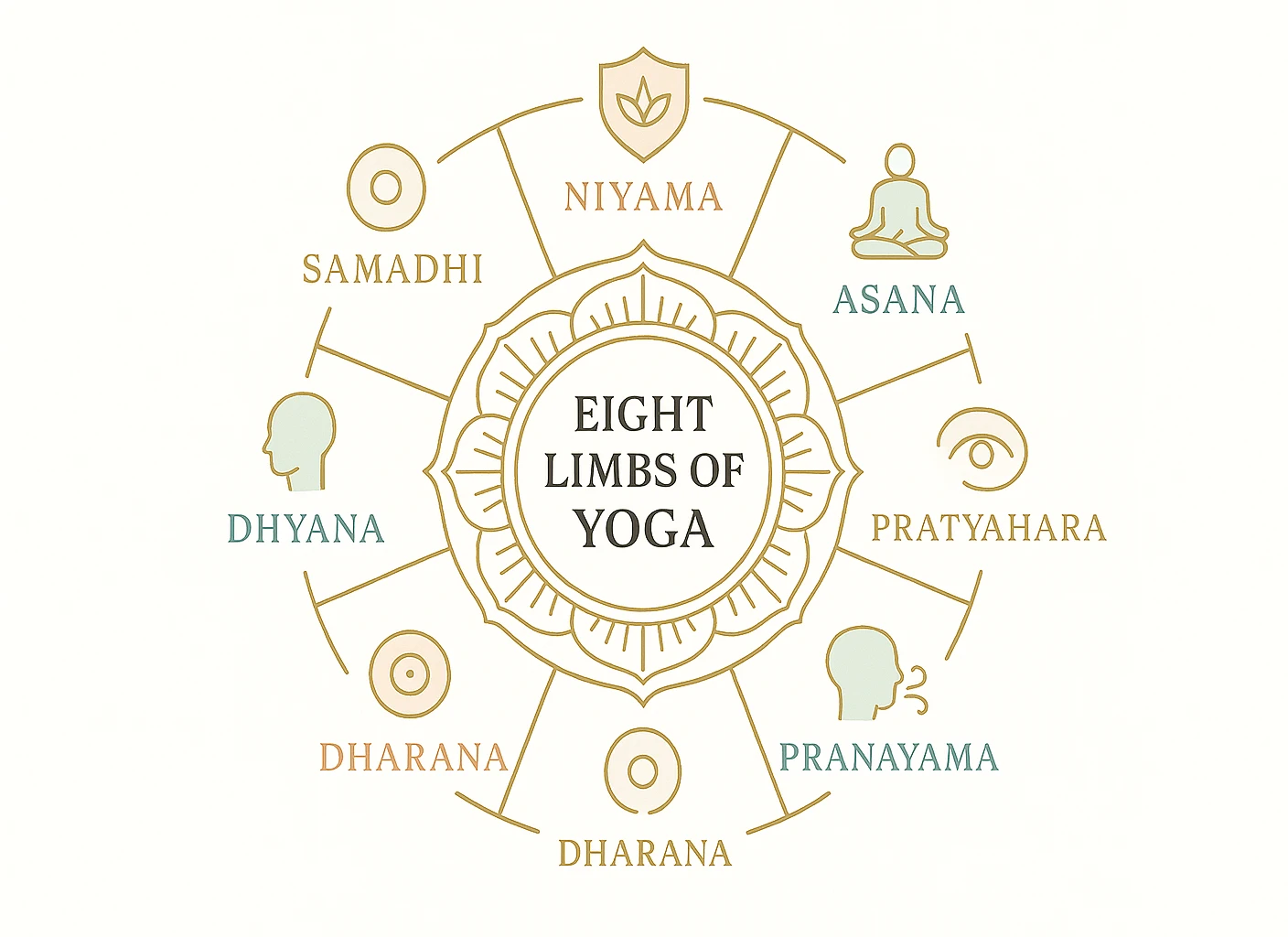
The Eight Limbs: Your Path to Growth
Patanjali’s Eight Limbs organize practice from ethical restraints and personal observances through posture, breath, sensory withdrawal, concentration, meditation, and samadhi. This is a compact map; the dedicated guide goes deeper.
1. Yamas (Ethical Guidelines)
The five Yamas are Ahimsa, Satya, Asteya, Brahmacharya, and Aparigraha. They are ethical restraints concerned with how you act in relation to others and the world. The dedicated Yamas and Niyamas guide gives them fuller treatment.
2. Niyamas (Personal Observances)
The five Niyamas are Saucha, Santosha, Tapas, Svadhyaya, and Ishvara Pranidhana. They turn attention toward personal habits, discipline, study, and devotion.
3. Asana (Posture)
Patanjali treats posture briefly as one limb of the larger practice; the extensive pose systems familiar today developed much later.
4. Pranayama (Breath Regulation)
Regulation of the breath; methods and purposes vary across yoga traditions.
5. Pratyahara (Sense Withdrawal)
Turning attention away from ordinary sensory pull so concentration can become steadier.
6. Dharana (Concentration)
Holding attention on a chosen object or focus.
7. Dhyana (Meditation)
Sustained meditative attention.
8. Samadhi (Absorption)
Deep meditative absorption; interpretations depend on the philosophical tradition and commentary.
Meditation Practices
Meditation is one place where philosophy becomes practice rather than vocabulary. A simple starting point is to choose one object of attention—breath, a mantra, or another appropriate focus—and notice when attention wanders before gently returning.
Yoga’s History in Five Useful Waypoints
Yoga does not have one neat starting date or a single unbroken form. The IEP overview cited above traces clearly recognizable yoga practices in late Vedic and Upanishadic literature and emphasizes that multiple Indian traditions developed related methods before Patanjali. For the fuller arc, see the detailed yoga history timeline.
- Late Vedic and Upanishadic traditions: literary sources begin to describe practices that can be related to later yoga, especially disciplined attention and meditation.
- Epic traditions: the Mahabharata and Bhagavad Gita preserve several approaches to yoga rather than one standardized method.
- Classical Yoga: Patanjali systematizes an influential eight-limbed path centered far more on mind, ethics, and meditation than on a catalogue of postures.
- Medieval hatha traditions: later texts develop distinctive body, breath, and subtle-body practices that are not simply identical to Patanjali’s system.
- Modern yoga: the posture-centered systems familiar in studios today took shape much later. An Oxford Research Encyclopedia overview of modern yoga places these developments from the nineteenth century onward.
Beyond Patanjali: Other Traditions and Concepts
Contemporary classes often combine postures, breath, meditation, and philosophical language in ways that differ from premodern systems. Terms such as Tantra and Kundalini also refer to large, internally diverse traditions; they are better treated as subjects to study in their own right than as a single “advanced” stage of ordinary studio yoga.
A few other concepts help explain yoga’s philosophical roots, but their meanings change across traditions. Treat the list below as vocabulary to investigate, not as one universally agreed system:
- Karma: action and its consequences; different traditions explain the mechanism in different ways.
- Dharma: a broad term that can refer to duty, right conduct, teaching, or an appropriate way of living depending on context.
- Samskara: latent impressions or conditioning that help shape habitual responses.
- Gunas: in Samkhya-related thought, the three qualities of prakriti—sattva, rajas, and tamas.
- Chakras: subtle-body centers described in some yogic and tantric traditions; they are not anatomical organs.
- Nadis: subtle channels described in some traditions; they should not be confused with nerves or blood vessels.
Philosophy gives you a framework for why you practice. The next section adds a second question: what is your body being asked to do, and how can you adapt the movement without losing the intention behind it?
Yoga Anatomy: Practice With More Body Awareness
Philosophy can shape the intention of a practice; anatomy helps you ask what a particular movement is asking from your joints and muscles. The useful goal is not one “perfect” shape for every body, but enough understanding to modify load, range, and support when needed.
Yoga Anatomy Basics: Why It Matters
If anatomy is new to you, start with a few practical questions: Which joints are moving? Where is the load? Can you breathe comfortably? Does a prop or smaller range make the position more workable? The U.S. National Center for Complementary and Integrative Health notes that injuries can occur in yoga, advises beginners to avoid extreme practices, and says people with health conditions may need individual modifications.
- Joint awareness: notice where movement is coming from instead of forcing range at one joint.
- Load management: use a wall, chair, block, or smaller range when a position asks for more strength or mobility than you comfortably have.
- Body awareness: distinguish normal effort from sharp, worsening, or concerning pain.
- Adaptation: treat props and variations as legitimate ways to practice, not as a failure to reach the “real” pose.
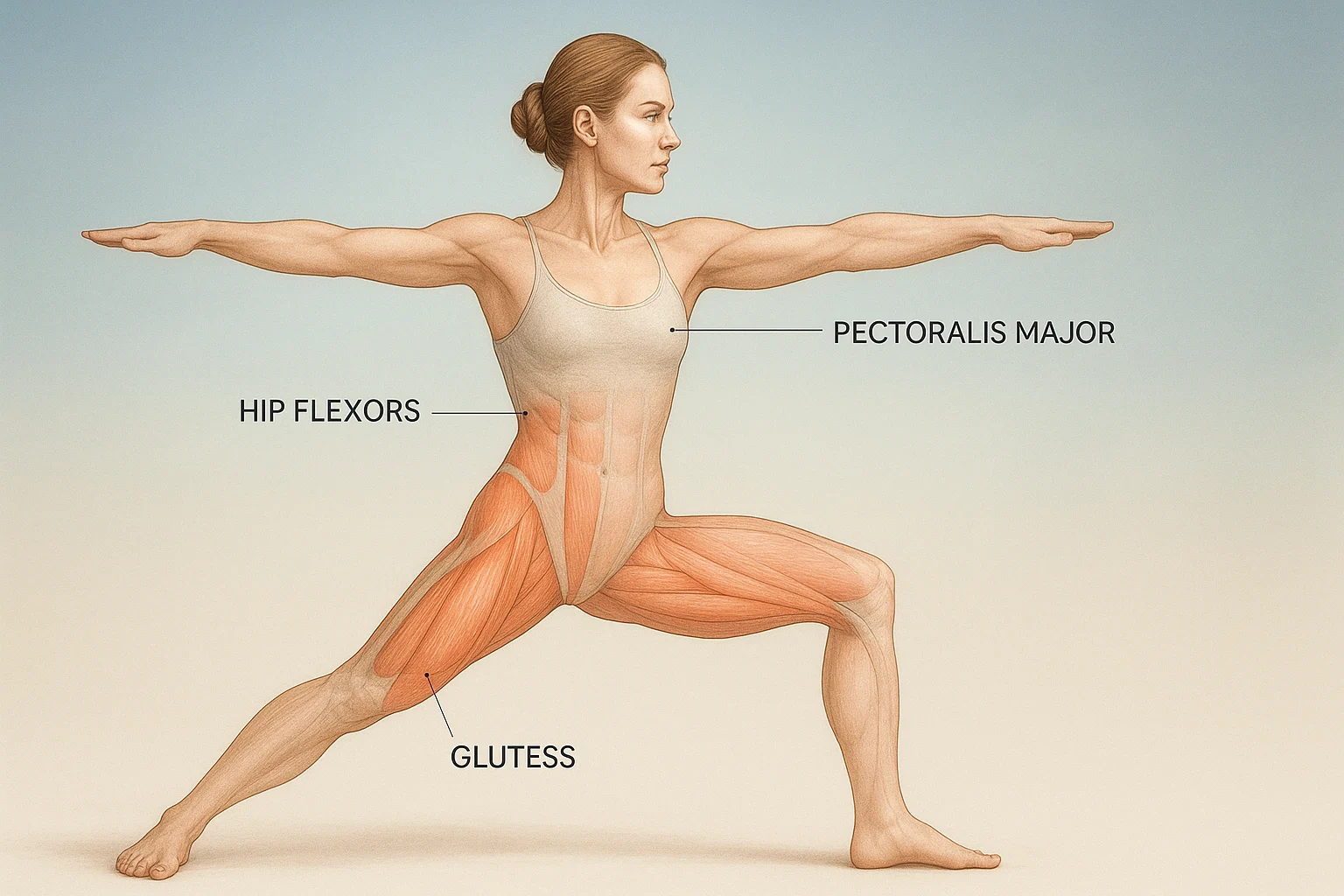
If you want muscle-by-muscle detail, the review of Leslie Kaminoff’s Yoga Anatomy is the better next step. This pillar stays focused on the questions that change a practice decision: range, load, support, and comfort.
Yoga Alignment Principles
Alignment is most useful when it helps you organize a pose for your own proportions and current capacity—not when it is treated as one universal geometric rule. For a fuller explanation, see the yoga alignment principles guide:
- Build a stable base: use the floor, wall, chair, or props to make the starting position dependable.
- Choose a workable range: reduce depth when you lose control, breath, or comfort.
- Distribute load deliberately: notice whether one joint is taking more pressure than the rest of the shape seems to require.
- Keep breathing: breath-holding can be a useful signal that the effort or range is too high for the moment.
- Use Ahimsa as a decision rule: a pose does not become more “yogic” because you force farther into it.
Reducing Avoidable Strain
No checklist can prevent every injury, but basic load management and appropriate modification can reduce avoidable strain. If you have an injury, health condition, pregnancy, balance concern, or another reason a standard pose may not fit, use individual medical or qualified teaching guidance rather than this general list:
- Lower back: reduce the range of a fold or backbend if the position feels pinchy or difficult to control.
- Knees: shorten the stance, add support, or choose a different variation when a lunge or squat creates joint discomfort.
- Shoulders and wrists: decrease load or use a wall, forearms, fists, or props when weight-bearing is not comfortable.
- Hamstrings: avoid chasing depth; a smaller range with steady control is still a complete practice choice.
If you want to put the adaptation ideas above into practice, start with a gentle seated routine.
Get the 10-Minute Chair Yoga Routine
Confirm to get the routine and yoga tips. Unsubscribe anytime.
Something went wrong. Please check your email address and try again.
How Philosophy and Anatomy Work Together
Philosophy and anatomy can inform the same decision from different directions. Philosophy asks what intention or principle should guide the choice; anatomy asks what the movement is loading and whether another variation would serve the same intention better.
Take Warrior II as a simple example. If the position feels unstable or overly demanding, you can ask three different questions:
- Anatomy: Would changing stance length, range, or support make the position more workable?
- Ahimsa: Is going deeper worth forcing?
- Svadhyaya: What do you notice when you choose a smaller range instead of chasing the shape?
A steadier, more comfortable position may remove one source of distraction during meditation. Traditional yoga teachings may also discuss breath, posture, and prana together; treat prana here as philosophical or subtle-body language rather than anatomy. If you are unsure which direction to explore next, use the Path Finder below.
Find Your Next Yoga Focus
Bringing Yoga Wisdom into Daily Life
Yoga philosophy becomes easier to understand when you test one principle in an ordinary situation instead of trying to memorize every Sanskrit term at once.
Living the Yamas and Niyamas
You do not need to turn all ten principles into a checklist. Pick one and test it in one practice or ordinary situation. For example:
- Ahimsa: choose a variation that does not require you to force range just to match a shape.
- Satya: be honest about what is workable today instead of performing what you think practice should look like.
- Santosha: let today’s workable range be enough without turning comparison into the goal.
- Tapas: repeat a small practice consistently instead of waiting for the perfect long session.
- Svadhyaya: notice what happens when effort, frustration, or comparison shows up.
These are practice prompts, not literal translations or the only way to apply each term. The point is to notice whether a principle changes a choice you were already making.
Mindfulness in Everyday Moments
Ordinary tasks can become small attention practices without needing to turn them into formal meditation. Try these:
- Eating: Set the utensil down between bites and actually taste the spices.
- Walking: Notice heel–toe contact and the swing of your arms.
- Communication: Leave a breath before replying so the other person finishes.
- Chores: Feel the warm water and the slick plate—let that be the practice.
Tips for Beginners
If you are new to yoga philosophy, keep the study small enough to use. These tips, plus a shortlist of yoga philosophy books for beginners, can help:
- If you want feedback on poses, choose a teacher who welcomes questions and modifications.
- Go slowly enough to notice how a pose feels before increasing range or effort.
- Use props or smaller variations when they make a position more workable.
- Use the breath as an attention anchor rather than a performance test.
- Pick one philosophical idea—such as Ahimsa or Svadhyaya—and notice where it shows up in practice.
- Keep practice and study small enough to repeat consistently.
Philosophy-book starting point: The Yoga Sutras of Patanjali by Sri Swami Satchidananda.
Choose it if you want the sutras and one named commentary in a single paperback. If you want to compare translations and approaches first, use the beginner book guide.
If you want to sample ideas in shorter form before committing to a full book, you can browse Blinkist’s book and podcast summaries.
Frequently Asked Questions
Choose the Next Part of Yoga to Explore
This yoga philosophy guide works best as a map, not a syllabus. If you want the framework, follow the Eight Limbs or Yamas and Niyamas route. If your question is physical, use the anatomy and alignment routes. If the useful next step is still unclear, return to Find Your Next Yoga Focus and choose the question you want to carry forward.
You do not need to understand every branch before the philosophy becomes useful. One principle, one practice question, and one honest next step are enough to begin.