Yoga did not travel in a straight line from Vedic ritual to the modern studio. Across centuries in South Asia, the word yoga, its goals, and the practices grouped under it changed as different traditions emphasized different methods and ends.
This yoga history timeline gives you the fast map first, then the evidence behind each shift: Vedic roots, Upanishadic and Bhagavad Gita teachings, Patañjali’s system, medieval Haṭha methods, and modern posture-focused yoga. For the wider ideas behind ethics, meditation, and practice, see the yoga philosophy guide.
This post contains an Amazon affiliate link. If you purchase through it, I may earn a commission at no extra cost to you. As an Amazon Associate, I earn from qualifying purchases. Learn more.
Table of Contents
- Yoga History at a Glance
- Vedic Roots: Ritual, Discipline, and Early Uses of Yoga
- Upanishads and the Bhagavad Gita: Yoga Broadens
- Patañjali and Classical Yoga
- Haṭha Yoga: The Body Becomes a Central Method
- Modern Yoga Goes Global: Philosophy and Posture
- Frequently Asked Questions About Yoga History
- Yoga’s History Is a Story of Change
Yoga History at a Glance
This yoga historical overview uses broad era labels as teaching anchors, not hard borders; historians do not use one universally agreed set of period boundaries. The shifts also overlap: older practices continued while newer systems developed. The big story is a series of changes in emphasis—from ritual and ascetic discipline to inward inquiry, systematic meditation, body-and-breath methods, and the global rise of posture-centered practice.
Choose an era for the quick version; each result tells you what changed, why it matters to the history of yoga, and where to read the full section.
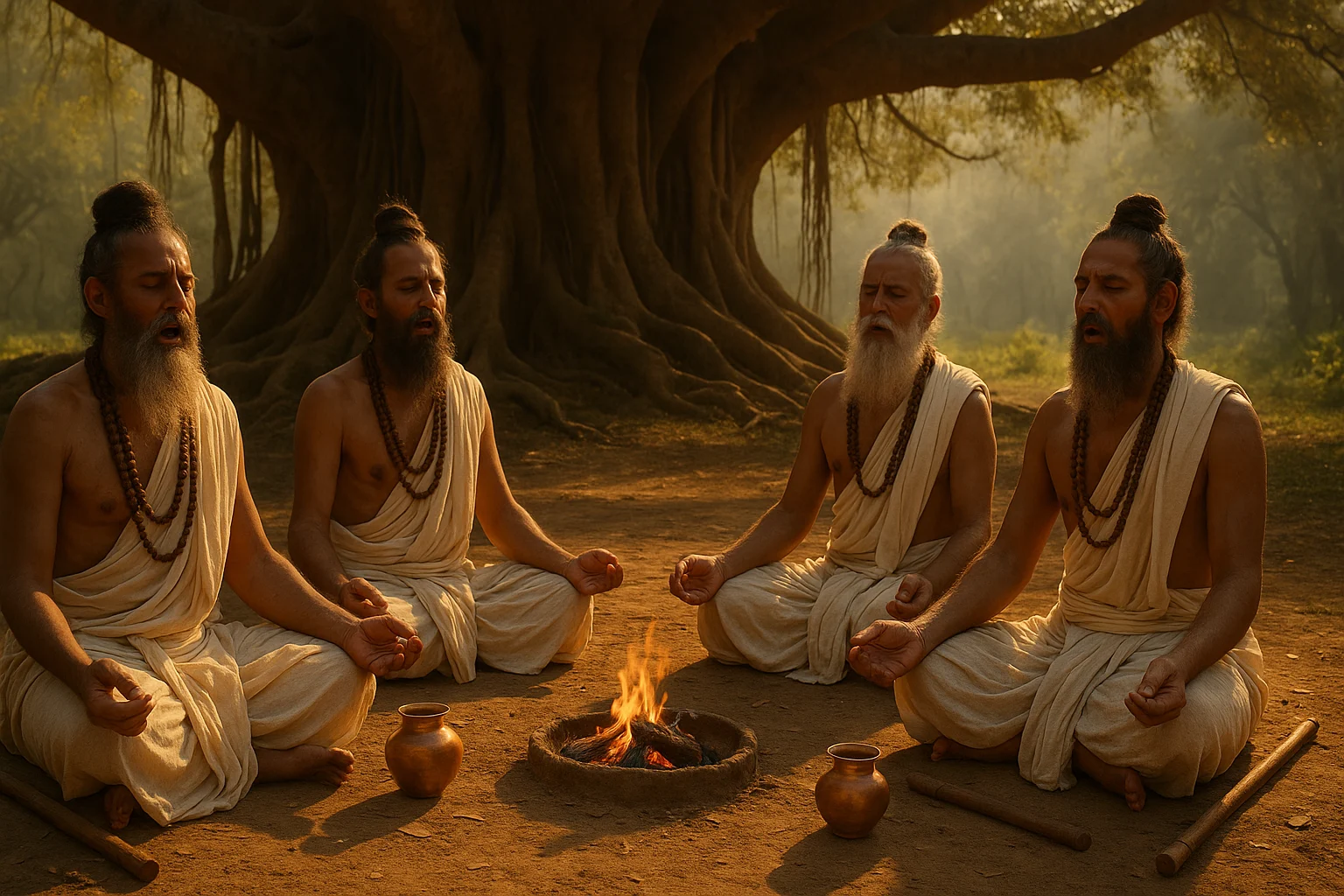
Vedic Roots: Ritual, Discipline, and Early Uses of Yoga (c. 1500–500 BCE)
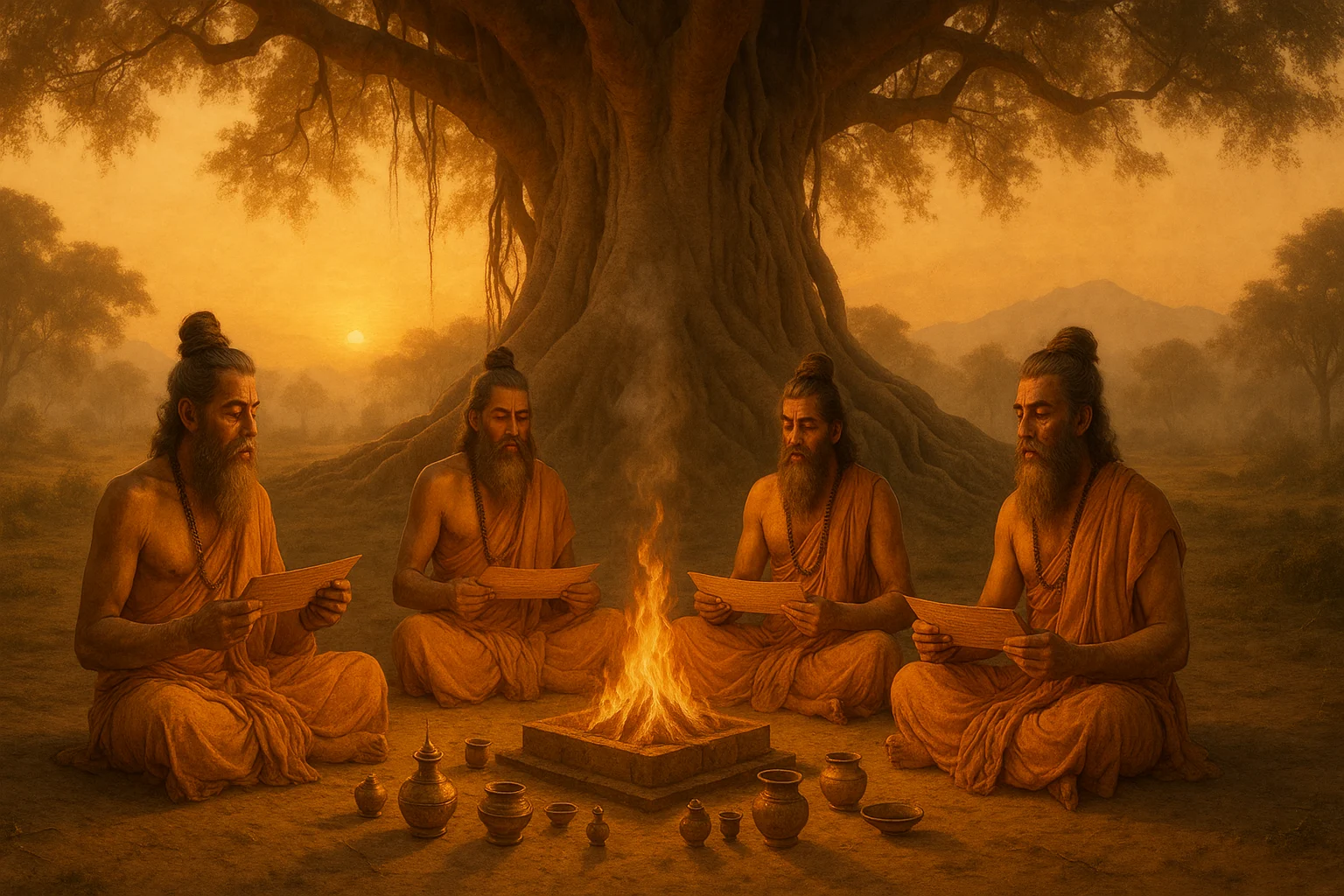
The Vedas provide an early cultural setting for ideas that later yoga traditions would develop, but they do not describe the posture-based system most people picture today. Their world is one of hymns, ritual, disciplined effort, and specialists seeking powerful forms of knowledge and control.
What “yoga” meant this early
The Sanskrit root yuj carries the sense of yoking or joining, but early uses of yoga are varied. It is safer to see this period as part of yoga’s background than to claim that a complete system of poses, breathwork, and philosophy already existed in Vedic form.
Archaeological seals from the Indus Valley are sometimes cited as proof of a much earlier yoga system, but that interpretation is contested and the Indus script remains undeciphered. This distinction matters because it separates evidence about yoga origins from later systems: ancient roots are real, but modern yoga should not be projected backward unchanged.
Upanishads and the Bhagavad Gita: Yoga Broadens
Across the first millennium BCE and into the early Common Era, important Indian texts increasingly turn attention inward. The Upanishads explore the self, liberation, disciplined attention, breath, and the relationship between ordinary experience and ultimate reality. These developments also unfolded alongside śramaṇa renouncer communities, including Buddhist and Jain traditions, whose ascetic and meditative practices were part of the same wider conversation. Sahapedia’s historical overview is a useful guide to that overlap. The history is not a neat handoff from “ritual” to “meditation,” but inward practice becomes much more explicit.
The Bhagavad Gita makes “yoga” plural
The Bhagavad Gita is especially useful for understanding how broad the term became. It discusses paths commonly described as karma yoga (disciplined action), jñāna yoga (knowledge), and bhakti yoga (devotion). Yoga is no longer one technique; it can describe different ways of orienting action, knowledge, devotion, and liberation.
- Inward inquiry grows: meditation and self-knowledge become more explicit concerns.
- Liberation stays central: the goal is not simply fitness or flexibility.
- Yoga becomes a family of paths: different texts and communities emphasize different methods.
Patañjali and Classical Yoga (around the early centuries CE)
The dating of Patañjali’s yoga text is debated. Philologist Philipp Maas places the Pātañjalayogaśāstra around 400 CE, while other scholarly estimates have been earlier. The useful point for this timeline is what the text does: it systematizes a demanding path of mental discipline and liberation rather than inventing yoga from scratch.
Its best-known framework is the Eight Limbs. If you want the full explanation, use our guide to Yoga’s Eight Limbs; for the timeline, the sequence is enough:
- Yama: ethical restraints.
- Niyama: personal observances.
- Asana: posture, described briefly as steady and easeful.
- Pranayama: regulation of breath.
- Pratyahara: withdrawal of the senses.
- Dharana: concentration.
- Dhyana: meditation.
- Samadhi: deep absorption.
That balance is easy to miss from a modern studio perspective: asana is one limb, not the whole system. Ethics, attention, meditation, and liberation carry most of the philosophical weight.
Haṭha Yoga: The Body Becomes a Central Method (from c. 1000 CE)
The SOAS Haṭha Yoga Project places the emergence of Haṭha yoga among diverse ascetic traditions around 1000 CE. Over the following centuries, texts describe increasingly elaborate ways of working with the body, breath, vital energies, and altered states.
The name also deserves care. Haṭha is associated with “force,” while the familiar explanation that ha means sun and ṭha means moon is a later esoteric interpretation, not a simple literal translation. Jason Birch’s study of the term helped clarify that history.
What Haṭha practice added
| Practice | Historical role |
|---|---|
| Asana | Postures used within a larger discipline; the repertoire expands over time. |
| Pranayama | Breath regulation used to influence mind and vital processes. |
| Mudra and bandha | “Seals” and “locks” intended to redirect or retain vital energies. |
| Shatkarma | Cleansing techniques taught in some Haṭha systems. |
Texts that shaped the tradition
The 15th-century Haṭhapradīpikā became one of the first comprehensive systematizations of Haṭha yoga; later works such as the Gheraṇḍasaṃhitā and Śivasaṃhitā became influential reference points too. They do not describe one frozen system: Haṭha yoga changed across texts, lineages, regions, and centuries.
Modern Yoga Goes Global: Philosophy and Posture (late 19th century–present)
Modern yoga is where the timeline stops looking like a simple inheritance story. Philosophical forms of yoga circulated internationally in the late nineteenth century, while posture-centered systems expanded rapidly in the twentieth. The result is both continuity and reinvention.
1893: Vivekananda and yoga philosophy in the West
Swami Vivekananda’s speeches at the 1893 World’s Parliament of Religions in Chicago helped make Indian religious and philosophical ideas more visible to Western audiences. His later presentation of Raja Yoga was influential, but it was not the posture-heavy studio yoga that would become globally familiar.
20th-century posture practice
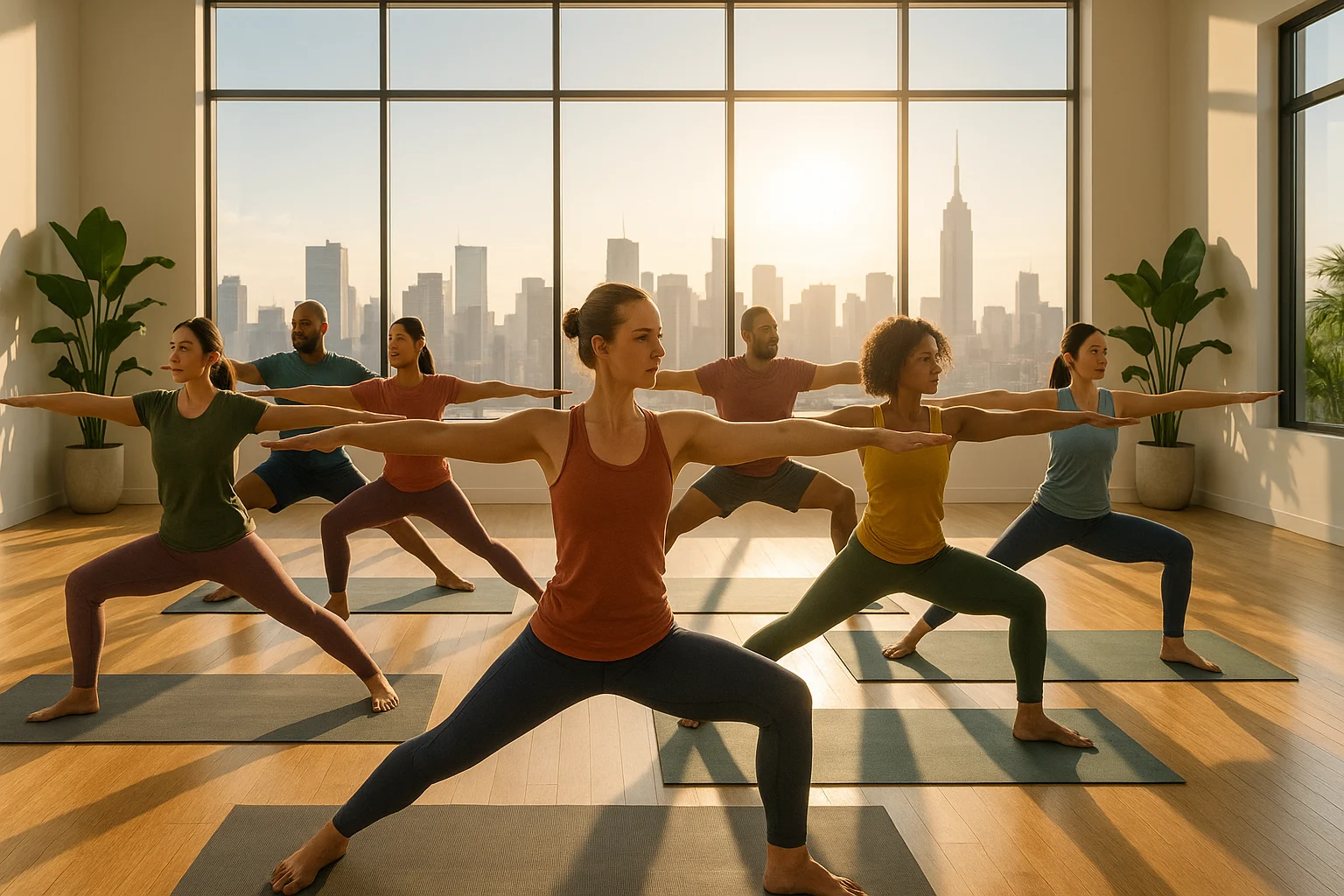
T. Krishnamacharya’s teaching in Mysore in the 1930s–1950s became one important source for modern posture-focused yoga. His students—including B.K.S. Iyengar, K. Pattabhi Jois, and T.K.V. Desikachar—developed influential but different approaches. Modern scholarship on postural yoga treats this period as a creative synthesis: older yoga traditions interacted with contemporary Indian and international physical-culture movements rather than simply preserving an unchanged ancient sequence.
- Asana moves toward the center: posture becomes the main public face of yoga for many practitioners.
- Methods diversify: alignment-focused, flowing, individualized, restorative, and other approaches spread internationally.
- Yoga keeps multiple identities: it can be religious, spiritual, philosophical, meditative, wellness-oriented, recreational, or primarily physical depending on context.
That is why “modern yoga” should not be dismissed as fake or described as an unchanged ancient survival. It is better understood as a living set of traditions that inherited, selected, reinterpreted, and added practices over time.
Yoga Body: The Origins of Modern Posture Practice by Mark Singleton
A focused next read if the modern-posture story is the part of the timeline you want to investigate more deeply. Skip it if you want a broad beginner introduction to yoga philosophy instead.
For a wider reading list rather than one specialist history book, see our yoga philosophy books for beginners.
Frequently Asked Questions About Yoga History
Yoga’s History Is a Story of Change
The most useful lesson from this timeline is not a single birth date. Yoga repeatedly changed its emphasis while older aims and methods continued alongside newer ones: ritual and disciplined effort, liberation and meditation, body-and-breath techniques, and eventually the posture-centered practices familiar in many studios today.
So when you hear that a pose, idea, or style is “ancient yoga,” ask one simple question: ancient in which period, text, or tradition? That keeps the history interesting without flattening several thousand years of change into one origin story.
If reading the history makes you curious about what one gentle modern practice actually feels like, try a short routine for yourself.
Get the 10-Minute Chair Yoga Routine
Try one gentle modern practice for yourself and keep it for stiff mornings.
Confirm to get the routine and yoga tips. Unsubscribe anytime.
Something went wrong. Please check your email address and try again.