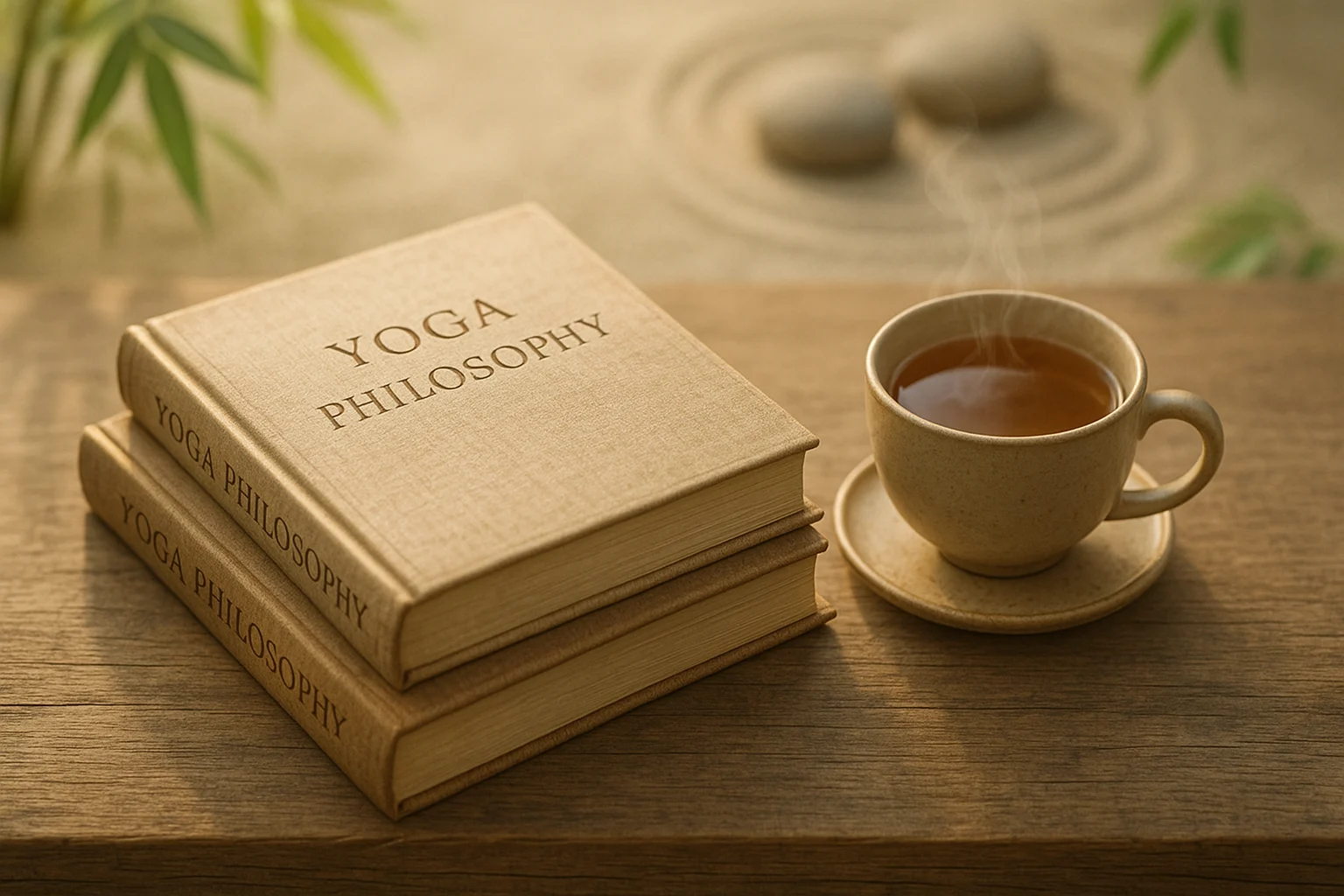
The best yoga philosophy books for beginners do different jobs. One gives you Patanjali’s classical framework, another makes ethics practical, another explores purpose and action, and others connect philosophy to practice or short daily reflection. The right first book is the one you’ll actually keep reading.
This guide narrows the field to six different starting points and explains who each one suits. If you want the wider map first—how philosophy, history, anatomy, and practice fit together—start with the complete yoga philosophy guide.
Find Your First Philosophy BookThis post contains affiliate links. If you purchase through them, I may earn a commission at no extra cost to you. As an Amazon Associate, I earn from qualifying purchases. Learn more.
Table of Contents
- 6 Yoga Philosophy Books, Compared by Fit
- How to Read Yoga Philosophy Without Getting Overwhelmed
- Frequently Asked Questions About Yoga Philosophy Books
- Which Yoga Philosophy Book Should You Start With?
6 Yoga Philosophy Books for Beginners, Compared by Fit
These six books are not interchangeable, and they are numbered for scanning rather than ranked from best to worst. The Yoga Sutras gives you Patanjali’s classical framework and the Eight Limbs of Yoga; The Yamas & Niyamas concentrates on ethical practice; the Bhagavad Gita asks what right action looks like when life is complicated. Light on Life is reflective and wide-ranging, The Heart of Yoga connects philosophy to a personal practice, and Meditations from the Mat is built for short daily reading.
You do not need to read them in historical order. Start with the question you most want help thinking through, then choose the format you are most likely to return to. If you want one recommendation instead of six possibilities, use the matcher; if you prefer to browse, scan the Best for line under each book and read the trade-off before deciding.
Find Your First Yoga Philosophy Book
Answer three quick questions to get one starting recommendation based on what you want to learn and how you like to read.
1 of 3
2 of 3
3 of 3
1) The Yoga Sutras of Patanjali — Sri Swami Satchidananda
Best for: A beginner who wants the classical framework behind Patanjali’s Eight Limbs and does not mind reading a compact text slowly.
What you’ll get: Satchidananda’s edition pairs a translation of the Yoga Sutras with commentary, giving you context around short aphorisms that can otherwise feel very compressed. It is the strongest starting point here when your question is, “What system is classical yoga actually describing?”
Know before you choose: This is not a narrative book and it is not mainly about poses. The Sutras reward rereading, so choose it for a foundation rather than for a quick, cover-to-cover introduction.
2) The Yamas & Niyamas — Deborah Adele
Best for: A beginner who wants yoga philosophy to show up in ordinary choices—how you speak, consume, work, rest, and relate to other people.
What you’ll get: Adele focuses on the yamas and niyamas, yoga’s ethical restraints and observances, with a modern, practical tone. If those ten principles are new to you, our Yamas and Niyamas guide gives you the quick map first.
Know before you choose: This is a focused modern exploration of yoga ethics, not a complete survey of Indian philosophy. Pick it when application matters more to you than studying a classical text line by line.
3) The Bhagavad Gita — Eknath Easwaran (translation)
Best for: A reader drawn to purpose, duty, action, and the problem of making difficult choices without being ruled by the outcome.
What you’ll get: Easwaran’s edition includes a substantial introduction that places the Bhagavad Gita in context, plus chapter introductions that explain key ideas. The dialogue between Arjuna and Krishna gives the philosophy a dramatic frame rather than presenting it as a list of principles.
Know before you choose: The Gita is broader than a beginner manual to modern postural yoga. If you specifically want Patanjali’s Eight-Limb framework, choose the Yoga Sutras instead. Start here when questions about purpose, action, and difficult choices are what pull you in.
4) Light on Life — B.K.S. Iyengar
Best for: A reader who wants a reflective book about how yoga can connect body, emotions, mind, and meaning across a lifetime of practice.
What you’ll get: Iyengar uses stories, examples, and reflections to explore the yogic journey beyond physical exercise, including the relationship between postures, breathing, inner obstacles, and a more integrated life.
Know before you choose: Light on Life is a different book from Light on Yoga. If you want a pose reference, Light on Yoga is the more relevant book. Choose Light on Life when the meaning of practice interests you more than pose instruction.
5) The Heart of Yoga — T.K.V. Desikachar
Best for: A beginner who wants philosophy tied closely to an adaptable personal practice rather than treated as a separate subject.
What you’ll get: Desikachar presents a practical approach shaped by the idea that yoga should be adapted to the individual. The book connects posture, breath, meditation, and philosophy while showing how a complete practice can develop step by step.
Know before you choose: If your main goal is to study the Sutras or the Gita themselves, choose a more text-focused book first. Choose The Heart of Yoga when you want philosophy tied directly to an adaptable personal practice.
6) Meditations from the Mat — Rolf Gates
Best for: A reader who wants short, repeatable reflection instead of a dense philosophical argument.
What you’ll get: Gates organizes the book as daily meditations that bring yoga theory into ordinary life. The format makes it easy to work with one idea at a time rather than keeping track of a long argument.
Know before you choose: If you want a systematic framework first, start with the Yoga Sutras or The Heart of Yoga. Choose Meditations from the Mat when short daily reflection is the reading habit you are most likely to keep.
How to Read Yoga Philosophy Without Getting Overwhelmed
If you’re new to yoga philosophy, keep the reading habit simple. The goal is not to finish a shelf of books; it is to understand one idea well enough to notice what it changes in your practice or your choices.
- Start with one question. Read for the issue that brought you here—ethics, meditation, purpose, practice, or reflection—instead of trying to “learn all of yoga philosophy.”
- Read less at a time. A few pages or even one short passage can be enough when the material is dense.
- Keep a question list. Write down what is unclear, surprising, or difficult to accept. Those questions are often more useful than a long set of highlighted quotes.
- Use commentary when a primary text feels opaque. A translation plus explanation can help you distinguish the text itself from one modern interpretation of it.
- Apply one idea before adding another. If you are reading about ahimsa or santosha, notice one real situation where the principle changes your response.
- Keep context nearby. When a term or tradition is unfamiliar, a reliable explainer such as Yoga Journal’s philosophy section can help you orient yourself before returning to the book.
If a full-length book feels like more than you want right now, you can explore Blinkist’s short book and podcast summaries as a quicker way to sample ideas. Use the full books above when you want the authors’ complete arguments and context.
Frequently Asked Questions About Yoga Philosophy Books
Which Yoga Philosophy Book Should You Start With?
If you want a classical foundation, start with Satchidananda’s Yoga Sutras. If you want practical ethics, start with The Yamas & Niyamas. If you want philosophy woven directly into practice, start with The Heart of Yoga. Choose the Gita for questions of purpose and action, Light on Life for a wider reflective view of the yogic journey, or Meditations from the Mat for short daily reading.
Pick one, give it a few weeks, and let your questions accumulate before buying the next. One book read slowly will teach you more than six books bought at once.