How many Yoga Sutras are there? Use 196 as the quick answer, but don’t be surprised to see 195 in a different edition. The discrepancy comes from how a passage in Vibhuti Pada is numbered, not from a different philosophy or a different set of four chapters.
If you only need the number, you can stop there. If you are comparing editions or want to understand the text, this Yoga Sutras guide shows where the count differs, what each of the four padas covers, and a simple place to begin reading. For the wider framework around Patanjali and classical yoga, see our yoga philosophy guide.
This page contains an Amazon affiliate link. As an Amazon Associate, I earn from qualifying purchases at no extra cost to you. Links marked with ‘#ad’ are affiliate links. Learn more.
Table of Contents
- Why the Count Is 196 in Some Editions and 195 in Others
- The Four Padas: What Each Chapter Does
- Who Wrote the Yoga Sutras and When?
- What Do the Yoga Sutras Actually Cover?
- Find a Yoga Sutra to Explore
- How to Start Studying the Yoga Sutras
- Frequently Asked Questions
- What to Remember About the Yoga Sutras
Why the Count Is 196 in Some Editions and 195 in Others
Two count conventions are in use. The Internet Encyclopedia of Philosophy describes the text as 195 sutras, while other editions count 196. An Integral Yoga overview explains that the difference turns on how a passage in Vibhuti Pada around III.22 is counted.
Using the 196-sutra convention, the familiar chapter breakdown is:
| Pada | Sutras | Main focus |
|---|---|---|
| Samadhi Pada | 51 | Mind, concentration, and samadhi |
| Sadhana Pada | 55 | Practice, obstacles, and the eight limbs |
| Vibhuti Pada | 56 | Samyama and extraordinary attainments |
| Kaivalya Pada | 34 | Liberation and the relation of purusha to prakriti |
That arithmetic gives 196. In 195-count editions, Vibhuti Pada is the section whose numbering differs. For readers comparing the Sanskrit directly, GRETIL hosts a scholarly electronic text based on an earlier printed edition.
The Four Padas: What Each Chapter Does
The four padas are not four separate books with unrelated goals. They move from the workings of mind and meditative absorption, through disciplined practice, into samyama and its extraordinary attainments, and finally toward kaivalya or liberation.
- Abhyāsa: sustained practice.
- Vairāgya: dispassion or non-attachment.
- Samādhi: meditative absorption.
- Purusha: the conscious seer or self in classical Yoga.
- Prakriti: nature or the material matrix described in Sāṃkhya-influenced Yoga philosophy.
1. Samadhi Pada: Contemplation (51 Sutras)
Core job: define yoga, describe the mind’s vrittis, and introduce practice, detachment, and forms of samadhi.
- Yoga Sutra I.2: Yogaś citta-vṛtti-nirodhaḥ, a compact definition whose English wording varies by translator.
- Five vrittis: correct cognition, error, conceptualization, sleep, and memory are listed as modes or activities of mind—not simply five moods or “mental states.”
- Practice and detachment: abhyāsa and vairāgya are paired as ways of working with those fluctuations.
Why it matters: Samadhi Pada gives you the vocabulary the rest of the text assumes. Without that vocabulary, later discussions of meditation and liberation can sound much simpler than they are.
2. Sadhana Pada: Practice (55 Sutras)
Core job: turn the philosophy into a path of practice. This chapter introduces Kriya Yoga, examines the kleshas or afflictions, and lays out yoga’s eight limbs.
- Yama: ethical restraints, including ahimsa, satya, asteya, brahmacarya, and aparigraha.
- Niyama: observances such as cleanliness, contentment, discipline, self-study, and devotion to Ishvara.
- Asana: posture.
- Pranayama: regulation of breath.
- Pratyahara: withdrawal of the senses.
- Dharana: concentration.
- Dhyana: meditation.
- Samadhi: meditative absorption.
Why it matters: The eight limbs place physical posture inside a much wider ethical and contemplative system. Asana is one limb, not the whole definition of yoga in Patanjali’s text.

3. Vibhuti Pada: Accomplishments (56 Sutras in the 196-count convention)
Core job: explain samyama—the combined practice of concentration, meditation, and samadhi—and describe the extraordinary attainments or siddhis associated with it.
- Samyama: dharana, dhyana, and samadhi applied together to one object or field of inquiry.
- Siddhis: the text presents unusual powers and forms of knowledge as attainments connected with intense concentration; it does not simply label them as metaphors.
- Caution: the text also warns that such attainments can become obstacles when the goal is samadhi and liberation.
Why it matters: Vibhuti Pada is easiest to misread when modern summaries either sensationalize the powers or explain them away. The chapter’s own tension is more useful: concentration may produce striking experiences, but they are not the final goal.
4. Kaivalya Pada: Liberation (34 Sutras)
Core job: bring the text back to its ultimate goal—kaivalya, usually translated as isolation, independence, or liberation of purusha from identification with prakriti.
- Transformation: the chapter examines change, mind, latent impressions, and the workings of nature.
- Karma and affliction: later sutras describe the cessation of afflictions and karmic activity as discriminative insight matures.
- Kaivalya: the closing sutra describes the culmination in which the gunas no longer serve purusha’s purpose and consciousness stands in its own nature.
- Yogaś citta-vṛtti-nirodhaḥ (I.2) — the compact definition of yoga.
- Abhyāsa–vairāgya (I.12–16) — practice and detachment.
- Kriyā-yoga (II.1) — discipline, self-study, and devotion to Ishvara.
- Aṣṭāṅga-yoga (II.29) — the eight limbs.
Who Wrote the Yoga Sutras and When?
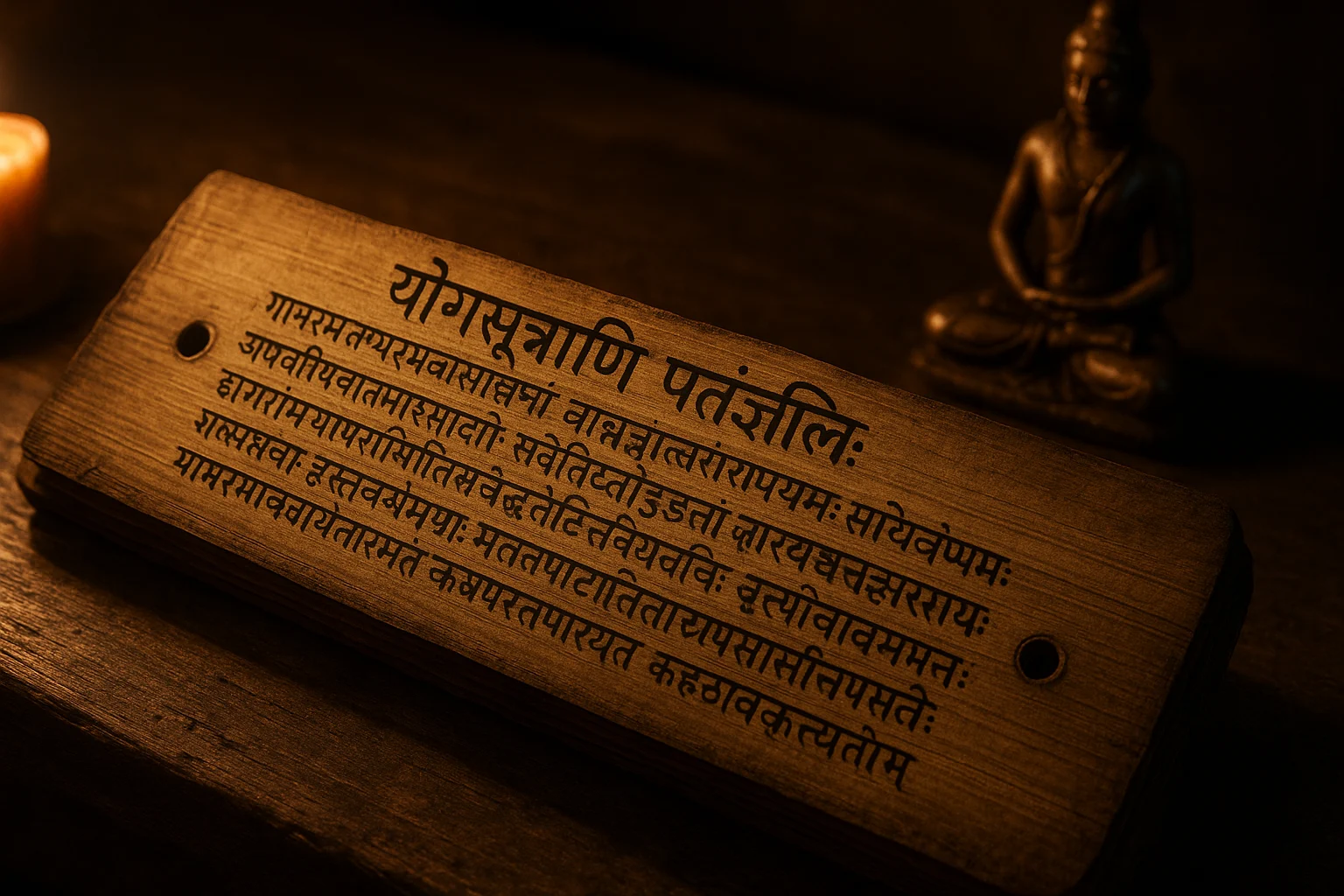
The Yoga Sutras—often called the Patanjali Sutras—are traditionally attributed to Patanjali. The historical person is difficult to identify with certainty, and the date is debated. The Internet Encyclopedia of Philosophy notes that many scholars place the text shortly after the turn of the Common Era, while also stressing that it cannot be dated precisely and does not postdate the fifth century CE.
What is clearer is Patanjali’s role as a systematizer rather than the inventor of yoga. Earlier Indian traditions already contained yogic practices; the Yoga Sutras organized a particular path around mind, ethics, meditation, and liberation.
What Do the Yoga Sutras Actually Cover?
If you know yoga mainly through posture practice, the biggest surprise is how little of the Yoga Sutras is about poses. The Internet Encyclopedia of Philosophy notes that Patanjali devotes only three brief sutras to asana; the wider text spends far more time on mind, ethics, concentration, meditation, and liberation.
- Mind and attention: the text examines mental fluctuations, habits, concentration, meditation, and discernment.
- Practice and conduct: the yamas and niyamas sit inside the same path as posture, breath, concentration, and meditation.
- Samyama and unusual attainments: Vibhuti Pada describes extraordinary forms of knowledge and power while warning that they are not the final goal.
- Liberation: Kaivalya Pada returns to the relation between purusha and prakriti and the culmination of the path.
So the text is less a handbook of poses than a compact map of what yoga is trying to change in attention, conduct, perception, and identification. The reflection selector below lets you pick one theme to explore without pretending that a single sutra summarizes the whole work.
Find a Yoga Sutra to Explore
Choose one theme you want to reflect on. I’ll show you a related sutra, a plain-language reading, and one practical prompt. Translations vary, so use this as a study starting point rather than a definitive interpretation.
Reflection:
Continue with practical ways to study the SutrasHow to Start Studying the Yoga Sutras
The easiest way to begin is to choose a short cluster that matches the question you actually have, then stay with it long enough to notice how the surrounding sutras change your first impression.
- If you want the basic definition of yoga: start with I.1–I.4, where the text introduces yoga, mental fluctuations, and the relation between the seer and what is seen.
- If you want a practical map of the path: start with II.28–II.32, where the eight limbs are introduced and the first ethical practices begin.
- Read the neighbors: avoid treating one famous sutra as if it stands alone.
- Compare commentaries: when two translations differ, notice which Sanskrit term is carrying the disagreement.
- Connect study to practice: use the yamas and niyamas or the eight limbs as concrete places to continue.
Try this for seven days: choose one of those clusters, read it with at least one commentary and its neighboring sutras, then write one sentence each day about what changed or became clearer.
Commentary option: The Yoga Sutras of Patanjali by Sri Swami Satchidananda.
It pairs the sutras with accessible commentary for the seven-day experiment. If you already have a commentary you trust, keep it—the point is context, not switching editions.
Frequently Asked Questions
What to Remember About the Yoga Sutras
Use 196 as the quick count, and expect to see 195 in some editions. The difference is a numbering convention in Vibhuti Pada, not a different four-part work.
You do not need to read all 195 or 196 sutras at once. For the larger system around Patanjali, continue with our yoga philosophy guide; if you want to work with the text itself, return to the study plan above and choose one short cluster.