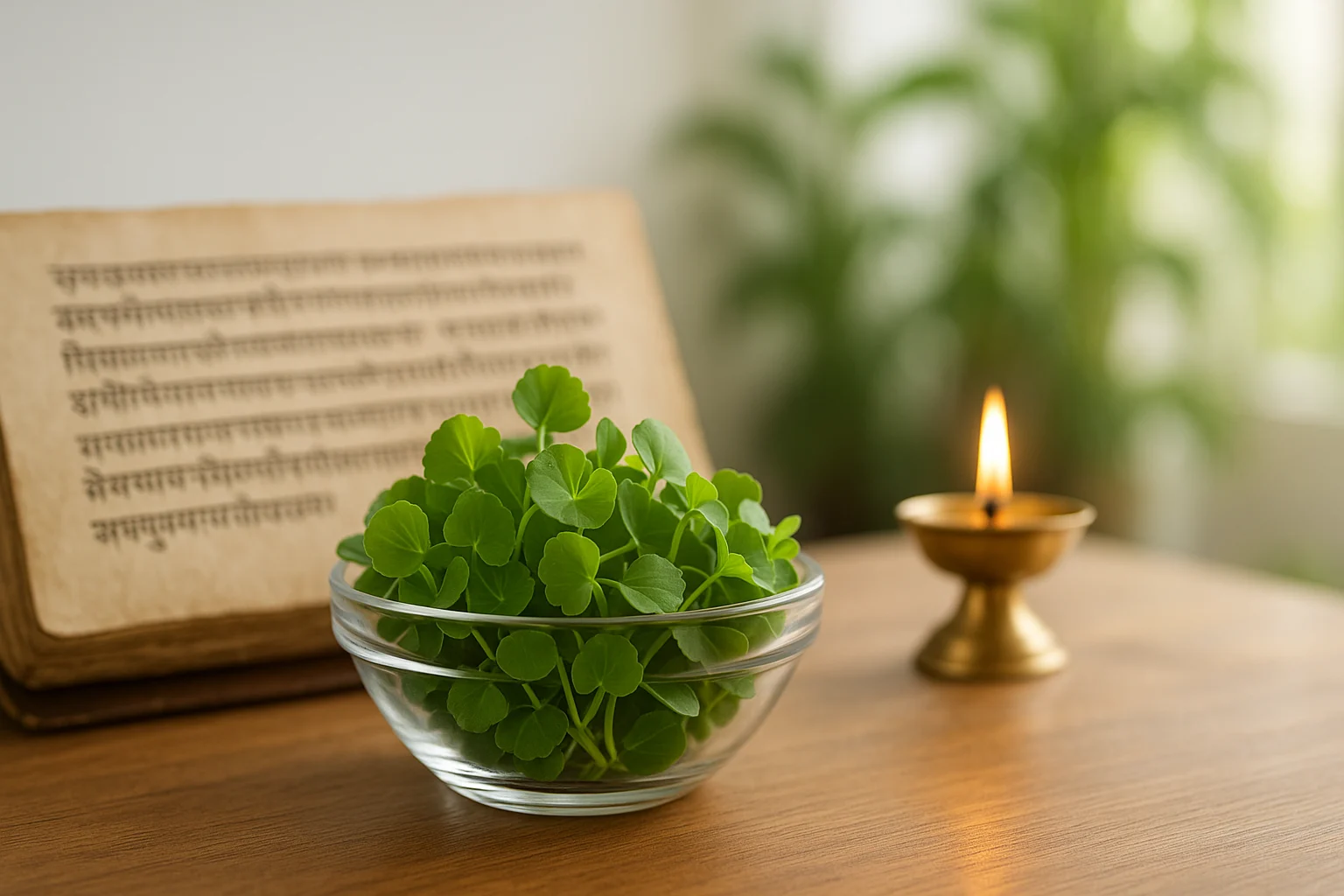
Brahmi (Bacopa monnieri) has a long Ayurvedic history, but the modern evidence is more modest than “brain booster” marketing suggests. Human studies have reported some benefits on selected memory or stress measures, while other well-designed trials have found no clear cognitive advantage over placebo.
If you’re considering Brahmi for memory, focus, or mental clarity, the useful questions are simple: what has actually been studied, how strong is the evidence, and what are the safety trade-offs? This guide separates traditional use from human research, then covers forms and labels without turning a supplement choice into a promise.
See the Evidence at a GlanceThis page contains affiliate links. As an Amazon Associate, I earn from qualifying purchases. Learn more.
Table of Contents
What Is Brahmi (Bacopa monnieri)?
In this article, Brahmi means Bacopa monnieri, a small water-loving plant used in Ayurveda. The name “Brahmi” is also sometimes used for gotu kola (Centella asiatica), so check the botanical name on any product or source you’re reading. Traditional use and modern clinical evidence are not the same thing: Bacopa has a long history as a cognitive herb, but human research is still mixed. See the NIH LiverTox overview of Bacopa monnieri.
Where Brahmi Fits Among Ayurvedic Cognitive Herbs
When Brahmi is compared with ashwagandha or ginkgo, it helps to separate traditions instead of treating “brain herbs” as one category. Brahmi and ashwagandha are associated with Ayurvedic medicine, while ginkgo has a long history in Chinese medicine. Their evidence and safety profiles differ, so treat each herb as a separate decision rather than assuming several herbs belong in one stack.
Potential Health Benefits of Brahmi: A Quick Evidence Guide
If you’re here for the health benefits of Brahmi, this is the short version: memory is one of the most studied outcomes, but results are mixed and none of the common benefits is guaranteed.
| Goal | What human evidence suggests |
|---|---|
| Memory and learning | Some randomized trials report improvements on selected memory measures; other trials do not. Possible benefit, not a reliable promise. |
| Focus, attention, and mental clarity | Results are inconsistent across studies and testing methods. |
| Stress and fatigue | Some studies report improvements in secondary self-reported measures, but that is not evidence that Bacopa treats anxiety or chronic stress. |
| Sleep, mood, and “brain protection” | Human evidence is limited or indirect; many stronger-sounding claims come from small studies or preclinical research. |
The next section explains why the findings differ and what newer trial and review evidence add to the picture.
What the Research on Brahmi Actually Shows
Bacopa contains compounds called bacosides, but proposed antioxidant, anti-inflammatory, and neuroplasticity mechanisms come largely from laboratory or animal research. Those mechanisms are interesting; they are not proof that taking Bacopa will noticeably improve memory, focus, mood, or sleep in a particular person.

Human Evidence Is Mixed
Some older randomized trials reported improvements in specific memory measures after about 12 weeks of a standardized Bacopa extract. Other trials have found little or no cognitive advantage over placebo, and different studies use different extracts, doses, populations, and tests.
A 2025 Trial Adds an Important Reality Check
A 2025 randomized, double-blind, placebo-controlled trial followed 101 adults ages 40–70 with self-reported memory and attention concerns. After 12 weeks, Bacopa did not outperform placebo on the trial’s primary measures of verbal learning, attention, or working memory. Some secondary stress and fatigue measures improved, but digestive complaints and headaches were reported more often in the Bacopa group.
A 2026 Network Meta-Analysis Is More Encouraging—but Still Indirect
A 2026 network meta-analysis of 29 randomized trials involving 2,107 healthy adults compared Brahmi (Bacopa monnieri) and ginkgo extracts. Higher-dose Brahmi groups (at least 600 mg/day) performed better on working and short-term memory in the network analysis, and lower-dose Brahmi also outperformed some comparators on delayed memory. The analysis did not find significant differences for sustained attention, selective attention, or processing speed. Because the analysis linked results across different trials rather than relying on head-to-head comparisons, the authors cautioned that the lack of direct comparisons limits how confidently those rankings can be applied to a specific product or person.
What That Means for Brahmi Brain Health
- Memory: There is some human evidence for improvements on selected memory tasks, but findings are not consistent enough to promise a noticeable benefit.
- Attention and focus: Results vary by study; a benefit is possible, not established.
- Stress and fatigue: A few studies report improvements in self-reported measures, but these are not the same as proving a treatment effect for anxiety, sleep problems, or another condition.
- Mechanisms: Antioxidant, inflammatory, and neuroplasticity findings are better treated as research hypotheses than as reader-facing health outcomes.
Bottom line: Brahmi is better described as a traditionally used herb with mixed but still actively studied cognitive evidence—not as a proven brain booster.
Research sources: 2025 randomized controlled trial · 2026 Brahmi-vs-ginkgo network meta-analysis · 2010 randomized memory trial · U.S. DoD Operation Supplement Safety overview.
Traditional Uses Beyond Cognition
Ayurvedic traditions describe uses for Brahmi beyond memory and concentration. These traditional uses should not be read as proof of a modern clinical benefit.
Digestive Traditions
Brahmi has been used traditionally for digestive complaints, but modern evidence is not strong enough to recommend it as a treatment for an upset stomach. In fact, nausea, diarrhea, abdominal discomfort, and increased bowel symptoms are among the better-documented adverse effects of oral Bacopa.
Scalp and Hair Rituals
Brahmi-infused oils are used in traditional scalp-care rituals. That is different from evidence that the oil grows hair or treats a scalp condition, so keep the expectation cosmetic and ritual-based unless a clinician advises otherwise.
Safety Tips for Using Brahmi
Short clinical studies generally describe Bacopa as reasonably well tolerated, but “natural” does not mean risk-free and long-term safety is less certain.
- Commonly reported effects: nausea, abdominal discomfort, diarrhea or increased bowel symptoms, dry mouth, headache, dizziness, fatigue, or sleep changes can occur.
- Medications and health conditions: interaction data are not complete. Ask a pharmacist or clinician before using Bacopa if you take prescription medicines or manage a medical condition.
- Pregnancy and breastfeeding: safety evidence is limited, so professional guidance is appropriate before use.
- Long-term use: much of the clinical evidence is measured in weeks to a few months rather than years.
Stop and seek medical advice if you develop a concerning reaction. NIH LiverTox reports that Bacopa has not been linked to clinically apparent liver injury, but that does not establish safety for every person, dose, or multi-ingredient supplement.
Safety source: NIH LiverTox: Bacopa monnieri.
If that safety picture still fits your situation, the next section explains the common forms you’ll see and how study doses should be interpreted.
Brahmi Forms, Labels, and Study Doses
Brahmi comes in several forms, and they are not dose-for-dose equivalents. Start by checking the botanical name, product type, and label rather than assuming that powder, tea, tincture, and standardized extract can be compared by one number.
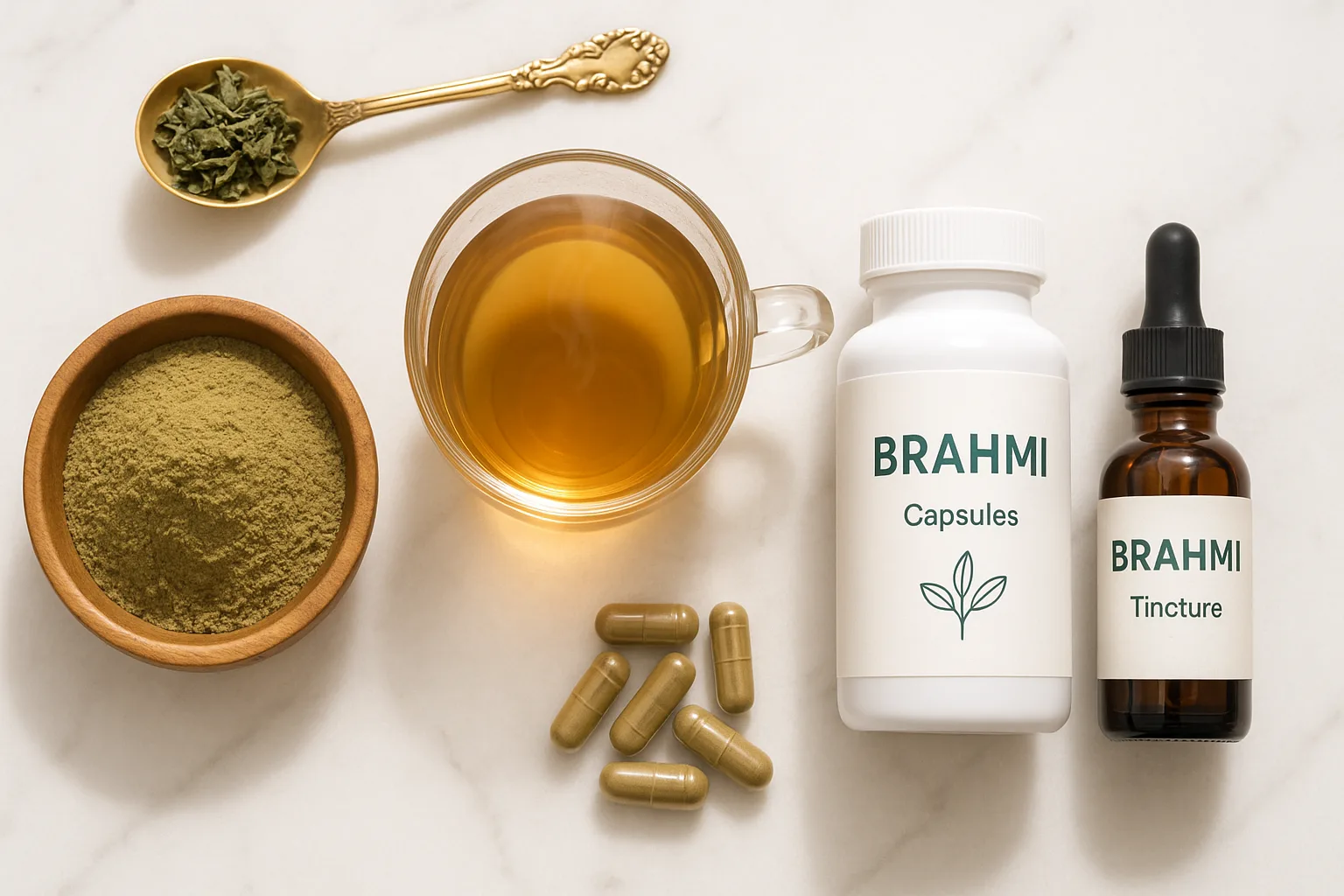
Forms of Brahmi
| Form | What It Is | How to Use It |
|---|---|---|
| Powder | Ground leaves. | Stir into water, juice, or smoothies; or mix with honey. |
| Capsules | Powder or extract. | Follow the label serving size or your clinician’s guidance. |
| Tea | Dried leaves. | Brew according to the product directions. |
| Tincture | Concentrated liquid. | Add drops to water as directed on the label. |
| Oil | Infused oil (external). | Massage into your scalp for a soothing ritual. |
Brewing note: Brahmi powder is very fine and can slip through a metal strainer. A coffee filter works. If you prefer a reusable option, Housim reusable cotton tea filter bags are a simple straining and cleanup aid—they solve the preparation problem, not the supplement decision.
What Studies Have Used
There is no single evidence-based dose that applies across powders, teas, tinctures, and standardized extracts. Human trials often study a specific standardized extract for several weeks, and those products are not automatically equivalent to one another.
For context—not as a personal dosing recommendation—several cognitive trials have used about 300 mg per day of a standardized extract for roughly 12 weeks. A 2026 network meta-analysis also grouped Brahmi trials into 300 to under 600 mg/day and at least 600 mg/day categories, but those categories combine results across different trials and products rather than establishing a personal target. A milligram number from one study should not be treated as interchangeable with another product. Follow the actual product label and ask a pharmacist or clinician if you take medications, have a medical condition, are pregnant or breastfeeding, or are considering long-term use.
How to Read a Brahmi Supplement Label
Product quality and evidence of benefit are two different questions. If you are comparing labels, check:
- Botanical identity: The label clearly names Bacopa monnieri so you do not confuse it with another herb also called Brahmi.
- Serving and extract details: The amount per serving is clear, and any standardized extract states what it is standardized to rather than relying on a vague “proprietary blend.”
- Independent quality verification: A recognized third-party quality seal can provide useful information about manufacturing, label accuracy, and contaminants. NIH ODS notes that these seals do not guarantee that a supplement is safe or effective; see its consumer guide to dietary supplements.
Frequently Asked Questions About Brahmi
Is Brahmi Worth Considering?
Brahmi has a long Ayurvedic history and a real—but mixed—human research record. The most defensible brain-health takeaway is not “it works” or “it doesn’t”: some studies suggest benefits on selected memory or stress measures, while others do not show a clear cognitive advantage. That makes Brahmi a supplement to evaluate cautiously, not a shortcut you need to add to a wellness routine.
If you’re still considering Brahmi, use the label to confirm Bacopa monnieri, the extract or serving details, and any third-party quality verification. If you take medications, manage a health condition, are pregnant or breastfeeding, or plan long-term use, bring the exact product label to a pharmacist or clinician.
If your goal is steadier attention or lower stress without adding another supplement decision, a non-supplement practice such as gentle movement or slow breathing is the simpler route.
If that non-supplement route sounds more useful—and stiff mornings are part of the picture—the free 10-minute chair-yoga routine below is a concrete morning practice to try.
Get the 10-Minute Chair Yoga Routine
Confirm to get the routine and occasional Golden Buddha Yoga emails. Unsubscribe anytime.
Something went wrong. Please check your email address and try again.