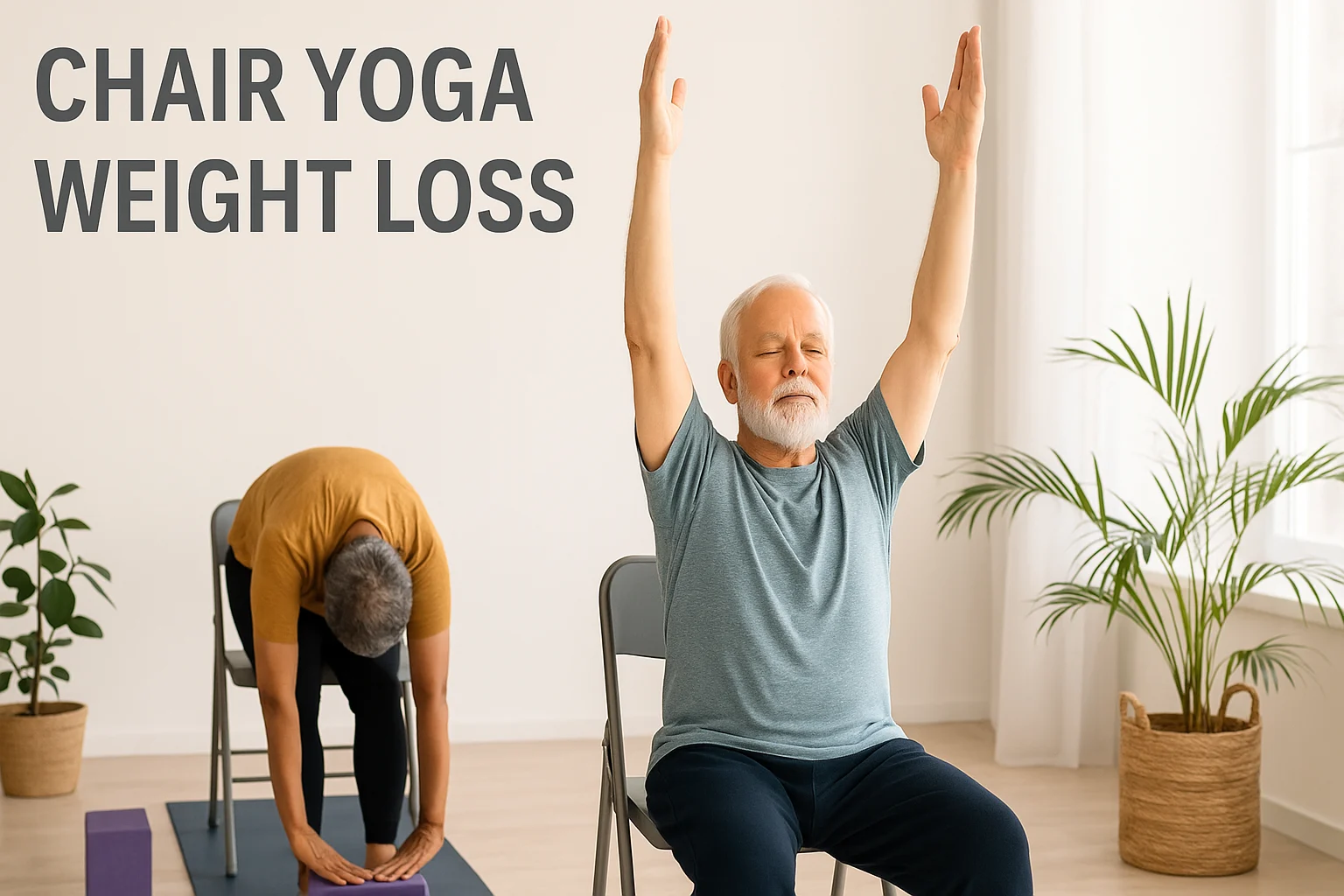
You do not need to get down on the floor to start moving. Chair yoga exercises for weight loss can give you a supported way to add activity and build strength when standing for long periods or higher-impact exercise is not a good fit. Its useful role is accessibility—not a special fat-burning shortcut.
If weight change is your goal, think bigger than one workout. Your overall activity, eating pattern, health, and other individual factors all matter. Use the five-move routine below as a practical starting point, then use the planner to choose the focus that feels most useful today. For broader adaptations, see our guide to yoga for specialized health.
Jump to the 5-Exercise RoutineTable of Contents
- Set Up Your Chair Safely
- 5 Chair Yoga Exercises for Weight Loss
- Chair Yoga Workout Planner — Choose Your Focus
- How Chair Yoga Fits a Weight-Loss Goal
- How to Progress Without Chasing Calories
- Free 10-Minute Chair Yoga Routine
- Chair Yoga for Weight Loss FAQs
- Start With One Round, Then Build
Set Up Your Chair Safely
Before you start, make the chair and the space do some of the safety work for you.
- Use a stable chair: Choose one without wheels or wobble. If it tends to slide, place it on a non-slip surface or position the back against a wall.
- Plant your feet: Sit where both feet can rest securely. If they do not reach the floor, use a firm, stable support rather than letting them dangle.
- Clear the floor: Move loose rugs, cords, and anything your feet could catch during marching or leg work.
- Keep the first round small: Use a range you can control instead of stretching toward the deepest version.
- Warm up gently: Try shoulder rolls, easy head turns left and right, ankle pumps, and a slow seated march.
Use symptoms as a stop signal. Pain, dizziness, faintness, or unusual shortness of breath are reasons to stop rather than push through. Older adults and people with health conditions may need individual modifications; the NCCIH yoga safety guidance recommends discussing appropriate changes with a healthcare professional or qualified yoga instructor when needed.
If you want an even simpler seated starting point before this routine, use our seated yoga poses for beginners guide.
5 Chair Yoga Exercises for Weight Loss
This five-move chair yoga routine mixes mobility, rhythmic movement, and chair yoga abdominal exercises. Start with one round. Move slowly enough to stay in control, and use the gentler option whenever balance, pain, or fatigue changes the movement.
Simple first round: Try 2–3 slow Sun Salutation cycles, 20–30 seconds of controlled punches, 2 comfortable breaths per side for the twist, and 4–6 controlled reps per side for the knee and leg work. Rest sooner whenever you need to.
1. Seated Sun Salutation Flow
Goal: Whole-body mobility and a smooth breathing rhythm.
- Sit tall with both feet planted and your hands on your thighs.
- Inhale and sweep your arms up only as high as your shoulders allow comfortably.
- Exhale and hinge forward a little, sliding your hands toward your knees or shins.
- Inhale to lengthen your spine and lift your chest.
- Exhale back to upright, lowering your hands to your thighs.
Make it gentler: Keep the forward hinge very small, or skip it if bending forward makes you dizzy.
2. Seated Cardio Punches
Goal: Add a little more pace while working the shoulders and trunk.
- Sit tall with both feet flat and make loose fists near your chest.
- Exhale and punch one arm forward without locking the elbow.
- Bring that hand back, then alternate sides at a controlled pace.
- Keep your ribs stacked over your hips instead of rocking hard from side to side.
Make it gentler: Punch lower or slow the pace. If you feel steady, you can add an easy opposite-knee march without adding hand weights.
3. Supported Seated Twist
Goal: Trunk control and comfortable spinal rotation without turning the chair into a balance challenge.
- Sit facing forward with both feet planted.
- Place your right hand on your left thigh and your left hand lightly on the chair beside you.
- Inhale to sit taller, then exhale and rotate only as far as you can without pulling on the chair.
- Return to center and repeat on the other side.
Make it gentler: Let your eyes and chest turn only a few degrees. The goal is controlled rotation, not a deep twist.
4. Core Compression
Goal: Strengthen the trunk with a version that can stay grounded. This is the most direct chair yoga abdominal exercise in the routine.
- Sit tall and hold the chair seat lightly if that helps you feel secure.
- Exhale and gently brace your abdomen as if preparing for a cough.
- Lift one knee a small amount, then lower it with control.
- Alternate sides while keeping the other foot planted.
Make it gentler: Keep both feet on the floor and practice the abdominal brace without lifting a knee.
5. Seated Leg Lift & Extension
Goal: Work the front of the thighs and practice controlled leg movement.
- Sit tall with both feet planted and your hands resting on your thighs or the chair.
- Lift one foot a little, then straighten that knee only as far as feels comfortable.
- Pause briefly without locking the knee.
- Bend the knee, return the foot to the floor, and switch sides.
Make it gentler: Skip the lift and simply slide one foot forward and back along the floor.
Optional: Finish With a Few Easy Belly Breaths
Breathing does not make the routine a weight-loss shortcut, but it can help you slow the pace and notice when you are bracing or rushing. For more detail, see our breathwork guide for anxious beginners.
Try a few easy belly breaths
- Sit comfortably with both feet supported.
- Rest one hand on your upper chest and one on your belly.
- Inhale gently through your nose and let the lower ribs and belly expand without forcing a huge breath.
- Exhale slowly and let your shoulders stay relaxed.
- Repeat for a few comfortable breaths, then return to normal breathing.
You now have five movements plus an optional breathing reset. Choose a focus below to turn them into one short session.
Chair Yoga Workout Planner — Choose Your Focus
Choose one focus. Your plan will update right away using movements already explained in this guide.
Choose one focus above. Your chair-yoga plan will appear here.
How Chair Yoga Fits a Weight-Loss Goal
Now that you have a session you can actually do, the useful question is what that movement can realistically contribute to a weight-loss goal.
Use Chair Yoga as a Starting Point, Not a Shortcut
Chair yoga can add physical activity, challenge muscles, and make movement more approachable when you need support. That matters because a routine you can repeat is more useful than an “ideal” workout you cannot comfortably do. NIDDK’s weight-management guidance treats physical activity as one part of a broader, sustainable approach rather than a stand-alone solution.

Think in Movement, Not Calorie Estimates
Controlled arm, leg, and trunk work can function as light strength and mobility practice. Faster rhythmic moves, such as seated punches, may also raise your breathing and heart rate. The exact intensity varies by your pace, fitness, and health, so this guide does not attach a calorie estimate to the routine.
For adults 65 and older, current CDC physical-activity guidance emphasizes a weekly mix of aerobic, muscle-strengthening, and balance activity. If you cannot meet the full recommendation, the guidance says to be as active as your abilities and conditions allow.
What core work can do
Chair yoga core exercises and other seated trunk work can strengthen the muscles around your abdomen and back. That can support posture and movement control, but it does not guarantee fat loss from one specific area or “boost” your metabolism in a predictable way.
How to Progress Without Chasing Calories
Progress does not have to mean making every exercise harder. Use a simple ladder and stop at the first level that feels repeatable.
- Repeat one comfortable round. First make the sequence familiar enough that you are not fighting the setup or the order.
- Add a little volume or pace. On a good day, repeat selected moves or move slightly more continuously instead of adding a complicated variation.
- Add other kinds of activity. If your abilities allow, combine chair yoga with aerobic, strengthening, and balance work that suits you. Walking is one option, not a requirement.
For weight management, track the habit you can repeat rather than trying to estimate calories from each pose. If your weight is changing unexpectedly, or you have a medical condition that affects activity or nutrition, bring that goal to a healthcare professional rather than relying on a generic exercise target.

If you do better with a ready-made plan, keep a short chair-yoga routine nearby for mornings when getting started feels stiff.
A Seated Routine for Stiff Mornings
Confirm to get the routine and yoga tips. Unsubscribe anytime.
Something went wrong. Please check your email address and try again.
Chair Yoga for Weight Loss FAQs
Chair yoga can add physical activity and strength work, which can be useful parts of a weight-management plan. It should not be treated as a stand-alone method that guarantees a certain amount of weight loss or calorie burn.
There is no special chair-yoga frequency that guarantees weight loss. Start with sessions you can do comfortably and build a repeatable routine. Older-adult activity guidance also includes aerobic, muscle-strengthening, and balance activity, adjusted to your abilities and health.
Start with a grounded Core Compression or one-knee lift, then add the Supported Seated Twist if rotation feels comfortable. The easier version is the one you can control without holding your breath, losing your balance, or forcing range.
Core work can strengthen the muscles around your trunk, but this routine cannot promise fat loss from one specific area. Body weight and waist changes depend on broader factors such as overall activity, eating patterns, health, and individual physiology.
Use the smallest comfortable range and keep both feet supported when that improves control. Pain, dizziness, faintness, or unusual shortness of breath are reasons to stop. If a condition, injury, surgery, or balance problem changes what movement is appropriate for you, ask a healthcare professional about suitable activity and modifications.
Twenty minutes can be useful if it helps you build a consistent movement habit, but the number itself does not guarantee weight loss. Your overall activity and eating pattern matter more than hitting one specific chair-yoga session length.
Start With One Round, Then Build
The best first session is the one you can finish with control and feel willing to repeat. Choose one round of these seated yoga poses for seniors, use the planner when you want a different focus, and add more only when the easier version feels steady.
If you would rather practice away from a screen, our broader free chair yoga poses PDF gives you a printable next step. The useful goal is not to prove that chair yoga burns a certain number of calories; it is to make regular movement easier to return to.