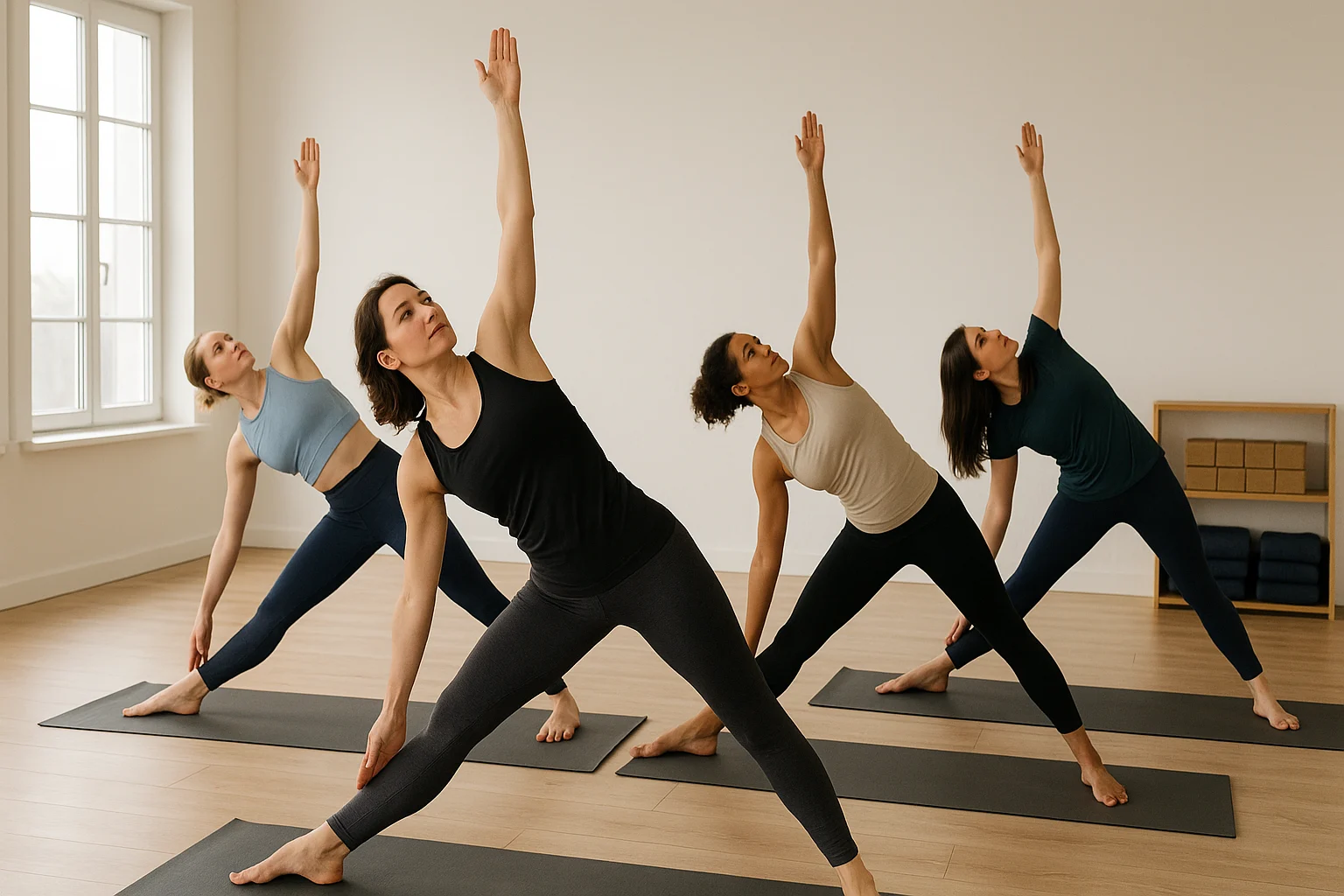
Yoga teacher training is a big investment of time, money, and attention. A useful yoga teacher training guide should begin with your goal, not a list of schools: what do you need the training to do for you? Deeper personal study, a foundation for teaching, advanced training after a 200-hour course, or a format that fits around real life?
From there, this guide explains what YTT covers, how the 200-, 300-, and 500-hour paths fit together, how online and in-person formats differ, what the real costs include, and what to verify if you want to become a yoga instructor.
Table of Contents
- Start Here: What Are You Trying to Decide?
- What Yoga Teacher Training Actually Covers
- 200, 300, and 500 Hours: What the Labels Mean
- Find Your YTT Starting Point
- How to Compare Yoga Teacher Training Programs
- Online vs. In-Person Yoga Teacher Training
- Costs, Time, and the Career Reality
- YTT: Frequently Asked Questions
- Before You Pay a Deposit
Start Here: What Are You Trying to Decide?
You do not need to read every training article at once. Start with the decision you are actually trying to make:
- Still deciding whether training is worth the commitment? Read the benefits and trade-offs of yoga teacher training.
- Want to know what you will study? Use the yoga teacher training curriculum guide.
- Comparing distance learning? Start with the online yoga teacher training comparison, then check how online certification and registration work.
- Already have foundational training? Compare the 300-hour advanced path and the 500-hour training path.
- Ready to compare schools? Use the yoga teacher training program guide.
- Planning to teach professionally? Add the yoga teacher insurance guide to your checklist.

What Yoga Teacher Training Actually Covers
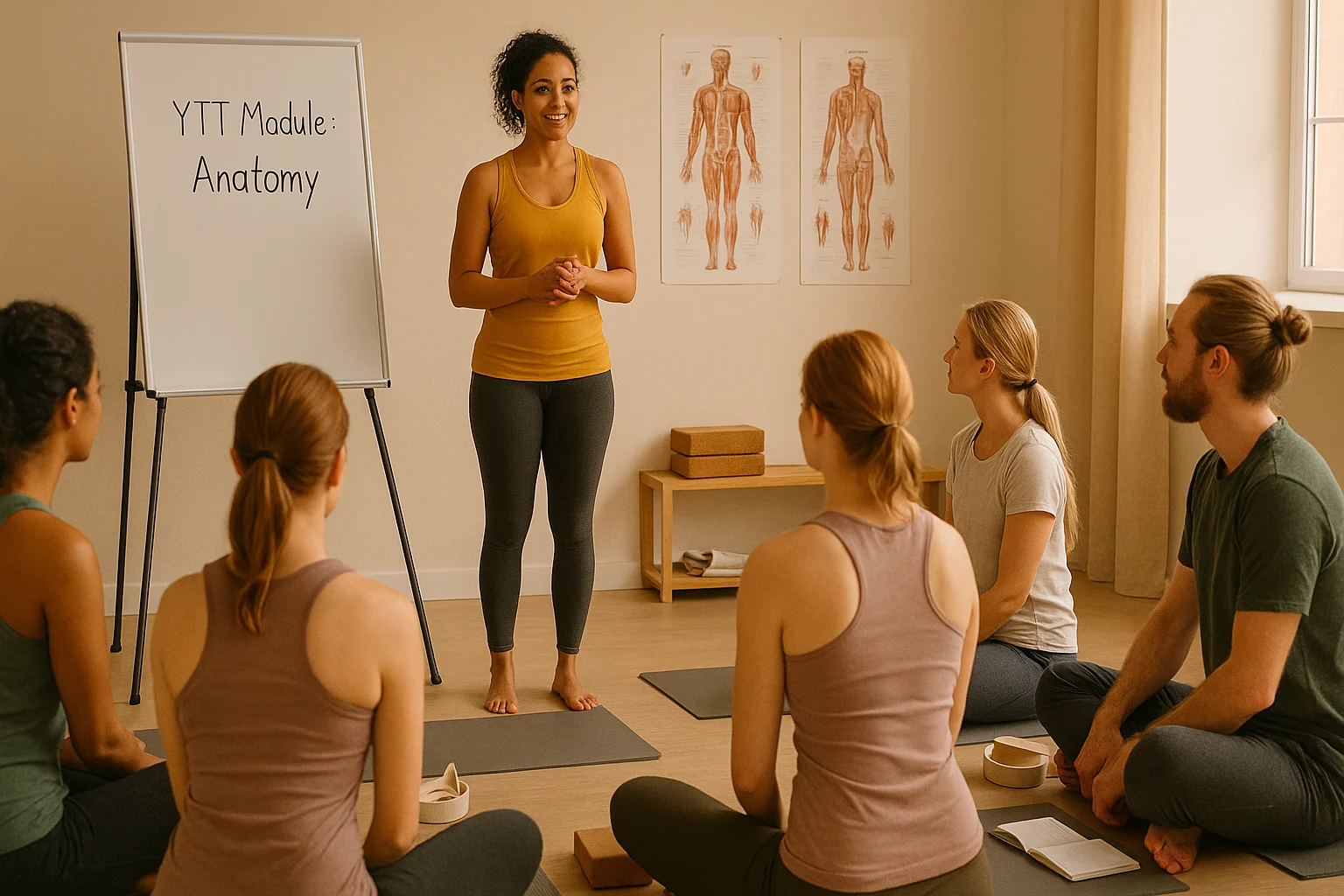
Yoga teacher training (YTT) is a structured course of study in yoga practice and teaching. A strong program goes beyond learning poses: it should help you understand practice, anatomy, philosophy, ethics, teaching methods, sequencing, observation, and how to communicate with real people whose bodies and experience levels differ.
Yoga Training Essentials
Curricula vary by school and tradition, but the useful questions are consistent:
- Practice: How much guided asana, pranayama, meditation, and personal practice is included?
- Anatomy and movement: Does the program connect anatomy to safe, adaptable teaching rather than memorization alone?
- Yoga humanities: Which texts, history, philosophy, ethics, and lineage questions are taught, and how are they handled?
- Teaching skills: How much sequencing, cueing, observation, practice teaching, and feedback will you actually do?
- Professional essentials: Does the course discuss scope, ethics, boundaries, accessibility, and the practical responsibilities of teaching?
If you want the detailed study breakdown, keep the curriculum questions above in mind as you compare schools; the program-selection section below turns them into a practical checklist.
Do You Have to Want a Teaching Career?
No. Teacher training benefits are not limited to a teaching career. Some people take YTT because they want to teach; others want a structured way to deepen practice, philosophy, and self-study.
The important question is whether the time, cost, and intensity fit what you want from the course. The guide to the benefits and trade-offs of yoga teacher training explores that decision in more depth.
If teaching people who need gentler options is part of what draws you to training, spend some time experiencing a gentler practice yourself first.
Get the 10-Minute Chair Yoga Routine
Try the gentle chair-based practice yourself and keep it for stiff mornings when you want a more approachable start.
Confirm to get the routine and yoga tips. Unsubscribe anytime.
Something went wrong. Please check your email address and try again.
200, 300, and 500 Hours: What the Labels Mean
The terminology is easy to muddle. RYT means Registered Yoga Teacher; RYS means Registered Yoga School.
Yoga Alliance currently lists teacher credentials such as RYT 200 and RYT 500, while RYS 300 refers to an advanced 300-hour program offered by a Registered Yoga School.
In other words, “300-hour training” is an important step, but it is not listed as a standalone RYT credential in Yoga Alliance’s current teacher-credential overview. You can verify the current designations in the Yoga Alliance credential directory.
Yoga Teacher Training Certificate vs. RYT Registration
Think of the yoga certification roadmap as two separate steps: complete the training and receive the school’s certificate, then apply for the RYT credential if that registration matters to you.
Yoga Alliance uses the RYS certificate as evidence in the application and sets specific certificate requirements. Before enrolling, verify both the school’s RYS designation and the certificate you will receive. See Yoga Alliance’s certificate requirements for RYT registration.
200-Hour Yoga Teacher Training and RYT 200
A 200-hour program is the common foundational route. If Yoga Alliance registration matters to you, verify that the school holds the appropriate RYS credential and that the training you are considering is eligible for the RYT pathway.
The value of the training is not the hour count alone; look closely at practice teaching, feedback, anatomy, philosophy, ethics, and how the school handles different bodies and abilities.
300-Hour Advanced Training
A 300-hour program is designed to build on foundational training rather than replace it. For a teacher who already holds RYT 200, an additional eligible 300-hour training at an RYS 300 can contribute to the 500-hour path. The 300-hour YTT guide explains what to compare before committing.
500-Hour Training and RYT 500
The 500-hour training route can be completed through an eligible integrated 500-hour program or by combining qualifying 200-hour and 300-hour trainings.
For the RYT 500 credential itself, Yoga Alliance’s current standards also require at least 100 teaching hours after completing an RYS 200 or RYS 500 training. See the current RYT standards for the credential requirements and the 500-hour YTT overview for the practical training differences.
Specialty Training Is Not One Standardized Category
Prenatal and children’s yoga have specific Yoga Alliance specialty credentials, while many other labels—such as Yin, restorative, trauma-informed, or senior-focused training—may be continuing education or school-specific certificates.
Do not assume a course is an official credential because it has an hour count in its title; verify the school, the certificate you will receive, and what that certificate actually qualifies you to claim.
Find Your YTT Starting Point
Choose your goal, training background, and preferred format. The result narrows what to compare next; it does not certify you or choose a school for you.
Answer 3 quick questions to see your starting point.
How to Compare Yoga Teacher Training Programs
The strongest program is not automatically the longest, cheapest, most spiritual, or most famous. Choose against your actual goal and the evidence the school can show you.
Define the Outcome First
Decide whether you mainly want deeper personal study, a foundation for teaching, an advanced 300-hour route, or a specific specialty. That single decision prevents you from paying for features that do not serve your goal.
Read the Curriculum, Not Just the Sales Page
Check how much time is spent on practice teaching, feedback, anatomy, philosophy, ethics, accessibility, and the style you actually want to study. Use the curriculum guide as a comparison checklist.
Verify the School and Trainers
If Yoga Alliance registration matters to you, confirm the school’s current RYS listing and designation in the Yoga Alliance school directory. Then read independent alumni feedback and look for specifics about teaching quality, feedback, workload, accessibility, and support rather than relying on star ratings alone.
Compare Format, Schedule, and Total Cost
Ask how much is live versus self-paced, what attendance is required, how missed sessions are handled, whether travel or lodging is extra, what books or props you need, and what the refund or transfer policy actually says.
Ask What Happens After Graduation
Do not assume a school provides mentorship, job placement, observation opportunities, or business support. Ask what is included and for how long. When you are ready to compare programs more directly, use the yoga teacher training program guide.
Online vs. In-Person Yoga Teacher Training
Both formats can support a serious training experience, but the trade-offs are different.
Yoga Alliance’s current RYS standards allow training to be 100% in person, 100% distance learning, or a mix of both, while requiring at least 15% of program hours to be synchronous.
If registration matters to you, confirm the school’s current status and the exact training format before enrolling. Check the current RYS standards when you compare online or hybrid programs.
In-Person Yoga Teacher Training
Often works well when you value:
- Real-time observation, demonstration, practice teaching, and feedback in the same room.
- A fixed schedule that creates immersion and accountability.
- Face-to-face relationships with trainers and your cohort.
Trade-offs:
- Travel, lodging, commuting, or time away from work may add substantially to the real cost.
- Fixed attendance can be difficult when you have work, care, mobility, or health constraints.
- A retreat-style setting can feel immersive without necessarily being the best fit for how you learn.
Online Yoga Teacher Training
Often works well when you value:
- Less travel and more control over where you study.
- A format that may fit more easily around work, caregiving, disability, or location constraints.
- Access to schools and trainers you could not reasonably reach in person.
Trade-offs:
- You need to check how much live interaction, observation, and feedback the program actually provides.
- Self-directed work can be harder to sustain if the course has weak deadlines or little instructor contact.
- Not every “online certification” claim means the same thing, so verify both the school and the credential path.
For a deeper comparison, read the online yoga teacher training guide. If your main question is whether an online course can lead to Yoga Alliance registration, use the separate online certification guide.
| Question | In-Person | Online / Distance Learning |
|---|---|---|
| Schedule | Usually more fixed | Varies from scheduled live sessions to flexible coursework |
| Feedback | Immediate in-room observation is easier | Depends heavily on live sessions, video review, and trainer access |
| Travel | May require commuting or lodging | Usually reduces travel |
| Best fit | Readers who want immersion and face-to-face practice | Readers who need geographic or scheduling flexibility |
Costs, Time, and the Career Reality
Training can be personally meaningful and still be a poor financial fit. Work out the full commitment before you enroll: tuition, travel, lodging, books, props, time away from paid work, and any registration or continuing-education costs that matter to your plan.
What Does Yoga Teacher Training Cost?
Yoga Alliance currently says schools set their own tuition and that training commonly ranges from about $1,500 to $5,000+, depending on length, location, and format. It also lists a $50 one-time RYT application fee and $65 annual membership fee. Those figures can change, so verify the current numbers on Yoga Alliance’s training-options page before budgeting around them.
Tuition alone is not the useful comparison. Ask each school for the total expected cost and what is included, especially if the course involves accommodation, meals, travel, required reading, props, make-up sessions, or extra assessment fees.
How Long Does Yoga Teacher Training Take?
The hour label tells you the amount of training, not the calendar length. A 200-hour course might be delivered as an intensive, over weekends, or across a longer online or hybrid schedule. Choose the pace you can realistically absorb rather than the fastest finish date.
What Can You Do After Yoga Teacher Training?
Possible paths include studio classes, private sessions, workplace yoga, online teaching, retreats, community programs, or simply continuing your own study. Income varies too widely by location, experience, business model, and demand for a single salary promise to be useful here. Treat any school’s earnings examples as marketing unless you can verify the assumptions behind them.
If you intend to teach, check local business or employment requirements and think about liability protection before your first paid class. The yoga teacher insurance guide explains the questions to ask without assuming one policy fits everyone.
YTT: Frequently Asked Questions
Before You Pay a Deposit
Make sure you can answer five things before you commit: what you want from the training, which certificate or credential matters to you, what the curriculum actually includes, what the full cost and attendance commitment are, and what the refund or transfer rules say.
If those answers are clear and the program matches your goal, you have a real reason to move forward. If they are not, use the YTT starting-point tool to narrow what to compare next, then keep looking rather than paying for a credential that does not match what you wanted from training in the first place.