If you’re searching for a yoga teacher training online certification, yes—an eligible Registered Yoga School program can lead to the Yoga Alliance RYT pathway. The key distinction is simple: online describes how the training is delivered, not a separate credential.
This guide shows you how to verify the school, choose a format you can realistically sustain, compare practicum and feedback, estimate the weekly workload, and understand what happens after graduation. If you are still deciding between 200-, 300-, and 500-hour paths, start with our yoga teacher training guide.
Find Your Best-Fit Training FormatTable of Contents
- When Online Yoga Teacher Training Makes Sense
- Understanding Yoga Alliance and Online Certification
- Which Online Yoga Teacher Training Format Fits You?
- Step-by-Step: How to Start Your Online Yoga Teacher Training
- Choose the Program You Can Actually Complete
When Online Yoga Teacher Training Makes Sense
Online training is useful when location, work, caregiving, or travel makes a fixed studio schedule difficult. It can also give you more control over when you review recorded material. The trade-off is that flexibility only helps when the program still gives you enough live contact, teaching practice, and feedback.
Where Online Training Helps
- Schedule flexibility: Recorded coursework can be easier to fit around work and family commitments.
- Location flexibility: You can consider schools beyond commuting distance without relocating for the full training.
- Replay value: Recorded lessons can make dense topics such as anatomy or philosophy easier to revisit.
- Lower travel burden: A distance-learning format can reduce commuting or accommodation needs, although tuition itself is not automatically lower.
If you are still deciding whether teacher training is worth the commitment at all, our guide to the benefits of yoga teacher training covers the broader reasons people enroll.
Where It Can Be Harder
Online study asks more of your self-management. It can also feel thin if a program relies heavily on recorded lessons without enough live teaching practice or useful feedback. If you learn best through immediate in-person correction, a hybrid or studio-based format may be a better fit than the most flexible online option.
Understanding Yoga Alliance and Online Certification
Yoga Alliance now permits Registered Yoga Schools (RYSs) to offer programs through 100% distance learning or a mix of online and in-person training. Current standards still require at least 15% of program hours to be synchronous, meaning teachers and trainees meet live in real time. For a 200-hour online yoga teacher training offered by an RYS 200, that minimum is 30 synchronous hours.
What to Verify Before You Enroll
- Credential path: For RYT 200, Yoga Alliance requires completion of a 200-hour training with an RYS 200. The credential is based on the registered training you completed, not on a separate “online RYT” designation.
- Quality standards: Registered schools must meet Yoga Alliance curriculum and trainer standards. Review the current Yoga Alliance training guidance before you enroll.
Marketing phrases such as “virtual yoga credentials,” “online yoga credentials,” or “digital certification” can describe the format or sales framing, but they are not separate Yoga Alliance credential names. Check the school’s actual RYS designation and the RYT pathway you want instead of relying on the label alone.
If RYT registration matters to you, verify the school and the exact program credential in the Yoga Alliance School Directory before you pay a deposit.
How Studios May Evaluate Your Training
There is no single rule that every studio follows. Online delivery can fit the Yoga Alliance credential pathway when the school and program meet the current RYS standards, but employers can still evaluate the school, the quality of your practicum, your teaching skills, and their own hiring requirements.
That makes program quality more important than the word “online.” Look for enough live interaction, practice teaching, useful feedback, and curriculum depth for the kind of classes you hope to teach.
Once you understand how online certification works, the next question is what kind of learning structure will actually fit your life. This quick matcher gives you a format to prioritize before you compare schools.
Which Online Yoga Teacher Training Format Fits You?
Answer four questions to find a training format to prioritize. This is not a verdict on school quality or registration status.
Step-by-Step: How to Start Your Online Yoga Teacher Training
Keep your format result in mind as you work through the steps below. The same school can be a strong fit for one schedule and a poor fit for another, so use your preferred structure as a filter rather than treating every online program as interchangeable.
Step 1: Compare Programs Against the Same Checklist
Compare every school against the same criteria before price, branding, or a polished sales page makes the decision for you. The goal is not to find a “perfect” program; it is to find one whose training structure matches what you need to learn and teach well.
- RYS registration: If your goal is RYT 200, confirm that the training is registered as an RYS 200 program in Yoga Alliance’s directory.
- Live schedule: Check when synchronous sessions happen, how attendance works, and whether the time zone is realistic for you.
- Curriculum and practicum: Look for clear coverage of practice, anatomy, yoga humanities, teaching skills, and opportunities to practice teaching.
- Trainer fit: Read trainer bios and, when possible, watch or attend a sample session so you can judge teaching style rather than credentials alone.
- Feedback and community: Find out how you receive feedback, how often mentors are available, and whether peer interaction is built into the program.
- Student feedback: Read recent reviews with an eye for specific comments about support, workload, practicum quality, and communication.
- Total cost: Yoga Alliance says RYS tuition ranges from $1,500 to $5,000+ depending on program length, location, and format. Compare payment plans, refund terms, and exactly what the tuition includes.
Do the workload math: divide the program’s advertised training hours by the number of weeks in its schedule. A 200-hour program spread across 20 weeks averages about 10 training hours a week; across 10 weeks, about 20. The workload will not be perfectly even every week, but this quick check makes “flexible” schedules easier to compare.
Before paying a deposit: ask the school to show you a sample week, the live-session schedule, practicum expectations, and its cancellation or refund policy. Those details tell you more about day-to-day fit than a long feature list.
Step 2: Check Prerequisites and Enrollment Policies
Practice expectations, deposits, refund terms, and interviews vary by school. Read the current admissions information for the exact program you are considering, and clarify anything that is vague before you pay.
Step 3: Set Up for Online Training
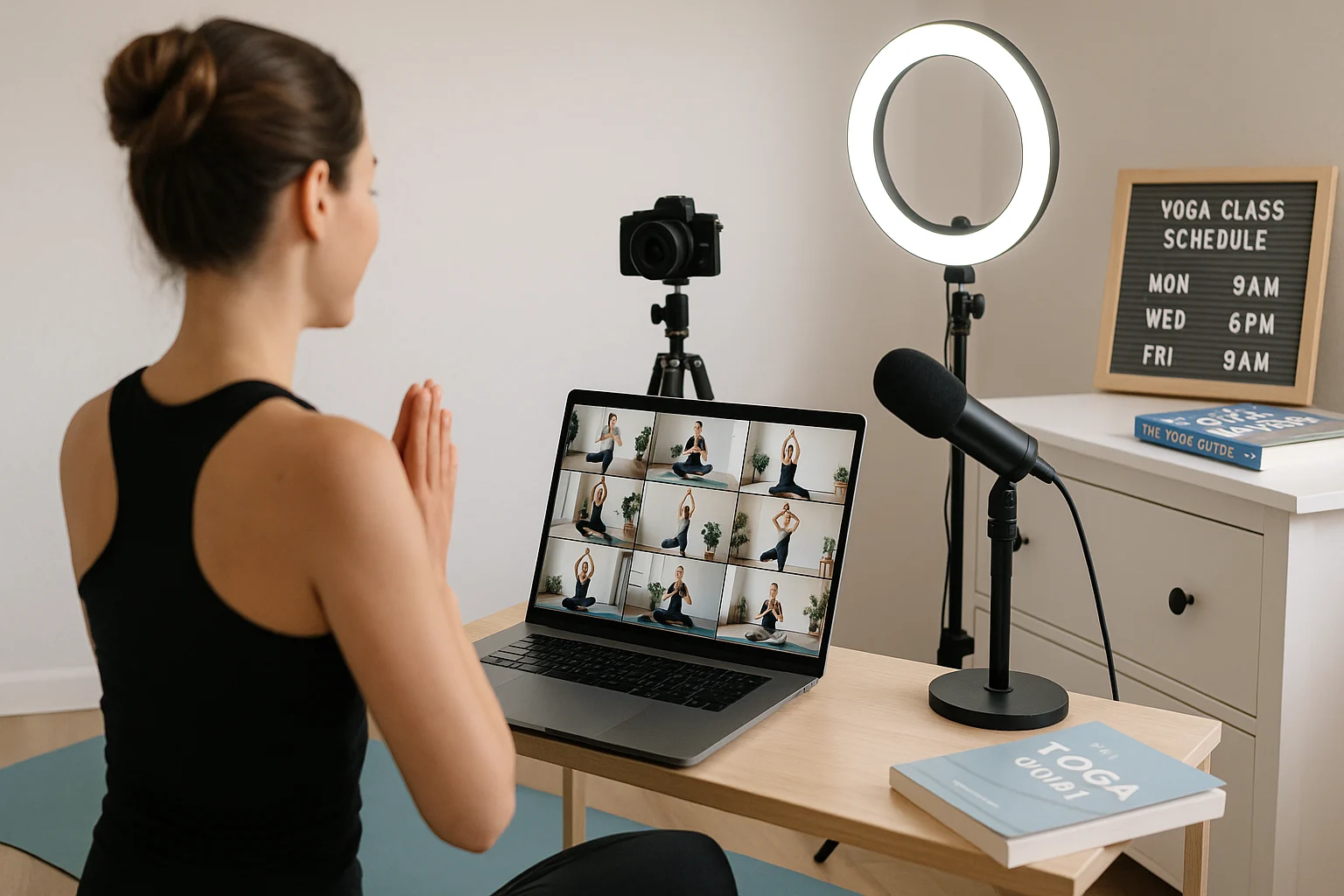
You do not need a complicated home studio. The practical goal is reliable participation in live sessions, clear audio and video when you teach, and enough space to practice safely.
| Item | What It Supports |
|---|---|
| Reliable Internet | Streaming coursework and joining live sessions without frequent dropouts |
| Laptop or Computer | Coursework, video calls, assignments, and easier screen sharing |
| Webcam and Microphone | Helping trainers see and hear you clearly during teaching practice |
| Quiet Practice Space | Enough room to move, demonstrate, and participate without constant interruption |
| Yoga Mat and Usual Props | Your own practice and demonstrations; follow the school’s specific equipment list |
Step 4: Work Through the Coursework
Online programs may combine recorded lessons, live instruction, assignments, and guided practice. A good curriculum should make it clear what is self-paced and what requires you to attend in real time. If you want a deeper look at the subjects commonly covered, see our yoga teacher training curriculum guide.
- Recorded lessons: Useful for material you may want to pause, repeat, or review.
- Live sessions: The place for real-time instruction, discussion, demonstrations, and feedback.
- Assignments: May include written reflections, quizzes, lesson planning, or other checks on understanding.
- Personal practice: Keeps the training connected to the yoga you are learning to teach.
Step 5: Practice Teaching and Get Feedback
Do not treat practicum as a box to tick. Ask how often you will teach, who observes you, and what kind of feedback you receive.
- Peer teaching: Practice with other trainees in live sessions or breakout groups.
- Recorded teaching: Submit a class or sequence for trainer review when the program uses asynchronous feedback.
- Live practicum: Teach in real time so trainers can observe pacing, cueing, and class management.
- Feedback: Look for specific comments you can apply on the next teaching attempt, not only a pass/fail result.
If you hope to teach people who need gentler or seated options, experience a simple chair-based sequence from the participant’s side first.
Get the 10-Minute Chair Yoga Routine
Confirm to get the routine and yoga tips. Unsubscribe anytime.
Something went wrong. Please check your email address and try again.
Step 6: Finish Assessments and Graduate
Complete the assessments, teaching requirements, and projects your school uses to confirm that you have met its graduation standard. Keep a copy of your completion certificate and any records you may need for later registration.

Step 7: Apply for Yoga Alliance Registration If You Want It
If you want the Yoga Alliance RYT credential after an eligible RYS training, submit your training details and certificate, wait for the school confirmation, and complete the remaining registration steps. Use Yoga Alliance’s current RYT application guidance for the latest process and fees.
Frequently Asked Questions About Online Yoga Training
Choose the Program You Can Actually Complete
Online teacher training is not automatically easier or lower quality; it is a different delivery format. The strongest choice is the registered program whose live schedule, practicum, feedback, curriculum, and total cost fit the way you can realistically learn.
When you are ready to compare broader options, use our yoga teacher training programs guide, then verify the exact RYS credential before you pay a deposit.