Choosing a yoga teacher training can get expensive fast, and the hardest part is not finding options—it is knowing which differences actually matter. A polished course page can still be the wrong fit for the way you need to learn.
I’d start with four questions: Do you want to teach soon or mainly deepen your practice? How much live feedback do you need? Can you travel? And does Yoga Alliance registration matter to your plans? This guide compares six programs with current first-party information and gives you a finder to build a shortlist. If you’re still mapping the broader 200-, 300-, and 500-hour path, start with the complete yoga teacher training guide.
Use the Program FinderTable of Contents
- Before You Compare Programs: Decide What You Want From Training
- Understanding Yoga Alliance Credentials
- How to Compare Yoga Teacher Training Programs
- Yoga Teacher Training Program Finder
- Yoga Teacher Training Programs to Compare
- Online, In-Person, or Hybrid?
- What Comes After Teacher Training?
- Frequently Asked Questions
- How to Make Your Shortlist
Before You Compare Programs: Decide What You Want From Training
You do not have to be certain that you want to teach before you take a YTT, but your goal changes what is worth paying for. If you are still deciding whether training itself makes sense, the benefits of yoga teacher training guide explores that question in more depth.
- If you want to teach soon: prioritize practice teaching, useful feedback, a schedule you can finish, and any credential or local requirements relevant to where you plan to teach.
- If you mainly want to deepen your practice: curriculum, philosophy, style, pacing, and instructor access may matter more than a career-oriented package.
- If you want both: look for a balanced program that gives you enough teaching practice to test the role without turning every part of the training into career preparation.
Understanding Yoga Alliance Credentials
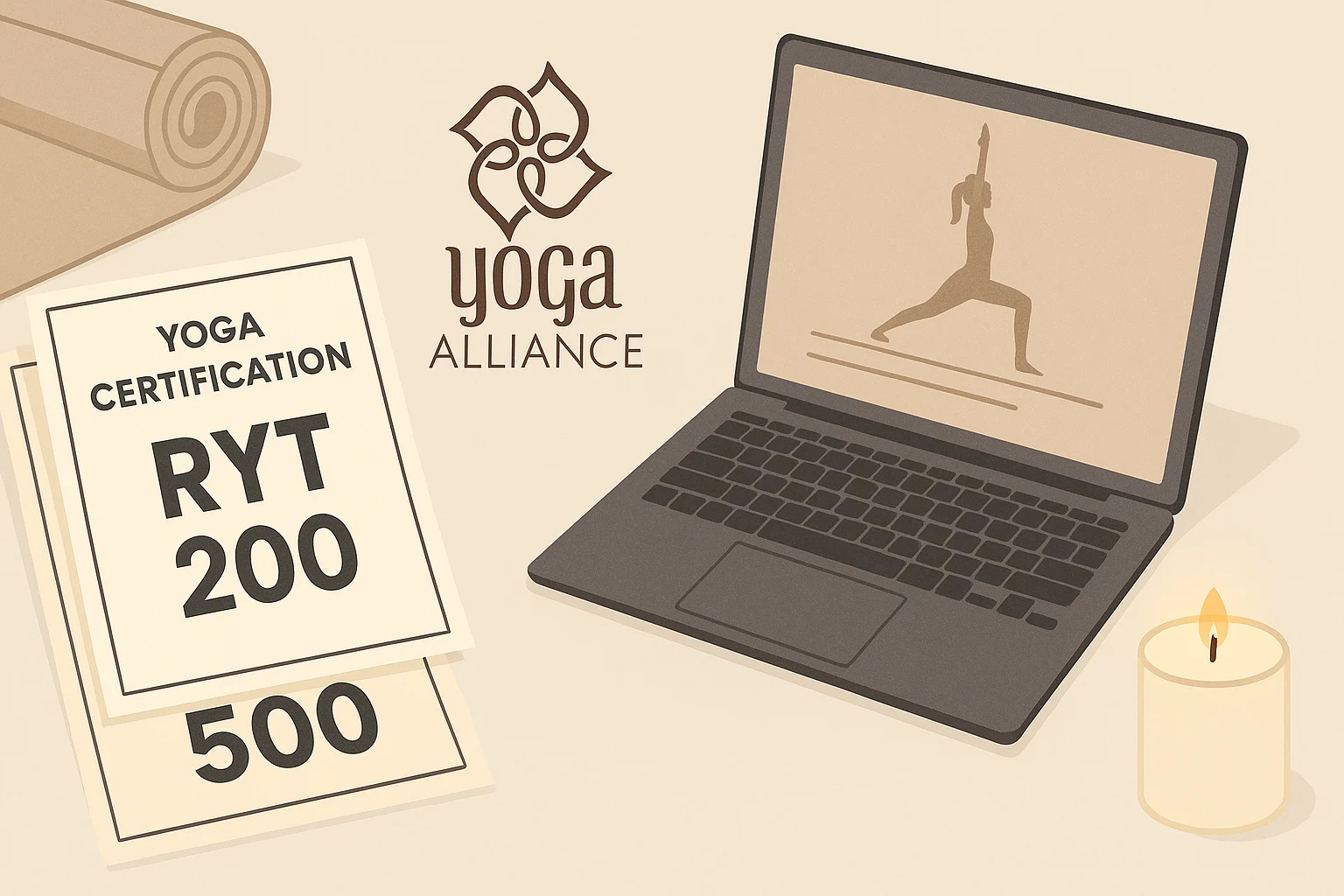
Yoga schools issue their own training certificates. Yoga Alliance separately maintains voluntary professional credentials for schools and teachers: a school can register as an RYS, and a graduate can apply for an RYT credential when the applicable training requirements are met.
RYT 200: the foundational registration
For RYT 200, Yoga Alliance currently requires completion of a 200-hour yoga teacher training with a single RYS 200. Its current RYS 200 standards organize the curriculum into four educational categories: Techniques, Training, and Practice; Anatomy and Physiology; Yoga Humanities; and Professional Essentials.
RYT 500: two training pathways plus teaching experience
For RYT 500, the training route can be either a full 500-hour program at one RYS 500 or a 200-hour RYS 200 training followed by a 300-hour program at one RYS 300. The credential also requires at least 100 teaching hours after the qualifying training timeline begins.
A school certificate and an individual RYT credential are related, but they are not the same thing.
What Yoga Alliance registration does — and doesn’t — mean
Yoga Alliance is a professional credentialing and membership organization. It registers schools and teachers that meet its credential requirements, but an RYT credential is not the same thing as a government teaching license.
That distinction matters when you compare programs. A school’s RYS status can preserve your option to apply for an RYT credential, while individual studios, gyms, insurers, retreat operators, and local jurisdictions can still set their own hiring or operating requirements.
- Credential framework: RYS and RYT designations give schools and teachers a common professional reference point.
- Directory visibility: registered teachers and schools can appear in Yoga Alliance directories.
- Continuing-education resources: membership includes access to continuing-education and professional resources.
If registration matters to your plans, verify the specific school and program in the current Yoga Alliance school directory before paying.
How to Compare Yoga Teacher Training Programs
A useful yoga certification guide should help you compare the parts of training that affect your day-to-day learning, not just the logo on the certificate. Before you shortlist a program, check:
- Current school registration. If you want the option to apply for a Yoga Alliance credential later, confirm that the school and training pathway are currently registered for the credential you need.
- Curriculum and practice teaching. Compare the school’s yoga teacher training curriculum with how anatomy, philosophy, sequencing, teaching methodology, practicum, and feedback are actually taught and assessed.
- Faculty and feedback. Current RYS 200 standards require lead trainers to hold E-RYT 500 credentials. Also check how much access you get to trainers and whether your teaching is reviewed live, recorded, in writing, or mainly through self-study.
- Format and live participation. Compare the amount of live interaction, time-zone demands, travel, and whether the schedule is fixed, cohort-based, or self-paced.
- Total cost and access. Check current tuition, payment terms, required books or travel, course-access length, and extension or refund policies rather than relying on an old roundup price.
- Recent reviews and post-training support. Look for patterns in recent feedback, then check what remains available after graduation: mentorship, community calls, continuing education, or course materials.
Once you know what matters most, use the finder below to turn those priorities into a shortlist of up to three programs before you compare the full list.
Yoga Teacher Training Program Finder
Choose the format you can attend, then add learning or style preferences. The finder compares the six programs below and explains why each shortlisted option fits.
Choose at least one preference to build a shortlist. You can leave any field on “Any.”
This is a shortlist aid, not a quality score. A selected format acts as a filter; learning setup and style help rank the remaining programs. Verify current RYS status, schedule, tuition, and enrollment terms on the official program page before you commit.
Yoga Teacher Training Programs to Compare
These six programs had current first-party information available when this guide was checked in August 2026. They are not ranked from best to worst; use the table to find a plausible fit, then verify the latest schedule, tuition, and registration details on the school’s own site before enrolling.
| Program | Current format | What stands out | Official details |
|---|---|---|---|
| My Vinyasa Practice | Online, self-paced | Live calls, practice teaching, mentorship, and flexible pacing | My Vinyasa Practice details |
| Aura Wellness Center | Online, self-paced | Dedicated Hatha and Vinyasa 200-hour pathways | Aura 200-hour details |
| Tribe Yoga | Residential / in-person | Immersive mixed-style training with Ashtanga, Vinyasa, and Hatha | Tribe 200-hour details |
| YogaRenew | Online, self-paced | Hatha/Vinyasa core training with live support options | YogaRenew 200-hour details |
| Power Living Australia | Online or hybrid | Scheduled cohort options with live Q&A and practice teaching | Power Living training details |
| Online Yoga School / Lifted Lotus | Online, self-paced | Online RYS-200 pathway with an accessibility-focused school positioning | Online Yoga School RYT-200 details |
My Vinyasa Practice
Why compare it: The current 200-hour program is fully online and self-paced, with a minimum nine-week completion window plus live lectures, practice teaching, one-to-one support, and mentorship.
Trade-off to check: Flexible pacing can be useful when your schedule changes, but confirm how much live participation you personally want before choosing a mostly self-directed format.
Consider it if: You want online flexibility without giving up access to live support and feedback. Check current My Vinyasa Practice program details.
Aura Wellness Center
Why compare it: Aura currently offers fully online 200-hour Hatha and Vinyasa pathways, which makes it easier to choose a style-specific foundation rather than a mixed-style course.
Trade-off to check: The home-study format is highly flexible, so compare its feedback model and live interaction with the amount of structure you know you need.
Consider it if: You are a self-directed learner who wants an online Hatha or Vinyasa pathway with a clearly defined curriculum. Check current Aura Wellness Center program details.
Tribe Yoga
Why compare it: Tribe’s current Level 1 training is a residential 200-hour program built around mixed styles including Ashtanga, Vinyasa, and Hatha, with an immersive group-learning format.
Trade-off to check: Residential training asks for a larger block of time away from normal routines, so confirm the current location, dates, travel requirements, and accommodation details before committing.
Consider it if: You want an intensive in-person experience and value community as part of the training itself. Check current Tribe Yoga program details.

YogaRenew
Why compare it: YogaRenew currently offers an online 200-hour Hatha and Vinyasa training through a Registered Yoga School, with self-paced study and live support resources.
Trade-off to check: A large online support ecosystem can be helpful, but decide whether you prefer an open self-paced schedule or a smaller cohort with fixed live contact.
Consider it if: You want a flexible online foundation with frequent opportunities to ask questions and stay connected. Check current YogaRenew program details.
Power Living Australia
Why compare it: Power Living currently offers 200-hour online and hybrid routes, including scheduled programs that combine recorded study with live Q&A and practice-teaching sessions.
Trade-off to check: Scheduled cohorts can add accountability but also create fixed attendance and time-zone demands, especially outside Australia.
Consider it if: You want more structure than a fully self-paced course and are comfortable working around a cohort schedule. Check current Power Living program details.
Online Yoga School / Lifted Lotus
Why compare it: The school currently lists an online, self-paced RYS-200 pathway and emphasizes accessibility, long-term course access, and community connection.
Trade-off to check: Because the course is self-paced, compare the current mentorship and live-feedback options with how much instructor contact you want.
Consider it if: You want an online, flexible entry point and place a high value on accessibility and self-paced study. Check current Online Yoga School program details.
Online, In-Person, or Hybrid?
Format is not a quality ranking. It changes how you receive feedback, how much travel you take on, and how tightly the training has to fit around the rest of your life.
| Question | Online | In person | Hybrid |
|---|---|---|---|
| Schedule | May be self-paced or cohort-based | Usually tied to fixed training dates | Mix of online work and scheduled in-person sessions |
| Feedback | Check how live calls, video review, and practice teaching work | More opportunities for immediate in-room observation | Check which feedback happens online versus in person |
| Travel | Usually little or none | May require local commuting or residential travel | Some travel is usually part of the format |
| Best question to ask | Will I stay engaged without a fixed room and routine? | Can I realistically protect the required dates and travel time? | Do the online and in-person pieces fit my calendar together? |
If online is your likely fit, the online yoga teacher training guide gives that format its own deeper comparison.
What Comes After Teacher Training?
Finishing a course does not automatically create a teaching career. Your next step depends on whether you want to register with Yoga Alliance, teach for an existing studio, work independently, or keep the training mainly for your own practice.
- Verify the requirements for the setting where you want to teach. Studios, employers, insurers, and local jurisdictions can set requirements beyond a training certificate.
- Build teaching experience gradually. Practice teaching, feedback, assisting, community classes, and small opportunities can tell you more about the role than rushing into a full schedule.
- Review insurance when you begin teaching. If you will teach independently or need your own coverage, use the yoga teacher insurance guide as a starting point for the questions to verify.
- Advance only when the next training solves a real need. If you already have a 200-hour foundation and are considering deeper study, the 300-hour yoga teacher training guide covers that next stage.
Frequently Asked Questions
How to Make Your Shortlist
Do not try to choose from six schools at once. Run the program finder to get a short list, then open each school’s official page and compare the details that can change the decision: live feedback, practice teaching, schedule, total cost, course-access terms, and current RYS status if it matters to you.
If two programs still look equally good, I’d choose the one whose learning format you can realistically finish—not the one with the loudest marketing. That is the part of choosing a yoga teacher training that no badge or sales page can decide for you.
Training, credential, hiring, insurance, and local teaching requirements can change. Verify the school’s current terms, Yoga Alliance status if relevant, and any requirements that apply where you plan to teach before you pay or begin offering classes.