Struggling with stiff joints? Yoga for arthritis can be one gentle way to stay active without asking every joint to do the same thing. Short bouts of movement still count, and the useful question is not whether you can make a pose look standard—it is which version feels workable today. This guide focuses on supported poses, breathing, and practical modifications. If you are adapting yoga around more than arthritis, see our guide to adapting yoga around health needs.
Table of Contents
- Safety Tips Before You Start
- How Yoga Fits Arthritis
- Simple Props for More Support
- Find Your Arthritis-Friendly Starting Point
- Arthritis Yoga Poses: Joint-Friendly Options
- Breathing and Body Awareness for Pacing
- Build a Routine You Can Adjust
- When to Get Individual Guidance
- Frequently Asked Questions
- Make the Practice Fit Your Joints
- Get the 10-Minute Chair Yoga Routine for Stiff Mornings
Safety Tips Before You Start
Before you start, put joint safety first. A few quick guidelines:
- Consult Your Doctor: Check in with your clinician first—especially if your arthritis is severe or you’ve got other conditions.
- Watch Your Response: Some soreness or stiffness can happen when you start a new activity, but sharp, severe, or lingering pain—and symptoms that keep worsening—are reasons to stop or adjust and, when needed, check in with a healthcare professional.
- Start Slowly: A short session is enough to begin. Increase time or effort in small steps only when your joints are tolerating the current level well.
- Use Props: Blocks, straps, and blankets can reduce how far you need to reach or how much pressure a contact point takes.
- Avoid Overstretching: Move gently without forcing or bouncing into stretches.
- Warm Up: Start with light movement to prepare your joints and muscles.
- Choose Adaptable Instruction: If you take a class, look for a teacher who is comfortable offering chair, prop, and range-of-motion modifications; a physical therapist can help when you need exercise tailored to a specific joint or condition.
How Yoga Fits Arthritis
Arthritis is a broad group of conditions that can cause joint pain, stiffness, swelling, and changes in movement. Osteoarthritis involves changes across the whole joint, while rheumatoid arthritis is an autoimmune inflammatory disease. Exercise is part of arthritis management, and the American College of Rheumatology includes yoga among mindful-movement options that can support posture, balance, and movement quality.
Osteoarthritis vs. Rheumatoid Arthritis
Osteoarthritis (OA): Joint tissues change over time, commonly affecting areas such as the hands, hips, knees, and spine. Strength and mobility work can be useful, but the right range and load depend on the joints involved and how they feel that day.
Rheumatoid Arthritis (RA): This autoimmune disease can cause inflammatory joint symptoms that vary over time. During periods when symptoms worsen, the goal is usually to adjust the amount or intensity of movement rather than force the usual practice.
What Gentle Yoga Can Offer
Yoga combines several kinds of activity that arthritis guidance commonly encourages. The useful part is not one special “arthritis pose”; it is having forms of movement that you can scale up or down.
- Mobility: Gentle ranges of motion can help you keep joints moving without forcing a stretch.
- Strength: Supported poses can train the muscles around a joint, which may make everyday movement feel more manageable.
- Balance and movement quality: Slower practice gives you time to notice alignment, footing, and how much load a joint is taking.
- Function and pain: Regular physical activity can reduce arthritis pain and improve physical function for many people, although response varies.
Simple Props for More Support
You do not need a special kit to adapt these poses. Start with a stable, non-slip practice area, then add only the support that solves a specific problem:
- Chair: Gives you a seated option and a steady support point when getting to the floor or standing feels awkward.
- Folded blanket or towel: Cushions knees and other sensitive contact points.
- Block: Brings the floor closer so you do not have to reach as far.
- Strap: Extends your reach so you can keep a stretch within a comfortable range.
- Yoga mat: Can add grip and cushioning, but it is optional if the surface you already have feels secure and comfortable.
Once you know which setup feels workable today, this quick tool can point you to a gentler place to begin in the pose guide below.
Find Your Arthritis-Friendly Starting Point
Answer three questions about how you want to move today. This does not diagnose arthritis or choose treatment; it simply matches you with a more supported starting point in this guide.
Step 1 of 3
Which position feels most workable right now?
Where do you most want to reduce pressure?
How is movement feeling today?
Arthritis Yoga Poses: Joint-Friendly Options
These arthritis yoga poses are starting points, not targets to push toward. Choose the version you can enter and leave comfortably, change the contact points that bother a joint, and skip any shape that asks for more range than you have today.
Seated Arm Raise (Chair-Supported)
Why try it: Lets you work with upright posture, breathing, and shoulder movement while the chair supports you. For a full no-floor practice, explore chair yoga for seniors.
How to:
- Sit in a sturdy chair with your feet flat, hip-width apart, and knees over ankles.
- Lengthen through your spine without bracing hard through your belly or shoulders.
- Inhale, lift arms forward or overhead, keeping shoulders relaxed.
- Stay for 3–5 easy breaths, keeping the effort comfortable.
- Exhale, lower arms. Repeat 3-5 times.
Modification: If lifting arms hurts, rest hands on thighs or press palms together at chest.
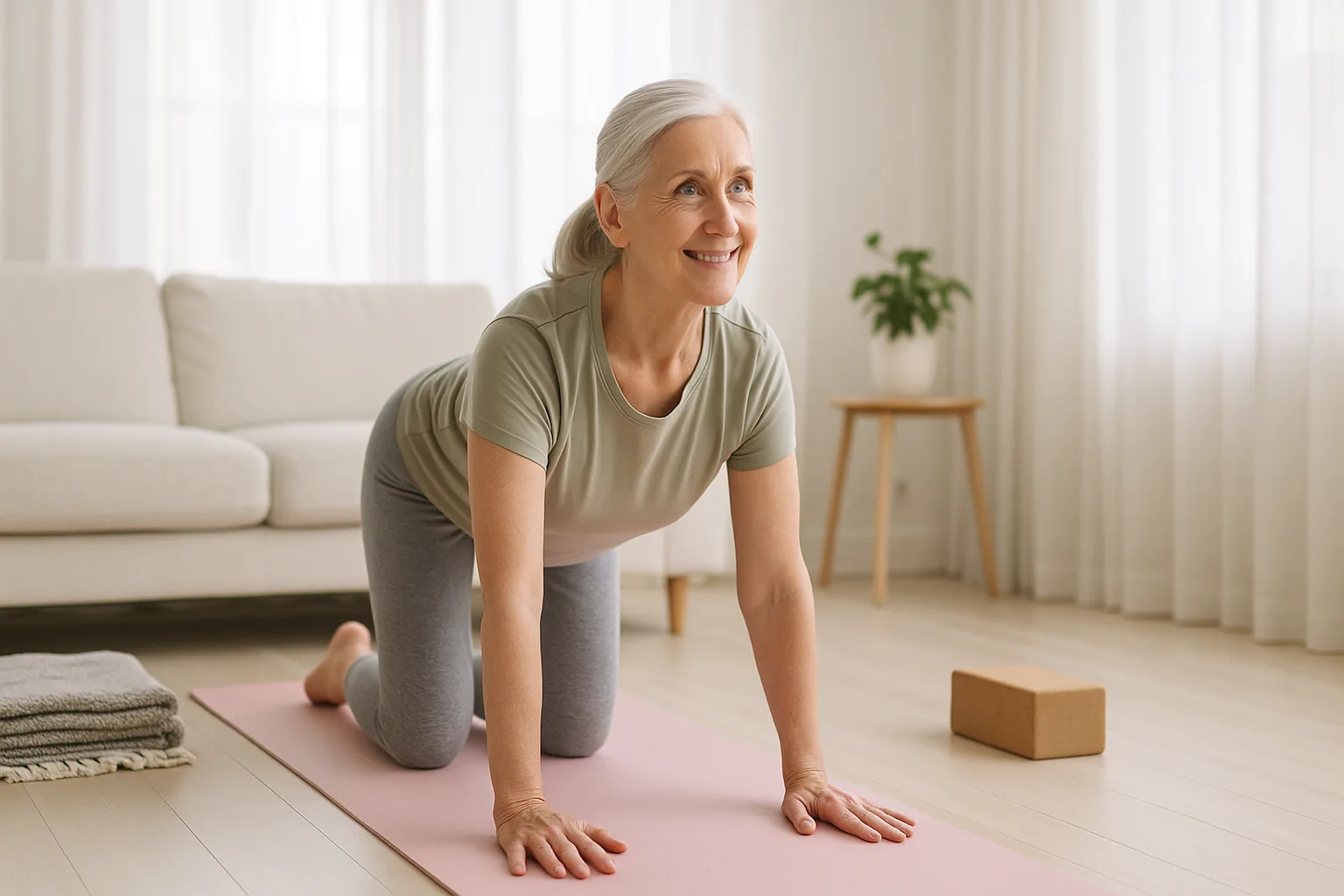
Cat-Cow Stretch (Marjaryasana-Bitilasana)
Why try it: Moves the spine through gentle flexion and extension and can help you explore a comfortable range without holding one position for long.
How to:
- Start in tabletop (hands under shoulders, knees under hips). Use a blanket under knees for comfort.
- Cow Pose (Inhale): Drop belly, lift chest, and look slightly up without neck strain.
- Cat Pose (Exhale): Round spine, tuck chin, and relax head.
- Flow between Cat and Cow for 5-10 rounds, syncing with breath.
Modification: For wrist pain, use forearms or do seated in a chair, gently arching and rounding your back.
Thread the Needle (Parsva Balasana)
Why try it: Offers a shoulder and upper-back rotation while giving you the option to support your head.
How to:
- From tabletop, shift weight to right hand.
- Exhale, thread left arm under right armpit, palm up. Lower left shoulder and head to mat.
- Keep your right hand down for support, or reach it forward only if that stays comfortable.
- Breathe for 5-10 breaths, then unthread and repeat on the other side.
Modification: Use a blanket or pillow under your head and keep the twist small. If wrists, knees, or the shoulder being threaded feel irritated in tabletop, skip this pose rather than forcing the setup.
Supine Spinal Twist (Supta Matsyendrasana)
Why try it: Gives the back and hips a supported rotation while you stay lying down. If low-back discomfort is your main issue, see our guide to yoga positions for lower back pain.
How to:
- Lie on back, knees bent, feet flat, hip-width apart.
- Extend arms in a “T” shape, palms up or down.
- Let knees fall to one side (e.g., right). Keep knees together or stacked.
- If comfortable, look opposite (e.g., left).
- Breathe for 5-10 breaths, then return to center and repeat on the other side.
Modification: Place a block or pillow between or under knees if the stretch is too deep.
Legs-Up-the-Wall (Viparita Karani)
Why try it: Offers a supported resting position that can gently lengthen the backs of the legs and give the lower body a break from weight-bearing.
How to:
- Sit with one hip near a wall.
- Lie back, swing legs up the wall, keeping sit bones close to the wall.
- Use a blanket or bolster under hips for comfort.
- Rest your arms comfortably and stay only as long as the position continues to feel easy to leave.
- To exit, bend knees, push off wall, and roll to side before sitting up.
Modification: If wall pose is hard, elevate feet on a chair or pillows.
Child’s Pose (Balasana)
Why try it: Creates a folded resting shape for the back and hips when deep knee bending is comfortable for you.
How to:
- Start on hands and knees.
- Bring big toes together, widen knees as comfortable.
- Sink hips toward heels, folding torso forward.
- Rest forehead on mat or blanket, arms by sides or extended.
- Keep your breathing easy and stay only as long as the position remains comfortable.
Modification: Place a blanket between your seat and heels or use a block under your forehead. If deep knee bending itself is uncomfortable, skip the pose rather than trying to pad your way through pain.
Breathing and Body Awareness for Pacing
These are optional ways to slow the session down and notice when effort is building. They can support pacing and relaxation, but they do not treat the arthritis itself.
An Easy Breathing Break
Sit or lie in a comfortable position. Let your breathing stay smooth rather than forcing a deep inhale; if it feels comfortable, rest a hand on your belly and notice it move. Take several easy breaths, then return to your normal breathing if you feel strained or lightheaded. If you want a longer practice, see our beginner breathwork guide.
A Quick Body Check-In
Before the next pose, notice your jaw, shoulders, hands, hips, and knees. While you move, ask two practical questions: “Can I breathe normally here?” and “Can I leave this position comfortably?” If either answer is no, reduce the range, change the support, or skip the pose.
Build a Routine You Can Adjust
Regular activity matters more than hitting a perfect yoga schedule. A practical way to build a routine is:
- Start Small: Begin with 5–10 minutes if that is what feels manageable; short bouts still count.
- Build Gradually: Add time or effort in small steps after your body is tolerating the current level.
- Adjust to Symptoms: When symptoms are worse, use less resistance, a smaller range, or longer breaks instead of forcing the usual session.
- Keep Options: A chair version, a lying-down option, or a breathing break makes it easier to stay active without treating every day the same.
When to Get Individual Guidance
Yoga can be one part of staying active with arthritis, but it does not replace diagnosis, treatment, or individualized rehabilitation. These are the people who can help when you need a more specific plan:
- Healthcare provider: Ask for guidance when symptoms are severe, keep worsening, or you are unsure whether a movement is appropriate for your condition.
- Physical therapist: A PT can help you choose joint-specific exercises, load, and modifications.
- Adaptive yoga teacher or yoga therapist: Look for someone comfortable with chair options, props, and range-of-motion changes, and tell them clearly what movements or transitions are difficult for you.
Frequently Asked Questions
Make the Practice Fit Your Joints
Think of yoga for arthritis as adaptable movement, not a test of how deeply you can stretch. Start with one position you can enter and leave comfortably, keep the range easy enough that you are not bracing through it, and remember the modification that helped most. The useful habit is not perfect poses; it is having more than one workable way to keep moving.
If stiff mornings are when you want a ready-made place to begin, the free routine below gives you a 10-minute chair-yoga practice to follow.
A Seated Routine for Stiff Joints
Confirm to get the routine and yoga tips. Unsubscribe anytime.
Something went wrong. Please check your email address and try again.