
Punarnava (Boerhavia diffusa) is a traditional Ayurvedic herb used especially around urinary and fluid-balance concerns. When people look for punarnava benefits, they often encounter claims about the kidneys, liver, swelling, inflammation, and blood pressure. Modern research has explored all of those areas, but most findings are still from laboratory or animal studies rather than robust human trials.
Traditional use is not the same as proven treatment. This guide separates the traditional claims from what current research can actually support, then covers the forms Punarnava comes in, the limits of generic dosing advice, and the situations where extra caution makes sense. For broader context on Ayurvedic wellness herbs and routines, see our Ayurvedic wellness guide.
This post contains an Amazon affiliate link. As an Amazon Associate, I earn from qualifying purchases. If you buy through the link, I may earn a commission at no extra cost to you. Learn more.
Table of Contents
- Punarnava Benefits at a Glance
- Kidney and Urinary Claims
- Inflammation, Swelling, and Fluid Balance
- Liver and “Detox” Claims
- Heart and Blood-Pressure Claims
- Forms and Dosing
- Safety and Interactions
- Frequently Asked Questions
- Bottom Line
Punarnava Benefits at a Glance: Tradition vs Evidence
The quickest way to read this herb is to separate why it is traditionally used from what has actually been demonstrated in people. The table below is the practical summary; the sections that follow explain the evidence in more detail.
| Claim | Why it comes up | What the evidence supports |
|---|---|---|
| Kidney / urinary health | Longstanding Ayurvedic use around urinary and fluid-balance concerns. | Kidney research is still mainly experimental, and a human kidney benefit has not been established. |
| Swelling / fluid balance | Traditional diuretic use. | Experimental diuretic findings exist, but robust human evidence for treating fluid retention is lacking; persistent edema still needs evaluation for its cause. |
| Inflammation | Traditional use plus anti-inflammatory findings in experimental models. | Reliable clinical benefit in people has not been established. |
| Liver health | Traditional liver-health use and modern preclinical liver-protection studies. | Current evidence is largely cell and animal research, not proof of a human “detox” effect. |
| Blood pressure / heart health | Research on diuretic activity and isolated plant compounds. | The cited blood-pressure study is a rat model; human cardiovascular benefit remains unproven. |
Punarnava and Kidney Health: What the Evidence Shows
Punarnava is traditionally used in Ayurveda for urinary and fluid-balance concerns. Modern studies have investigated kidney-protective effects, but the evidence remains mostly preclinical. A 2026 study found that a Boerhavia diffusa root extract reduced markers of methotrexate-induced kidney injury in rats; that is useful research context, but it does not show that Punarnava treats kidney disease in people (BMC Complementary Medicine and Therapies, 2026).
An older review also summarizes diuretic and kidney-related research (Pharmacognosy Reviews, 2014). Taken together, these sources justify saying the herb is being studied for kidney-related effects—not that “kidney support” is a proven human outcome.
What about kidney stones?
I could not verify strong human clinical evidence that Punarnava prevents or treats kidney stones. If stones are a concern, use medical guidance rather than relying on the herb as a substitute for evaluation or a stone-specific prevention plan.
Inflammation, Swelling, and Fluid Balance
Extracts and compounds from Boerhavia diffusa have shown anti-inflammatory activity in experimental models (Pharmacognosy Research, 2017). That supports further research, but it does not establish that taking Punarnava reliably reduces inflammation in people.
Swelling and the traditional diuretic use
Punarnava is also traditionally described as a diuretic herb. Older experimental work summarized in a pharmacology review reports increased urine output (Pharmacognosy Reviews, 2014), but I could not verify robust human clinical evidence establishing it as a treatment for fluid retention. That distinction matters because edema is a symptom with many possible causes, including heart, kidney, or liver disease, pregnancy, medicines, salt intake, and prolonged standing (MedlinePlus).
If swelling is persistent or significant, finding the cause matters more than choosing an herb. Punarnava should not be treated as a proven “gentler” substitute for prescription diuretics.
Punarnava and Liver Health: What “Detox” Claims Miss
Punarnava is traditionally used in Ayurvedic approaches to liver health, but “liver detox” is too strong a description for the current evidence. A 2026 study of an isolated Boerhavia diffusa constituent found hepatoprotective effects in rat and cell models; the authors describe further work as necessary before translation to people (Scientific Reports, 2026).
Your liver already processes and clears many substances as part of normal physiology. Laboratory and animal studies can identify mechanisms worth studying, but they do not establish that a consumer Punarnava product improves liver function, “cleanses” the liver, or improves metabolism in people.
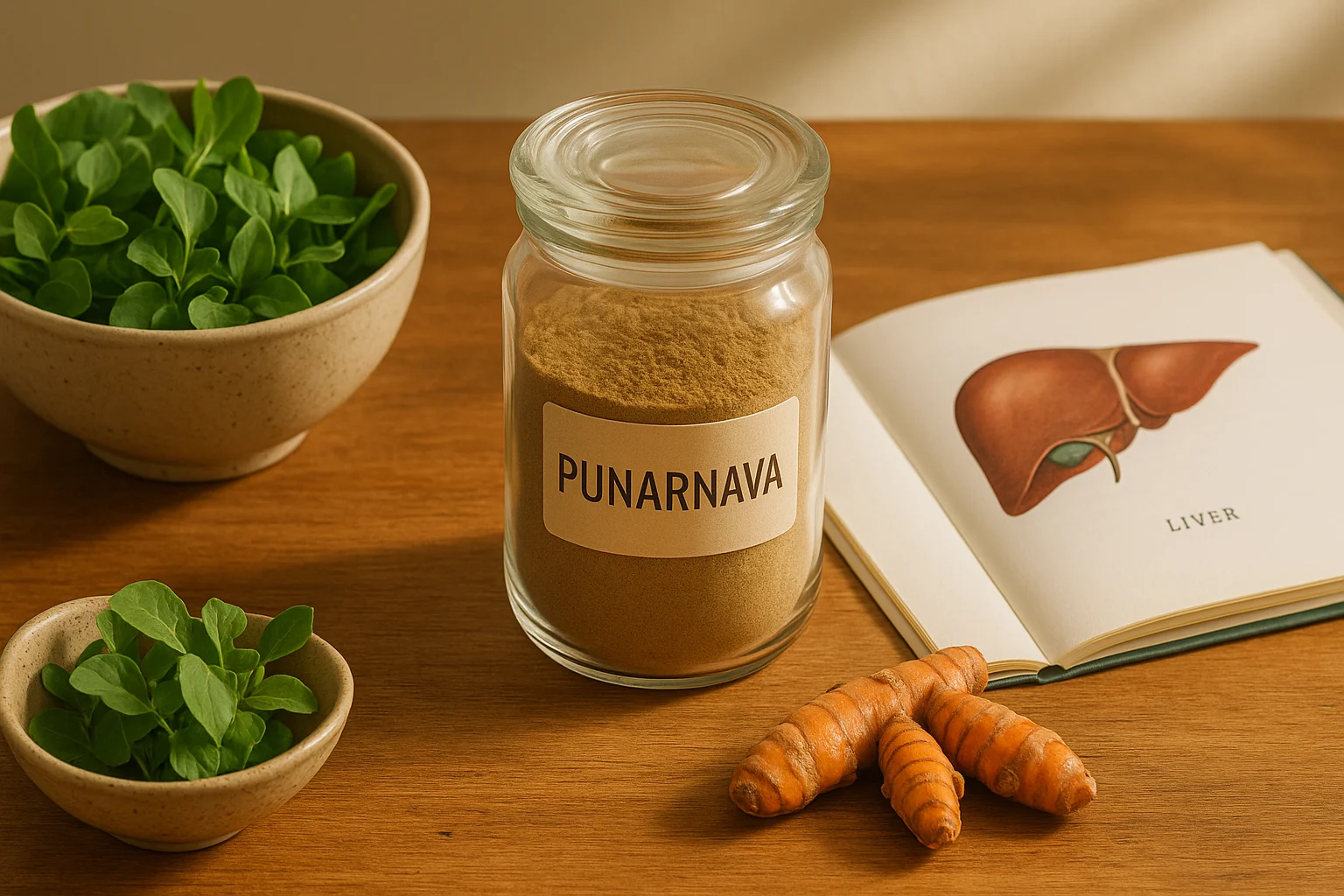
Punarnava and Heart Health: Evidence Is Preliminary
Current evidence does not establish a cardiovascular benefit in people. A 2024 study tested an isolated Boerhavia diffusa compound in a rat model of hypertension; that makes the work relevant to future research, not proof that Punarnava lowers blood pressure in humans (Pharmaceutics, 2024).
Antioxidant findings from laboratory or animal studies also do not by themselves demonstrate long-term cardiovascular protection. If you have a heart condition or take blood-pressure medication, discuss any herbal supplement with a healthcare professional rather than using Punarnava as a treatment substitute.
How Punarnava Is Sold and How to Think About Dosing
Punarnava is sold as powders, capsules or tablets, teas, and liquid extracts. Formulations can differ substantially, and a consumer product is not automatically equivalent to an extract or isolated compound tested in research. NCCIH similarly cautions that supplements sold in stores or online may differ from products used in studies (NCCIH).
Common forms
- Powder (churna): Loose powdered herb; preparation directions vary by product.
- Capsules or tablets: Premeasured forms, but extract strength and serving size vary.
- Tea: Dried Punarnava may be prepared as an herbal infusion; strength depends on the product and preparation.
- Liquid extracts: Concentration varies, so follow the specific product label rather than a generic drop count.
There is no one evidence-based Punarnava dose
I could not verify one evidence-based human dose that can be generalized across Punarnava powders, extracts, capsules, and the health goals discussed here. Follow the specific product label and ask a qualified clinician or pharmacist before use if you take medication or have kidney, heart, liver, or fluid-balance concerns.
Most punarnava listings never name a species. Banyan Botanicals’ powder states Boerhavia diffusa — which plant you have, not how much to take.
Do not convert doses from animal studies into a human supplement dose. Research extracts, plant parts, concentrations, and consumer products are not interchangeable.
If you are more interested in beverage-style herbal routines than concentrated powders or extracts, our guide to Ayurvedic teas is the more relevant next step.
Punarnava Safety: What Is Known and Unknown
Human safety data specific to Punarnava are limited, so it is more accurate to focus on uncertainty than to call the herb broadly “well tolerated.” FDA and NCCIH both advise discussing dietary supplements with a healthcare professional because supplements can interact with medicines, matter in the setting of medical conditions, and create problems around surgery (FDA; NCCIH).
Who should pause and ask first?
- Pregnancy or breastfeeding: Punarnava-specific human safety evidence is inadequate. NCCIH notes that many dietary supplements have not been well tested in pregnant or nursing people.
- Kidney, heart, liver, or fluid-balance conditions: Do not use an herbal supplement to self-treat these conditions without medical guidance.
- Prescription or over-the-counter medicines: Review Punarnava with a clinician or pharmacist because herb–drug interactions may be incompletely studied.
- Before surgery: Tell the surgical and anesthesia team about all supplements well in advance. NCCIH notes that some clinicians advise stopping herbal supplements several weeks before elective surgery, but the timing should come from your healthcare team rather than a universal “two-week” rule.
- Children: I could not verify a well-established pediatric dose or safety standard for Punarnava.
Side effects and interactions
Punarnava-specific human adverse-effect and interaction data are sparse. I could not verify strong clinical evidence for a Punarnava-specific interaction list covering diuretics, blood-pressure medicines, or blood thinners. That does not prove there is no interaction.
If you develop a concerning reaction after taking a supplement, stop using it and seek medical advice. FDA advises consumers to review supplements with a doctor, pharmacist, or other healthcare professional when medicines are involved.
Frequently Asked Questions About Punarnava Benefits
Bottom Line: Tradition Is Stronger Than the Human Evidence
If you came here for a simple yes-or-no answer, this is the useful one: Punarnava has longstanding Ayurvedic uses and interesting preclinical research, but current evidence does not establish it as a treatment for kidney disease, liver problems, swelling, inflammation, or high blood pressure.
Use the research as context—not as a reason to self-diagnose or copy a study dose. If a symptom or diagnosed condition is driving your interest, the useful next step is to address that problem directly with a qualified clinician or pharmacist before deciding whether Punarnava belongs in your routine.