MBSR is an eight-week commitment, not a drop-in meditation class. A standard course includes weekly sessions, an all-day session, and substantial home practice. Before you compare NYC programs, make sure that rhythm can fit your real week.
If you’re comparing mindfulness-based stress reduction (MBSR) programs in NYC, this guide gives you current program options and a practical way to compare course structure, teacher preparation, format, and cost. For mindfulness practices without the full MBSR structure, see our mindfulness practices for stress relief.
See Current NYC MBSR OptionsTable of Contents
- What Is Mindfulness-Based Stress Reduction (MBSR)?
- What an 8-Week MBSR Course Requires
- Find Your MBSR Course Fit
- Where to Find MBSR Programs in NYC
- What MBSR Costs in NYC
- What MBSR May Help With
- Frequently Asked Questions
- Choose the MBSR Course You Can Actually Complete
What Is Mindfulness-Based Stress Reduction (MBSR)?
Mindfulness-Based Stress Reduction (MBSR) is the structured eight-week program Jon Kabat-Zinn developed at UMass Memorial Medical Center in 1979. The current UMass program combines weekly group classes, mindfulness practice, an all-day session, and daily home practice.
At its core, MBSR trains present-moment awareness without immediately judging or reacting to what you notice. The aim is not to stop thoughts; it is to build a different relationship with thoughts, emotions, sensations, and stress.
How MBSR Differs from General Mindfulness Practices
MBSR follows a defined course structure. General mindfulness can be much lighter and may mean a short meditation, mindful eating, or a few minutes of deliberate attention.
- General mindfulness: flexible practices you can use on their own.
- MBSR: an eight-week course with sitting practice, body scan, mindful movement, group learning, home practice, and an all-day session.
For the program’s current description and history, see UMass Memorial Health’s MBSR program.
What an 8-Week MBSR Course Requires
A full MBSR course is a meaningful time commitment. The current UMass program lists eight weekly classes of about 2.5 hours, one all-day class, and daily home practice of about 45–60 minutes.
The 8-Week MBSR Program
- Weekly Classes (about 2.5 hours): live instruction, guided practice, discussion, and learning as a group.
- Guided Practices: body scan, sitting meditation, mindful movement, and other awareness exercises.
- Group Dialogue: time to reflect on practice and how it meets daily life.
- Teaching: guidance on mindfulness, stress, and applying the practices between sessions.
- Home Practice: the current UMass course asks for about 45–60 minutes a day.
- All-Day Session: one extended practice day, typically scheduled during the course.
Key Mindfulness Practices
Core practices you are likely to encounter include:
- Body Scan: bring attention through the body and notice sensations without needing to change them.
- Sitting Meditation: practice noticing breath, sensations, thoughts, and emotions as they arise.
- Mindful Movement: gentle movement used as an awareness practice; our mindful movement guide gives more background.
- Walking Meditation: bring attention to the experience of walking; see our walking meditation guide.
- Informal Practices: apply deliberate attention to ordinary moments such as eating, listening, or commuting.
Once that commitment is clear, the next decision is practical: which format and constraint matter most when you compare programs?
Find Your MBSR Course Fit
Answer three quick questions to get a practical starting point for comparing NYC or live-online MBSR options. This tool is about course fit and logistics; it does not assess whether MBSR is appropriate for a health condition.
Can you realistically make the weekly sessions, home practice, and all-day session?
How would you prefer to attend?
What matters most when you compare courses?
0 of 3 answered. Choose your first answer to start.
Where to Find MBSR Programs in NYC
Program details checked: August 10, 2026. MBSR schedules, fees, screening requirements, and enrollment status can change, so verify the provider page before you register.
- NYU Langone Psychiatry Associates: currently lists a Mindfulness-Based Stress Reduction group as accepting new patients, meeting Mondays at 7:00 p.m. Check NYU Langone’s current group listing.
- New York Insight Meditation Center: runs ongoing MBSR classes in New York City. Cohort availability changes, so use the center’s current MBSR page to find the next open group. Check New York Insight’s MBSR course page.
Online vs. In-Person MBSR
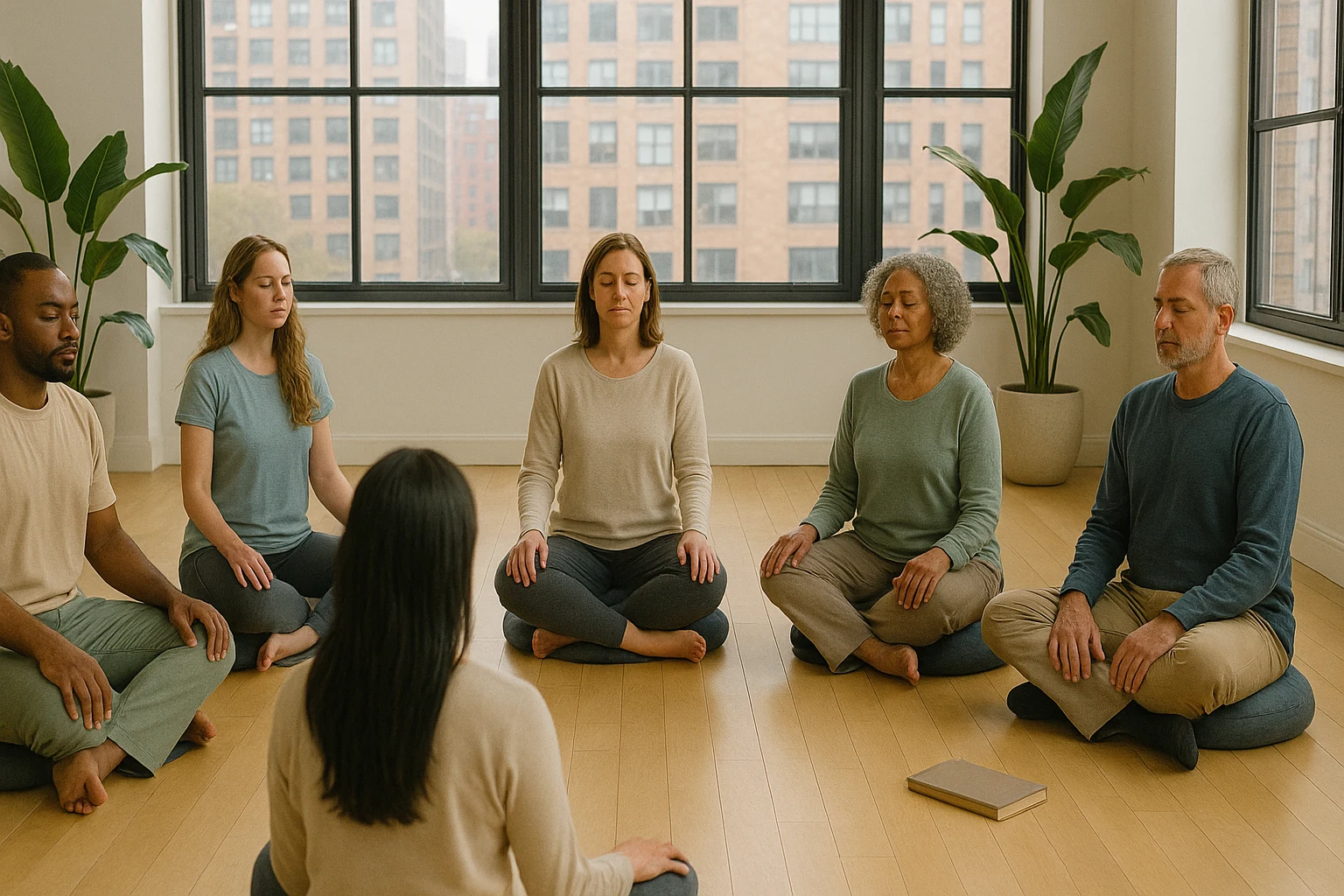
In-person classes add a real commute and a local room of people; live-online classes remove the commute but still require scheduled attendance and substantial home practice. Brown University is not an NYC provider, but its current eight-week MBSR course offers a useful live-online alternative when commuting is the main barrier. Review Brown’s current MBSR course. Choose the format that makes it more likely you will actually attend the full course, not simply the one that sounds more convenient today.
How to Compare MBSR Programs
Not every mindfulness class in NYC is a full MBSR course. If you are comparing broader stress reduction classes with MBSR programs, first confirm that the course follows the full eight-week MBSR structure rather than a shorter or more general mindfulness format.
- Check teacher training: ask how the teacher trained specifically in MBSR. Brown’s current pathway includes formal coursework, personal practice, progressively more advanced teaching practice, retreats, and teaching requirements. See Brown’s MBSR teacher-training curriculum.
- Check the course structure: compare the schedule with the standard eight weekly classes, an all-day session, and substantial home practice.
- Consider the real commute: a course across town can become harder to sustain once work, weather, and evening travel are part of the week.
- Ask about costs: confirm the total fee and whether sliding-scale pricing or financial assistance is available.
- Use an orientation when offered: it is a useful place to ask about expectations, attendance, practice time, and whether the group format feels workable.
What MBSR Costs in NYC
As of August 10, 2026, there is not one stable NYC-wide MBSR price, and NYU Langone’s current public group listing does not publish a fee. For current benchmarks, Brown lists its eight-week course at $599 online and $650 in person, while UMass Memorial Health lists its eight-week online MBSR program at $650. NYC providers may price differently, so use these as reference points rather than a local price range.
Before enrolling, ask the NYC provider for the current total fee, what it includes, whether an orientation or all-day session is included, what happens if you miss a class, and whether sliding-scale or financial-assistance options are available. UMass and Brown publish their current course structures and tuition.
What MBSR May Help With
MBSR and related mindfulness approaches have been studied for stress, anxiety, mood, sleep, blood pressure, and pain. The evidence is not equally strong for every outcome, so it is more useful to read these as possibilities than promises. The National Center for Complementary and Integrative Health summarizes both benefits and important study limitations.
| Area | What the evidence suggests |
|---|---|
| Stress and anxiety | Mindfulness-based approaches can reduce symptoms for some people, although results and study quality vary. |
| Mood | Some reviews find benefits for depression symptoms, but mindfulness is not a substitute for appropriate mental-health care. |
| Sleep and blood pressure | There is evidence of possible benefit, but effects are not uniform and mindfulness may not outperform established treatments. |
| Pain and chronic conditions | Mindfulness may help some people cope with pain or improve short-term outcomes in specific conditions; the evidence varies by condition. |
If you are considering MBSR for anxiety, depression, chronic pain, or another health concern, use the course as education and support—not as a replacement for treatment recommended by an appropriate healthcare professional.
Frequently Asked Questions
Choose the MBSR Course You Can Actually Complete
The strongest MBSR option is not automatically the closest, cheapest, or most impressive-sounding one. Start with the current NYC program options, then compare schedule, home-practice expectations, teacher preparation, format, and total cost side by side. Rule out any course you cannot realistically attend for the full eight weeks. If the local options do not fit, a live-online course may be a better choice than forcing a commute that already looks hard to sustain.