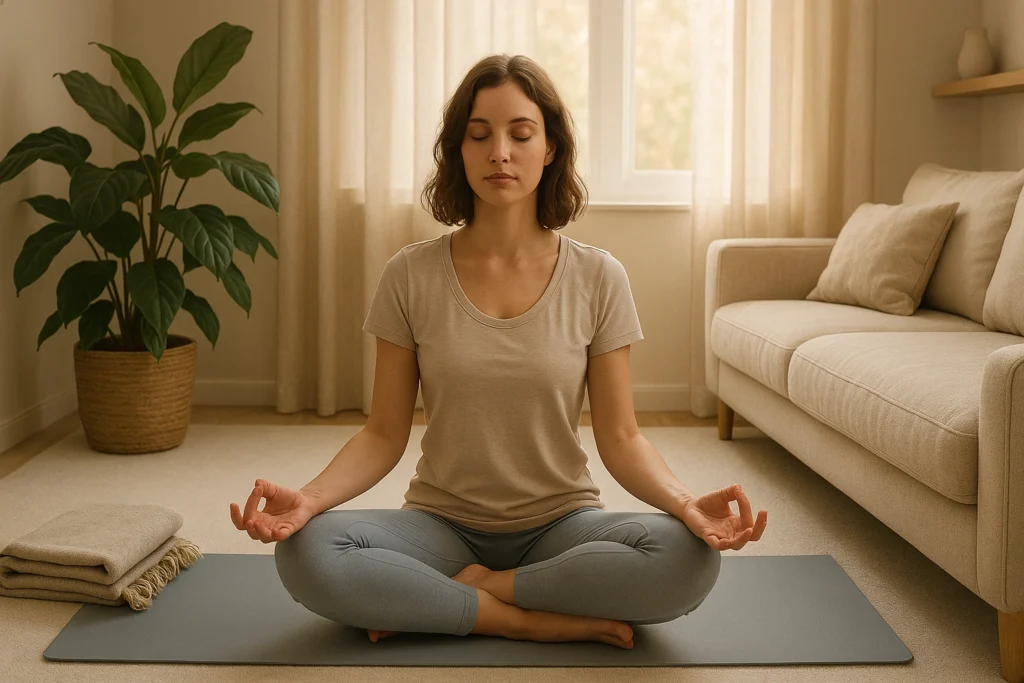
Distraction often feels like a motivation problem, but the practical issue is simpler: your attention keeps leaving the task. Mindfulness techniques for focus give you a repeatable way to notice that drift and return to one chosen anchor without turning the reset into another project. Use the selector below if you want a quick starting point, or read the five practices to choose for yourself.
Choose a Focus PracticeTable of Contents
- What Mindfulness Can and Can’t Do for Focus
- What the Research Says About Mindfulness and Attention
- Choose a Mindfulness Technique for Focus
- 5 Mindfulness Techniques for Focus
- When Mindfulness Practice Feels Difficult
- Mindful Productivity Without Adding More Work
- Frequently Asked Questions
- Pick One Practice and Practice the Return
What Mindfulness Can and Can’t Do for Focus
Mindfulness does not create perfect concentration on command. It gives you a way to practice the moment between noticing distraction and choosing where your attention goes next.
- Notice drift sooner: Catch the moment your mind moves to a tab, thought, sound, or worry.
- Return deliberately: Bring attention back to one chosen anchor instead of treating wandering as failure.
- Reduce unnecessary switching: Give one task, breath, sound, or movement your full attention for a short period.
Think of these techniques as attention practice, not an instant productivity fix.
What the Research Says About Mindfulness and Attention
Mindfulness means bringing attention to present-moment experience with an open, non-reactive stance. For focus, the useful skill is not never getting distracted; it is noticing distraction and returning.
In two small experiments with meditation-naive college students, a 2018 study in Frontiers in Human Neuroscience found better performance on specific attention tasks after a 10-minute guided mindfulness exercise than after a control activity. The authors also described important limits and variation between participants. The useful takeaway is cautious: a brief practice may help attention in some contexts, but it does not justify promises that one minute will instantly reset everyone’s brain.
That is why the practices below stay with observable actions—choose one anchor, notice when attention leaves it, and return—rather than broad claims about “rewiring” the brain.
If you are not sure which practice to start with, use the selector next. It matches the time you have with the situation you are dealing with.
Choose a Mindfulness Technique for Focus
Choose how much time you have and which situation sounds closest to yours. Your available time is a ceiling, not a target—you do not need to fill it.
Answer both questions to get a focus practice.

5 Mindfulness Techniques for Focus
These five concentration practices all use the same basic move: choose an anchor, notice when attention leaves it, and come back. The best option is the one that fits your situation and the time you actually have.
1. Focused Attention Meditation
Choose one anchor—often the breath, but sound or physical contact points can work too. Each time you notice that attention has wandered, gently return to that anchor.
Best when: your mind keeps drifting before deep work, during study, or in the middle of a scattered day.
- Sit or stand in a position you can maintain without strain.
- Choose one breath sensation, sound, or contact point as your anchor.
- When you notice a thought, sound, or urge pulling you away, name it briefly if that helps.
- Return to the anchor and repeat for 1–20 minutes, or stop sooner if a shorter reset is more useful.
If closing your eyes makes you sleepy or uncomfortable, keep them softly open and use a visual point instead.
2. Pomodoro with Mindful Breaks
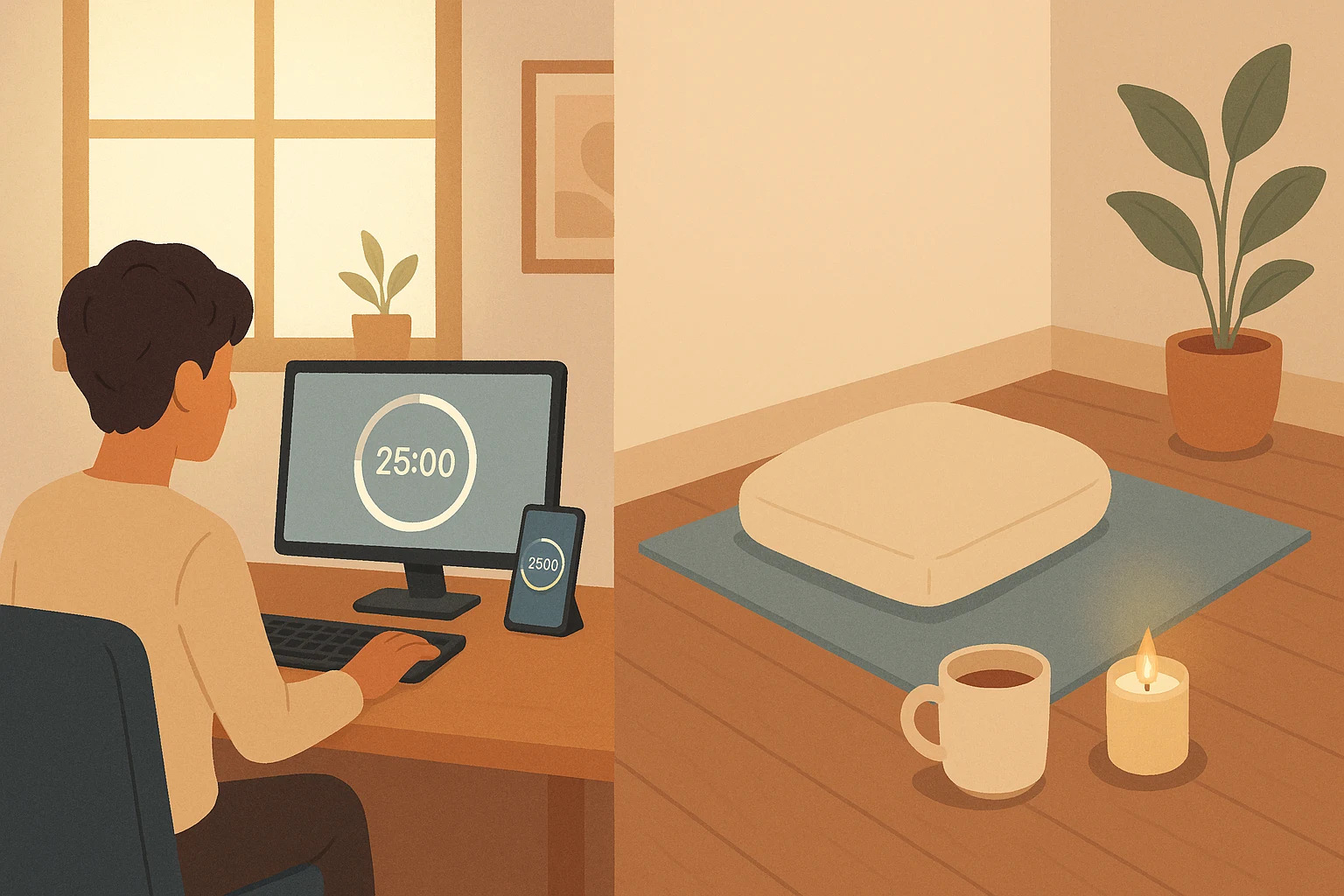
The Pomodoro Technique gives focus a clear container: one 25-minute work block followed by a short break. Making that break screen-free keeps it from becoming another stream of input.
Best when: you keep switching tabs, procrastinating on one large task, or losing track of where a work session starts and ends.
- Choose one task and define what “done for this block” means.
- Work on that task for 25 minutes.
- Take a 5-minute break without replacing work with another feed or inbox.
- Use the break for breathing, stretching, looking away from the screen, or noticing one physical sensation.
3. Visual Concentration
Use one steady visual point—a small object, a mark on the wall, a plant leaf, or a candle flame—as the anchor. The practice is the return to that point, not forcing yourself to stare without blinking.
Best when: you want a simple sensory anchor or the breath feels too subtle to hold your attention.
- Choose a stable object at a comfortable viewing distance.
- Let your gaze rest softly on one detail.
- Blink naturally and notice when your eyes or thoughts pull away.
- Return without straining. Stop if your eyes feel uncomfortable.
If you use a candle, place it on a stable surface and treat it like any other open flame; a non-flame object works just as well for this attention exercise.
4. Single-Task Eating or Walking
Single-task practice turns something you were already going to do into a mindfulness exercise. It is especially useful when a separate seated session feels like one more item on the list. For deeper guides, see mindful eating exercises or a mindful walking meditation.
Best when: you are restless, rushed, or more likely to practice during an ordinary routine than in a formal meditation session.
Mindful eating:
- Put away the extra screen or audio for a few minutes.
- Notice color, smell, texture, temperature, and taste.
- When your attention leaves the meal, return to the next bite or sensation.
Mindful walking:
- Notice the contact of each foot with the ground.
- Let sounds, sights, and breath register without trying to chase each one.
- When you get lost in thought, return to the next step.
5. Mindful Listening
Use sound as the anchor. You can listen to another person, music, or ambient noise and practice noticing when your attention moves away from what you are hearing.
Best when: you want a non-visual anchor, need to reset after screen time, or want to be more present in a conversation.
- Choose one sound source or one speaker.
- Notice details such as words, tone, pitch, rhythm, distance, or pauses.
- When your mind starts rehearsing a response or following another thought, return to listening.
Quick Comparison of the Five Practices
| Technique | Start With | Useful When |
|---|---|---|
| Focused Attention Meditation | 1–20 min | Mind wandering, pre-work reset |
| Pomodoro + Mindful Break | 25 + 5 min | Task switching, long work blocks |
| Visual Concentration | 1–5 min | Sensory overload, screen reset |
| Single-Task Eating/Walking | 5–15 min | Restlessness, everyday routines |
| Mindful Listening | 2–10 min | Conversations, noisy spaces, screen fatigue |
When Mindfulness Practice Feels Difficult
- Your mind keeps wandering: that is not a failed session. Noticing the drift and returning is the practice.
- Sitting feels like more work: use mindful walking, eating, or listening instead of forcing a seated exercise.
- You keep reaching for another tab or app: make one break deliberately screen-free, then return to a single task.
If stress is the main thing pulling your attention away, the mindfulness stress relief guide may be the better next step.
Mindful Productivity Without Adding More Work
Mindful productivity works best when the practice reduces switching instead of becoming another habit to manage. Attach it to moments that already exist in your day:
- Before one demanding task: take 1–3 minutes to settle on a breath, sound, or visual anchor.
- Between work blocks: use a screen-free break instead of replacing one stream of input with another.
- During a routine: turn walking, eating, or listening into the practice rather than scheduling a separate session.
Pick one cue and repeat it for a few days before adding another technique. The point is a reliable return to attention, not a bigger mindfulness checklist.
Frequently Asked Questions
If your Pomodoro break is already a stretch break, the routine below gives you a ready-made 10-minute sequence instead of improvising one each time.
A Chair-Yoga Routine for Stiff Mornings
Confirm to get the routine and yoga tips. Unsubscribe anytime.
Something went wrong. Please check your email address and try again.
Pick One Practice and Practice the Return
Choose the smallest technique you can use in a real moment today. If your mind is wandering, try a breath or sensory anchor; if tabs keep multiplying, use one Pomodoro block with a screen-free break; if you need a sensory reset, use visual focus, listening, or walking. The goal is not perfect concentration—it is noticing the drift and choosing where attention goes next.
If you are still deciding, use the focus-practice selector and take the result straight to the matching steps.