The benefits of neem oil for skin are often presented as a long list—acne, eczema, fungus, dark spots, wrinkles. The evidence is much narrower. The clearest cosmetic role for plain neem seed oil is moisture support on intact skin; the stronger treatment claims mostly come from traditional use, laboratory work, extracts, or finished formulations rather than trials of pure neem oil.
That makes the decision simpler. If your goal is dryness or general cosmetic skin care and your skin is calm, a label-following, small-area trial may be reasonable. If you are trying to treat an active flare, suspected infection, painful or scarring acne, or broken skin, neem is a poor DIY bet. My rule for this guide is cosmetic oil, not a skin treatment.
I’ll show what neem may reasonably offer, which popular claims overreach, what the actual product directions say, and how to decide whether to test it or skip it. For wider Ayurveda context, see the Ayurvedic wellness guide.
Check Whether Neem Oil Fits Your Skin GoalThis page contains Amazon affiliate links. As an Amazon Associate, I earn from qualifying purchases. If you purchase through an affiliate link, I may earn a commission at no extra cost to you. Learn more.
Table of Contents
- Quick Answer: Where Neem Oil Fits—and Where It Doesn’t
- Benefits of Neem Oil for Skin: What the Evidence Supports
- Risks, Reactions, and When to Skip Neem Oil
- How to Try Neem Oil Cautiously in Ayurvedic Skin Care
- Before You Try Neem Oil: Patch-Test, Pause, or Skip?
- Frequently Asked Questions
- Bottom Line: When Neem Oil Is Worth Trying—and When to Skip It
Quick Answer: Where Neem Oil Fits—and Where It Doesn’t
| If you’re considering neem for… | Best-supported takeaway |
|---|---|
| Dryness or rough-feeling skin | The most defensible use is cosmetic moisture support on intact skin. Follow the exact label and test a small area before wider use. |
| Acne or breakouts | Research on neem compounds and a finished neem face wash does not prove that pure neem oil treats acne. Do not keep increasing concentration or frequency to chase a treatment effect. |
| Eczema, psoriasis, or reactive skin | Do not use neem oil as a flare treatment. Allergic contact dermatitis has been reported, including during an atopic-dermatitis flare. |
| A suspected fungal infection or unexplained rash | Laboratory antifungal activity is not a home-treatment plan. Get an appropriate diagnosis instead of relying on neem oil. |
| Dark spots or fine lines | Human evidence for pure neem oil fading pigmentation or reversing visible aging is lacking. Moisturizing dry skin may make it look temporarily smoother. |
Benefits of Neem Oil for Skin: What the Evidence Supports
Neem oil is pressed from the seeds of Azadirachta indica and has a long history in Ayurvedic skin care. Modern research has identified antimicrobial, anti-inflammatory, and antioxidant activity in neem compounds, but much of that evidence comes from laboratory, preclinical, extract, or finished-formulation research rather than trials of pure neem oil used on common skin conditions. A dermatology review describes the potential while also pointing to the need for stronger clinical evidence. Traditional use can explain why people try neem; it does not by itself prove that pure neem oil treats a skin disease.
Moisture Support for Dry Skin
This is the clearest cosmetic use in the sources checked. The manufacturer of the verified NOW Solutions neem oil describes it as a fatty-acid-rich oil intended to support comfortable, healthy-looking skin. That makes dryness or rough-feeling skin a more defensible reason to try neem than treating a diagnosed condition.
- For dry areas: Follow your product’s directions and start with a small amount on intact skin.
- For a routine: Adding a few drops to a moisturizer can be simpler than building a multi-ingredient DIY blend when the product label permits it.
- Expectation: An emollient oil may make skin feel softer; that is different from treating the cause of chronic dryness or inflammation.
Acne: Interesting Research, but Not Proof for Pure Neem Oil
Neem is often promoted for acne because laboratory work suggests antimicrobial and anti-inflammatory activity. Human evidence is much narrower. One clinical study evaluated a finished purifying neem face wash in mild-to-moderate acne; that result cannot be generalized to pure neem seed oil or a DIY spot treatment.
If you are acne-prone, use the article’s patch-test guidance before trying neem cosmetically. Persistent, painful, or scarring acne deserves evidence-based care rather than progressively stronger DIY neem mixtures.
Eczema and Psoriasis: Don’t Treat a Flare with Neem Oil
Moisturizing intact skin and treating eczema or psoriasis are different jobs. Pure neem oil is not established here as a flare treatment, and allergic contact dermatitis to neem oil has been reported, including a 2023 case report involving an atopic-dermatitis flare. Avoid using neem on broken, irritated, or actively flaring skin unless your clinician has specifically advised it.
Fungal Infections: Lab Activity Is Not a Treatment Plan
Neem compounds have shown antifungal activity in laboratory research, but that does not establish a home-treatment concentration or schedule for athlete’s foot, ringworm, or nail fungus. Do not rely on neem oil to diagnose or treat a suspected infection. If you have a persistent or spreading rash, painful skin, or nail changes, get an appropriate diagnosis and treatment plan.
Dark Spots and Fine Lines: Keep Expectations Cosmetic
Neem’s antioxidant profile is interesting, but claims that pure neem oil fades dark spots, preserves collagen, or reverses visible aging go beyond the human evidence used for this guide. If you’re comparing natural skin remedies, neem makes more sense here as an optional moisturizing oil that may make dry skin look temporarily smoother or more supple.
Risks, Reactions, and When to Skip Neem Oil
Neem oil can irritate skin or trigger allergic contact dermatitis. Published case reports include reactions after cosmetic use and use on atopic dermatitis. Plant-derived does not automatically mean gentle. Stop if you develop redness, itching, swelling, burning, or a rash.
Product directions also matter. The verified NOW Solutions product linked in this guide says not to apply it to broken or irritated skin, to keep it away from sensitive areas, and not to use it directly on skin for more than two weeks at a time. Other neem products may give different directions, so check the label you actually own.
How to Try Neem Oil Cautiously in Ayurvedic Skin Care
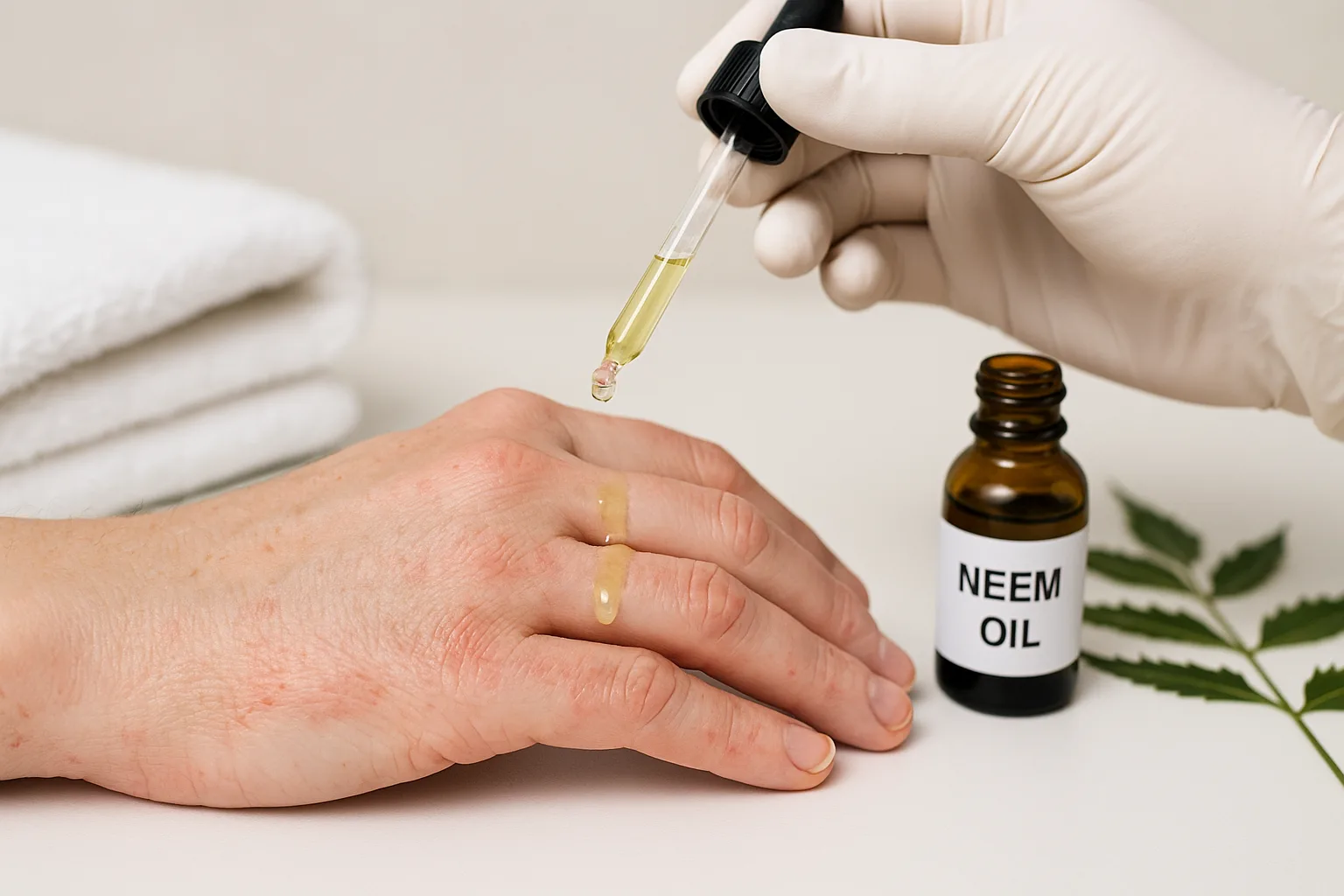
Keep the goal cosmetic and the method simple. For a simple neem oil skincare routine, start with the exact product label plus a small-area tolerance test—not a stronger DIY recipe.
Follow the Product Label, Not a Universal Dilution Recipe
There is no single dilution percentage that fits every neem product and every skin goal. For the verified NOW Solutions Neem Oil used as this post’s shopping example, the manufacturer suggests adding two or three drops to lotion, shampoo, or conditioner, or applying a few drops directly to skin. Its caution also says not to apply to broken or irritated skin and not to use it directly on skin for more than two weeks at a time. Follow the directions for the exact product you use rather than borrowing a stronger DIY formula from another source.
What to Expect from Plain Neem Oil
Plain cold-pressed neem oil has a couple of practical quirks. The National Pesticide Information Center describes neem oil as having a garlic- or sulfur-like odor, and NOW notes that its product can solidify at room temperature because of its fatty-acid content. Those traits can be normal for neem. If the smell or texture makes you want to disguise it with several other oils or fragranced products, keep the first trial simpler instead—you will have a clearer idea of what your skin is reacting to.
Patch Testing First
For a new skin-care product, the American Academy of Dermatology recommends testing a small area twice daily for seven to 10 days before wider use. Use the product the way you plan to use it. If redness, itching, swelling, burning, or another reaction appears, wash it off and stop. A home test can reduce surprises, but it cannot guarantee that a later reaction will not occur. See the dermatologist guidance.
For a cautious first trial: NOW Solutions Neem Oil 100% Pure, 1 oz.
A small, single-ingredient bottle for a cautious cosmetic trial on intact skin—not for treating a flare, infection, persistent acne, or another skin condition.
The remaining question is not how strong to make the oil; it is whether your current skin state makes a trial sensible at all. The selector below adds that context without turning the result into a diagnosis.
Before You Try Neem Oil: Patch-Test, Pause, or Skip?
Answer two quick questions. This tool does not diagnose or treat a skin condition; it helps you decide whether a cautious cosmetic patch test is reasonable or whether to pause and get better guidance.
Answer both questions to see a cautious next step.
If your result says to pause or skip, use that as a reason not to push ahead with a DIY skin treatment. The FAQ below answers common questions about face use, dilution, and expectations.
Frequently Asked Questions
Bottom Line: When Neem Oil Is Worth Trying—and When to Skip It
Neem oil makes the most sense here when the goal is modest: adding moisture or conditioning to intact skin. If that is what you want, follow the exact product label, test a small area first, and stop if your skin reacts.
If you are trying to treat acne, eczema, psoriasis, a suspected fungal infection, dark spots, scarring, or broken and irritated skin, stronger DIY neem is not the next step. The useful result of this guide is knowing when a simple cosmetic experiment is reasonable—and when to stop turning an oil into a treatment plan.