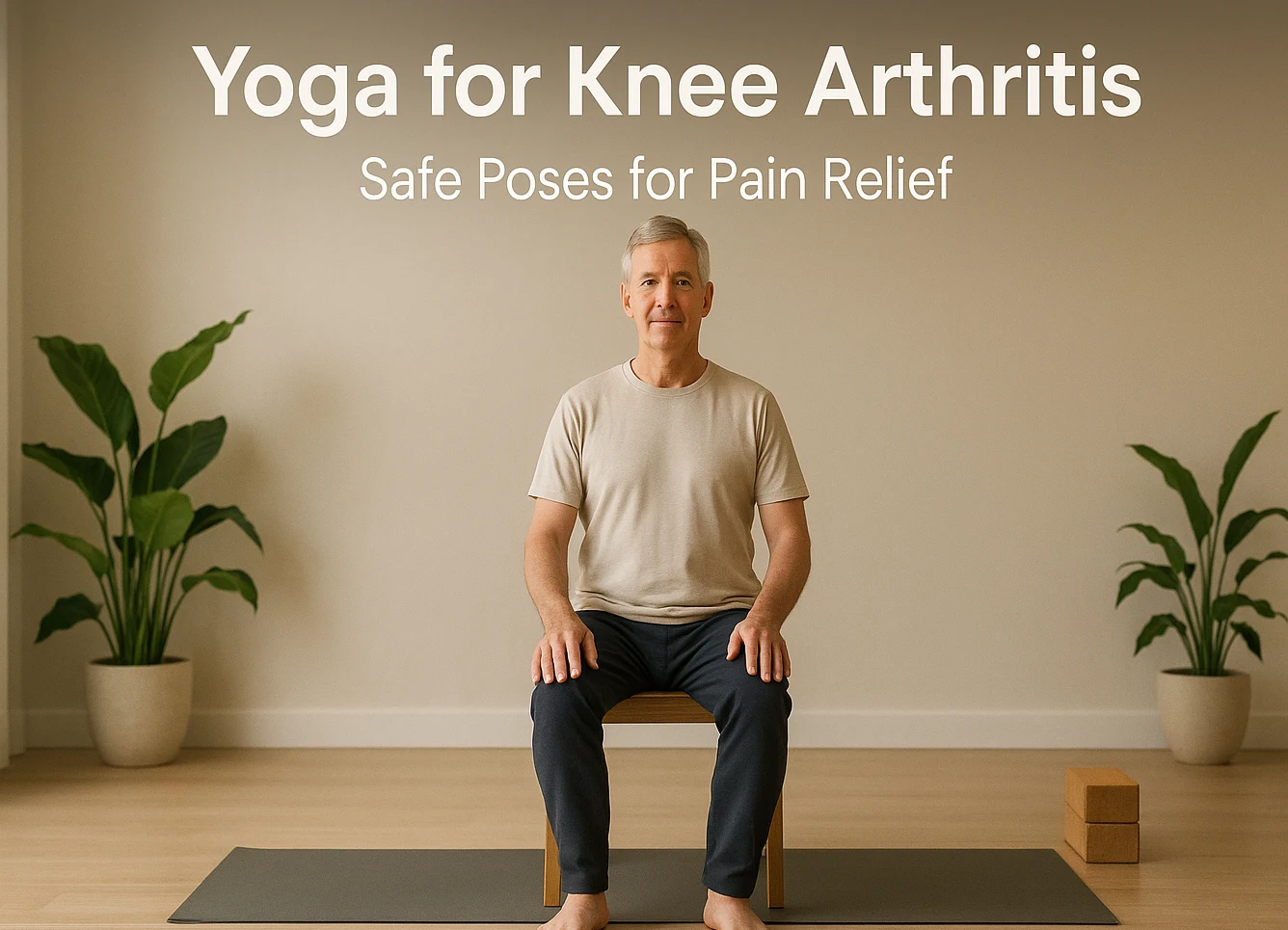
Knee arthritis can make stairs, standing up, and even the idea of exercise feel uncertain. You do not need a deep bend or a floor practice to begin. Start with a chair, wall, or supported floor position and use a range that feels manageable today.
This guide focuses on gentle yoga for knee arthritis: a chair-first routine, knee-friendly yoga modifications, and clear signs to stop or scale back. It is general movement education, not treatment. For broader guidance on adapting yoga to health conditions, see the guide to yoga for specialized health needs.
Table of Contents
- Why Movement Can Help
- Safety and Modifications
- Choose a Knee-Friendly Starting Point
- 5-Minute Chair-First Routine
- Gentle Poses and Modifications
- When to Stop or Get Medical Advice
- Make the Practice Repeatable
- Get the 10-Minute Chair Yoga Routine
- Frequently Asked Questions
- Start With Support, Then Build Gradually
Why Movement Can Help
Knee arthritis can have different causes, and most of the clinical guidance cited here is for knee osteoarthritis. Current guidance from AAOS and NICE includes therapeutic exercise as a core part of knee osteoarthritis care.
Yoga can be one way to add some of that movement when the practice is adapted to the person. The Arthritis Foundation describes modified yoga as an option that may support strength, flexibility, balance, and symptom management. For this page, the practical rule is simpler: use support when it helps, keep the range comfortable, and stop treating depth as the goal.
Safety and Modifications for Knee Arthritis
Use pain and stability as feedback, not as a challenge to overcome. Mild muscle effort or temporary soreness can happen when you build a new exercise habit, but sharp pain, increasing joint pain, or a feeling that the knee is unstable is a reason to stop or change the movement.
- Start with support: Keep a sturdy chair or wall within easy reach for standing options.
- Keep the range adjustable: Make bends shallower, shorten holds, and come out of a pose before symptoms build.
- Do not lock the knee: In standing poses, keep the leg active without forcing the joint into its end range.
- Use props for comfort: A chair, blanket, cushion, block, or strap can reduce the need to force a position. The yoga props guide shows the basic options.
- Progress gradually: There is no universal daily yoga dose for knee arthritis. Start with an amount that feels manageable and build only when your symptoms are settling well.
If your knee is newly hot or markedly swollen, you cannot bear weight, it locks or repeatedly gives way, or pain is severe, skip the routine and use the medical-guidance section below.
If you are not sure where to start, use the matcher below to compare seated, supported-standing, and floor options based on how you want to move and how the knee is responding today.
Choose a Knee-Friendly Starting Point
Answer three quick questions about how you want to move today. This does not assess arthritis severity or choose treatment; it simply points you to a more comfortable starting place in this guide. If you have sharp or increasing pain, new swelling or warmth, or the knee feels unstable, skip the matcher and review the red-flag guidance.
Step 1 of 3
A 5-Minute Chair-First Routine
If getting to the floor is difficult, this five-minute chair routine lets you try yoga for knee pain without getting down to the floor. Treat the times below as a simple structure, not a prescription; a shorter round is fine.
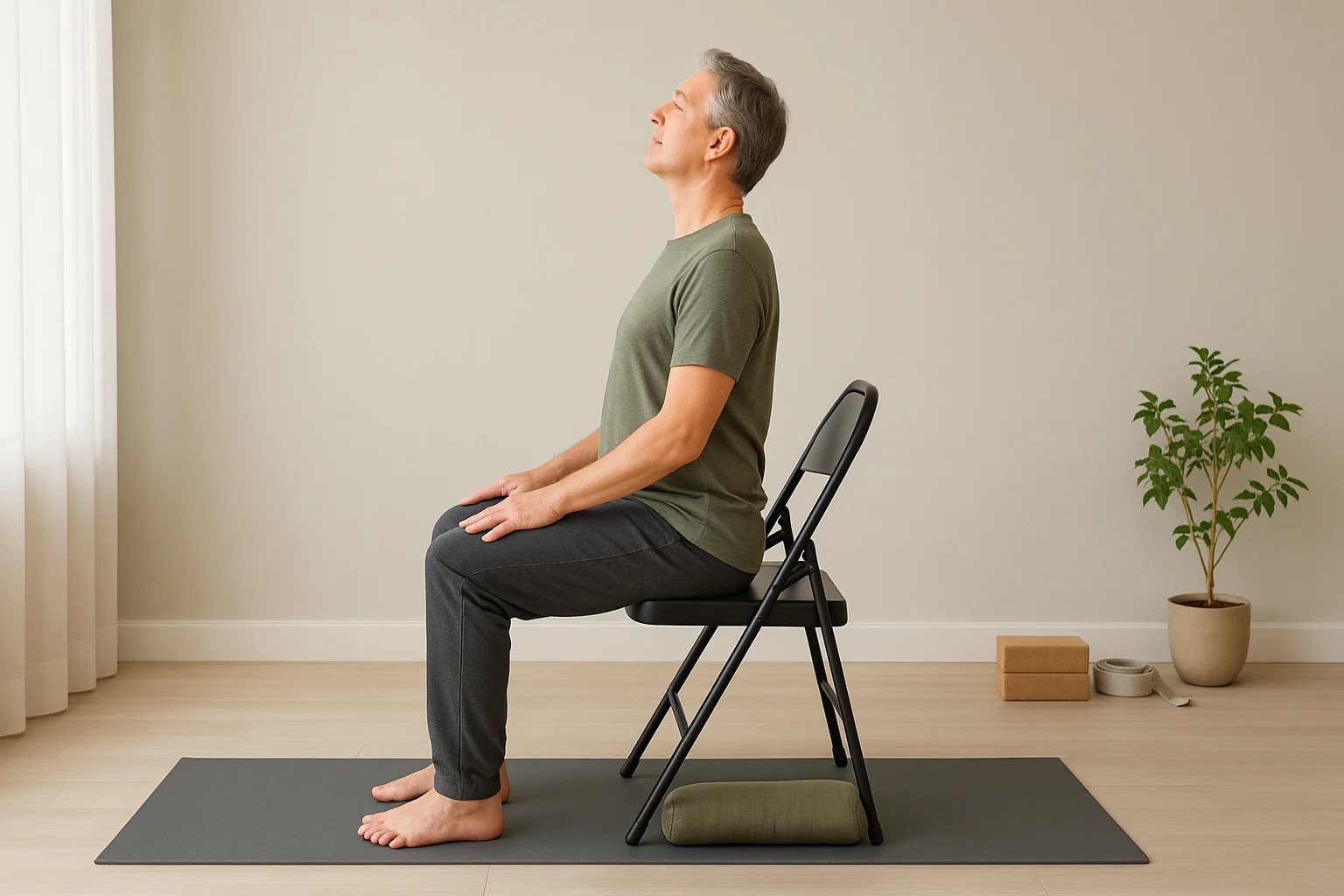
- Seated Cat-Cow — about 2 minutes: Sit with both feet supported. Gently alternate between a small chest lift and a small rounding of the upper back, letting the breath set the pace. The knee does not need to move much.
- Seated Leg Lifts — about 2 minutes: From the same chair, slowly straighten one leg only as far as it feels comfortable, then lower it with control. Alternate sides and keep the movement small enough that you do not brace or hold your breath.
- Easy seated breathing — about 1 minute: Let the feet rest on the floor, soften the shoulders, and take a few unforced breaths before you decide whether to continue.
On a more sensitive day, one seated movement may be enough. The point is to leave yourself room to repeat the practice, not to finish a checklist.
Gentle Yoga Poses and Modifications for Knee Arthritis
The options below are starting points, not a ranking of the “best” poses. Choose the position you can enter and leave comfortably, and skip any version that makes the knee feel sharper, less stable, or progressively more painful.
Supported Standing Options
- Supported Mountain Pose: Stand with feet in a comfortable stance and a wall or sturdy chair within reach. Keep the knees soft rather than locked. Make it gentler: Hold the support and make the practice about steady breathing and even footing instead of a long hold.
- Modified Chair Pose: Stand in front of a real chair, send the hips back, and bend the knees only as far as feels controlled. You can sit down fully instead of hovering. Make it gentler: Use your hands on the chair or another stable support and reduce the depth.
Floor Options — Only If Getting Down and Up Is Comfortable
You do not need the floor to make this practice count. If floor transitions are comfortable for you, these supported options can add variety.
- Supine Hamstring Stretch: Lie on your back and loop a strap around one foot. Lift the leg only until you feel a comfortable stretch, with a soft bend in the knee. Make it gentler: Keep the leg lower or bend the knee more.
- Bridge Pose: Lie on your back with knees bent and feet planted. Lift the hips only a small amount if that feels comfortable at the knees. Make it gentler: Keep the lift low or skip it if bending the knees feels pinchy or more painful.
- Supported Savasana: Rest on your back with a pillow, folded blanket, or bolster under the knees. Make it gentler: Change the support height until the legs feel held rather than stretched.
When to Stop or Get Medical Advice
Some temporary muscle soreness can happen when you begin or increase exercise, but joint pain that becomes sharp, keeps increasing, or changes how stable the knee feels is different. Back out of the movement rather than trying to push through it.
Scale the Practice Down
- The knee feels progressively more painful as you continue.
- You need to brace, hold your breath, or rush to get out of a position.
- A standing pose turns into a balance challenge instead of a controlled movement.
- Symptoms remain clearly worse instead of settling after you reduce the load.
Get Medical Advice for Concerning Changes
The NHS knee-pain guidance advises urgent assessment for problems such as very severe pain, inability to move the knee or put weight on it, major swelling or deformity, locking or giving way, and a hot/red knee with fever or feeling unwell. New or worrying symptoms deserve medical assessment even when they do not fit neatly into a yoga checklist.
Make the Practice Repeatable
A useful knee-friendly yoga habit is one you can adjust from day to day instead of forcing the same routine every time.
- Keep support ready: Put the chair, wall space, strap, or cushion in place before you start.
- Build gradually: Increase time, range, or challenge one step at a time and only when your current version is settling well.
- Stay seated when that is the better fit: The seated-yoga beginner guide gives you more no-floor options.
- Use home practice when it removes friction: A simple no-equipment yoga routine can help you keep the setup uncomplicated.
- Recheck instead of assuming: Run the starting-point matcher again on a different day if your easiest position or goal has changed.
If chair-first is the version you are most likely to repeat, this free 10-minute routine gives you a longer seated practice to keep for later.
Get the 10-Minute Chair Yoga Routine
Confirm to get the routine and yoga tips. Unsubscribe anytime.
Something went wrong. Please check your email address and try again.
Frequently Asked Questions
Start With Support, Then Build Gradually
Knee arthritis does not require you to prove anything with a deeper bend. You do not have to earn the floor—or a harder pose—to have a useful practice. Start where the knee feels most controllable today, use support early, and build only when that version is settling well.
If arthritis affects more than your knees, the broader yoga for arthritis guide can help you think through joint-friendly options elsewhere in the body.