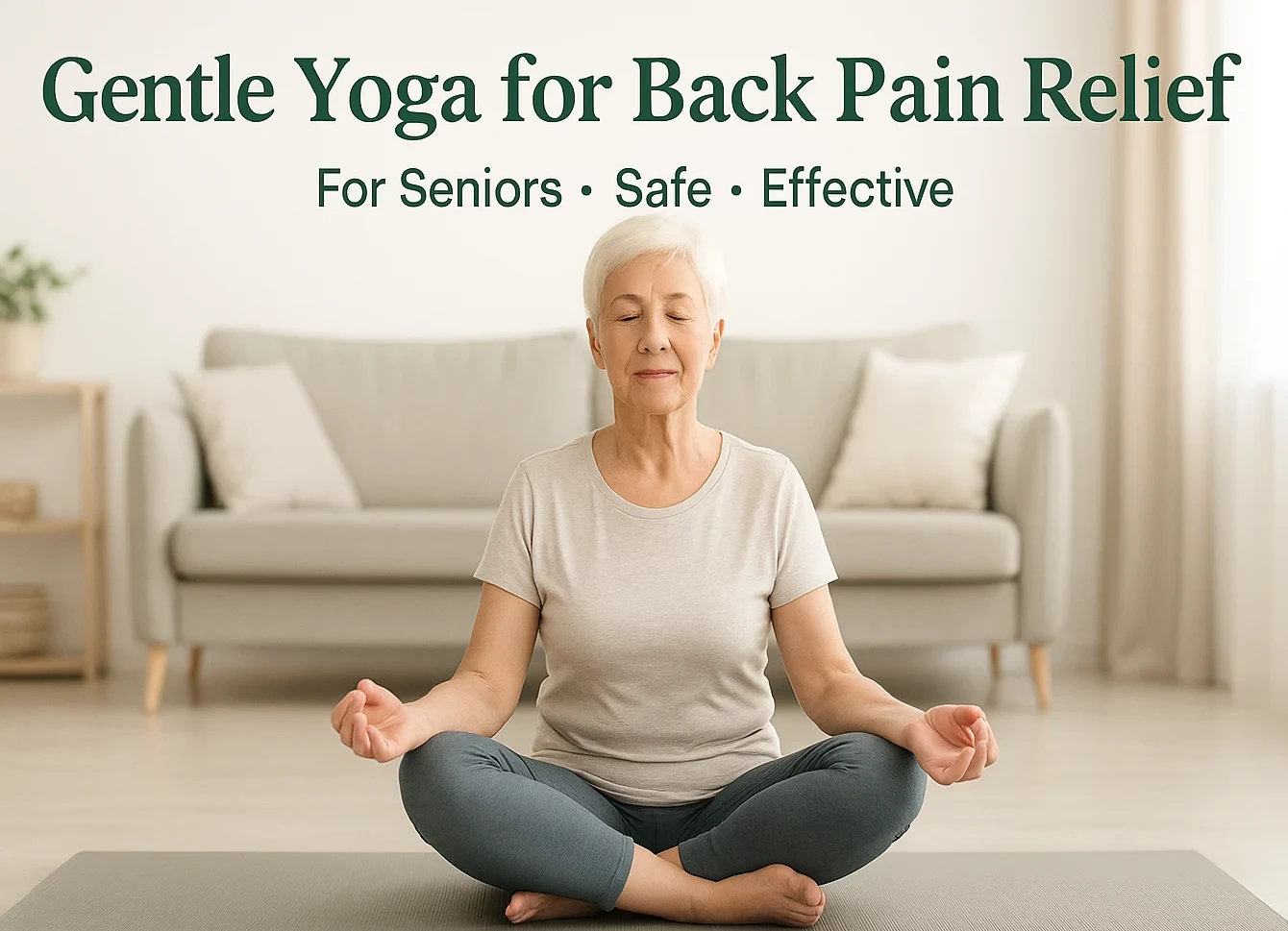
With back pain, the first question is not “How far can I stretch?” It is “What position can I get into and out of comfortably today?” This guide to yoga for back pain for seniors gives you seven options across chair, floor, and wall setups, plus a finder to narrow them by goal and setup. Yoga may help some people with chronic low-back pain, but the average benefit is modest and it is only one exercise option. A smaller, comfortable range still counts.
If you want a broader map of gentle movement for other painful areas, start with our yoga for pain relief guide.
Find a Gentle Starting PointTable of Contents
- What Yoga Can—and Can’t—Do for Back Pain
- Safety Tips for Gentle Back-Friendly Yoga
- Find a Gentle Starting Point
- Yoga for Back Pain for Seniors: 7 Gentle, Adaptable Poses
- Frequently Asked Questions
- Start With One Comfortable Option
What Yoga Can—and Can’t—Do for Back Pain
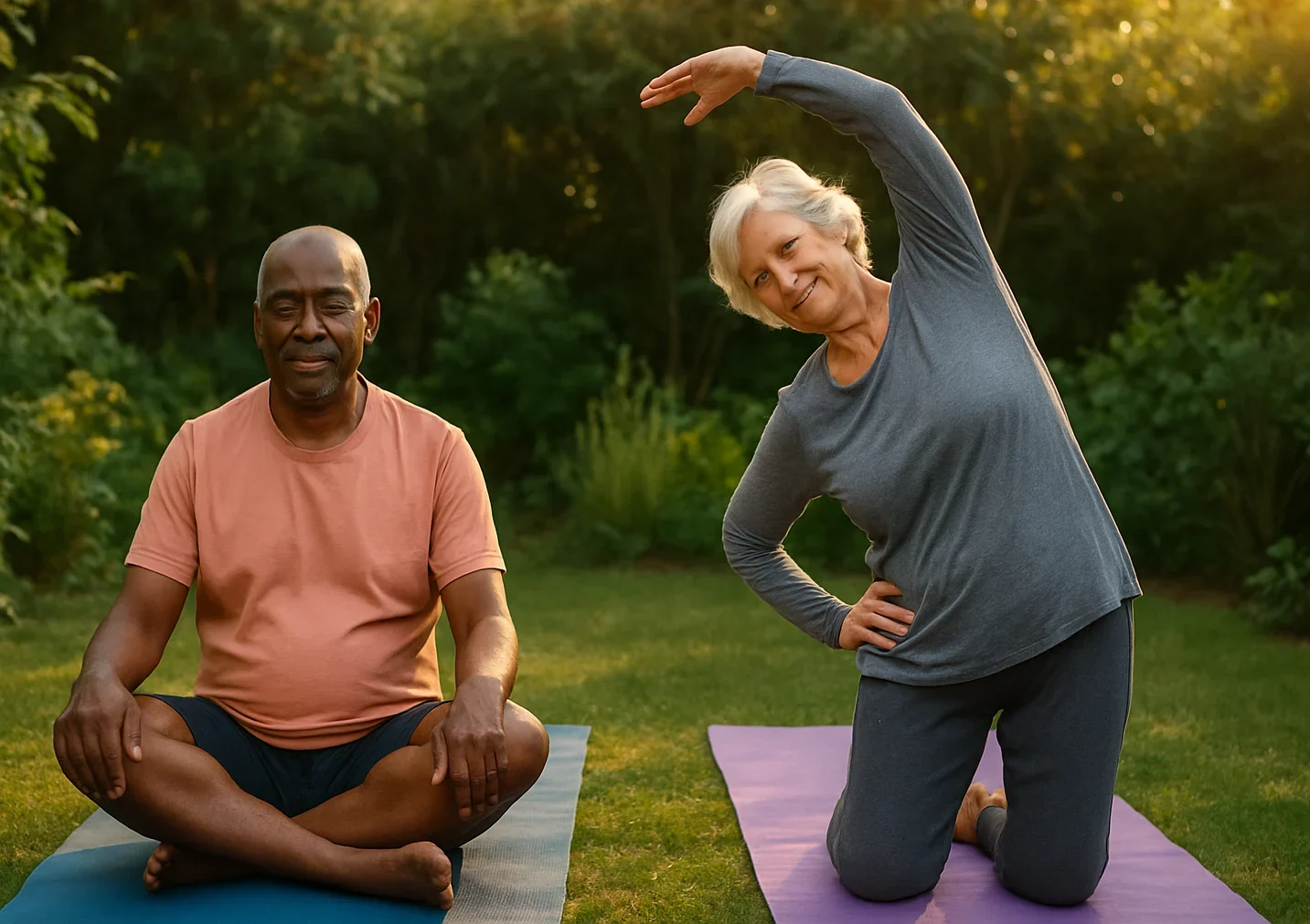
Yoga can be one way to stay active with chronic low-back pain, but it is not a uniquely effective treatment and it cannot tell you why your back hurts. The World Health Organization’s 2023 guideline on chronic primary low-back pain includes older adults and supports person-centred care that can include structured exercise. A 2022 Cochrane review found that yoga may offer small improvements compared with no exercise, while outcomes were similar to other back-focused exercise and some participants reported increased back pain. The practical takeaway is to treat yoga as one exercise option and choose movements you can tolerate rather than chasing a deeper stretch.
For this guide, the useful goals are modest and practical:
- Comfortable movement: Practice a range you can control without forcing an end position.
- Strength and coordination: Supported poses can give the trunk, hips, and legs a manageable movement challenge.
- Pacing and body awareness: Slower movement and steady breathing can make it easier to notice what feels comfortable and what does not.
If stress or general muscle tension is part of what makes movement feel guarded, the separate yoga and breathwork for stress relief guide covers the relaxation side in more detail.
Safety Tips for Gentle Back-Friendly Yoga
There is no single list of safe senior yoga poses that works for every older adult, because back pain is not one diagnosis and the right starting point depends on your symptoms and health history. NCCIH notes that older adults and people with health conditions may need to avoid or modify some yoga poses and practices. Get individualized guidance before self-directed yoga if you have recent or worsening pain, osteoporosis or a spinal fracture history, new weakness or numbness, or recent spine surgery.
- Use symptoms as feedback: Stop if a movement causes sharp, radiating, or clearly worsening pain.
- Start with a small range: A shorter, gentler version is a valid version; add range only when the movement remains comfortable.
- Make floor access optional: Use chair or wall variations when getting down or back up would make the pose harder than the movement itself.
- Use stable support: A sturdy chair, block, strap, pillow, or folded blanket can help you adapt the setup without forcing the position.
Seek urgent medical attention rather than exercising if you develop new bladder or bowel control problems, numbness around the groin or saddle area, or new or worsening leg weakness; these are recognized warning signs that need prompt assessment. The American Association of Neurological Surgeons lists these among the red flags for cauda equina syndrome.
If those checks are clear for you, the finder below can narrow the seven options by what you want help with and where you prefer to practice.
Find a Gentle Starting Point
Choose one goal, then tell the finder where you prefer to practice. It will point you to a starting option to read—not certify a pose as medically safe for you.
Skip the tool and seek urgent medical care for new bladder or bowel control changes or numbness around the groin/saddle area. New or worsening leg weakness also needs prompt medical assessment.
Choose a goal to see a starting option.
You can change the position or safety choices at any time.
Yoga for Back Pain for Seniors: 7 Gentle, Adaptable Poses
The seven poses below are the options referenced by the finder. Read the full instructions for any pose you choose, keep the range comfortable, and treat the modification as the normal version when it fits your body better. If you have osteoporosis or a spinal fracture history, recent spine surgery, or new or worsening numbness or weakness, use individualized guidance rather than selecting from this list. If a general fully seated routine fits your situation, the free chair yoga PDF gives you a screen-free option.
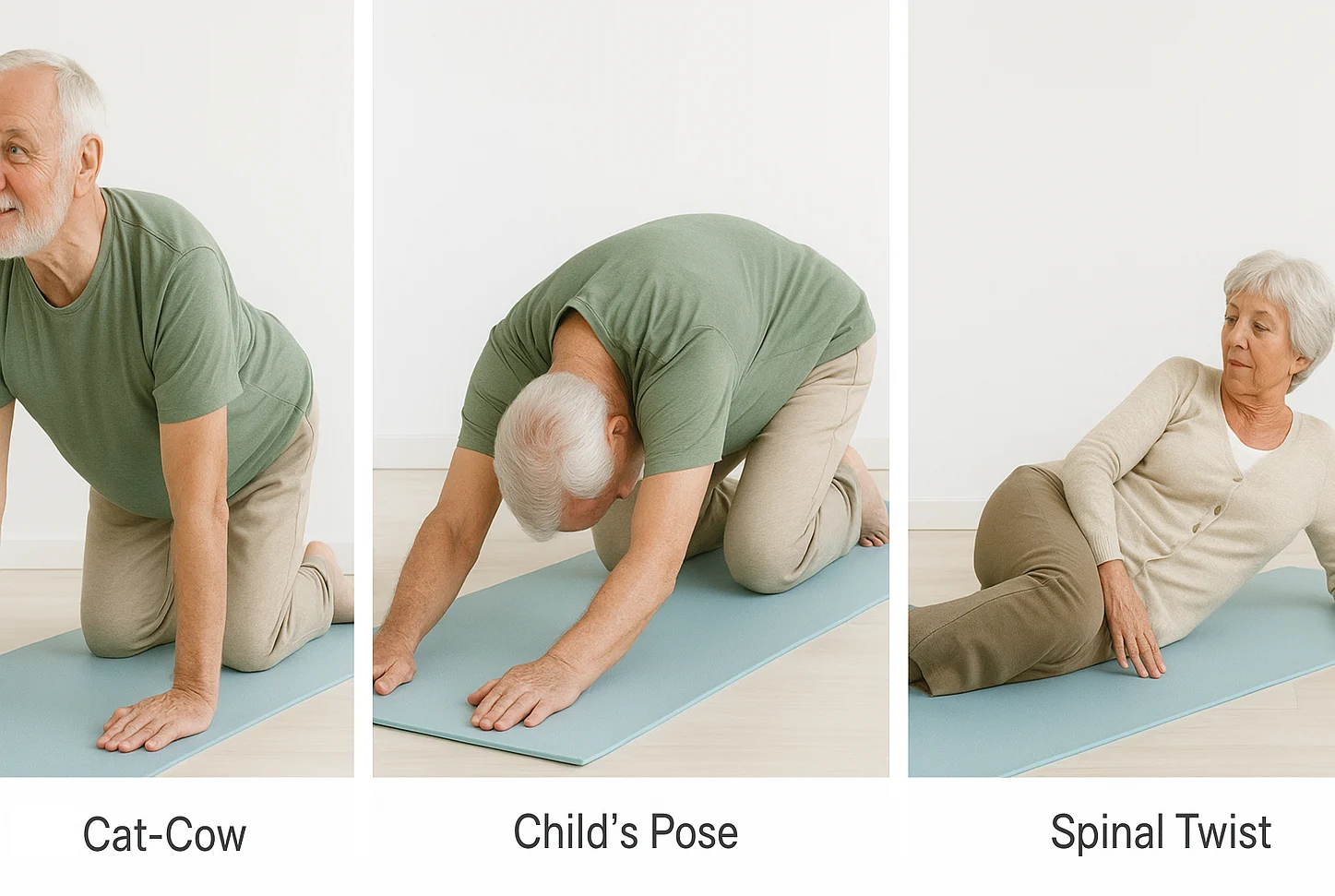
Cat-Cow (Chair or Floor)
Why it may fit: A moving warm-up that lets you explore a small range through the spine. Use the chair version if hands-and-knees work is uncomfortable.
How to do it:
- On the floor, start on hands and knees with hands under shoulders and knees under hips. Or sit toward the front of a sturdy chair with both feet planted.
- As you exhale, gently round the upper and middle back.
- As you inhale, return through neutral and make a small comfortable arch rather than forcing the belly or neck forward.
- Repeat for a few slow breaths.
Make it easier: Use the chair version, pad your knees, or make the movement smaller.
Supported Child’s Pose
Why it may fit: A quieter resting shape for people who are comfortable kneeling. A chair or table version keeps the same “fold and rest” idea without requiring the floor.
How to do it:
- Kneel only if that position is comfortable, with knees at a width that feels natural.
- Shift your hips back and let your torso come forward onto a pillow, bolster, or stacked support.
- Keep your head supported and breathe without trying to sink deeper.
Make it easier: Sit in a chair and rest your forearms or torso on a table or firm pillows in front of you.
Supine Twist (Small Range)
Why it may fit: A floor-based rotation option for people who already tolerate gentle twisting. Keep the movement small and supported.
How to do it:
- Lie on your back with knees bent and feet on the floor.
- Let the knees move a short distance to one side while your shoulders stay comfortable.
- Pause for a few easy breaths, return to center, and repeat on the other side only if the first side felt fine.
Make it easier: Put a pillow under or between the knees and reduce the range. If you have osteoporosis or significant spinal bone loss, use clinician-approved movements instead; the Bone Health & Osteoporosis Foundation cautions against extreme trunk twisting.
One- or Two-Knee-to-Chest
Why it may fit: A simple floor option that can be made smaller by moving one leg at a time.
How to do it:
- Lie on your back with knees bent and feet flat.
- Bring one knee toward your torso and hold behind the thigh or around the shin without pulling hard.
- Lower the leg, switch sides, and use both knees only if that feels better rather than stronger.
Make it easier: Keep the non-moving foot on the floor and support your head with a pillow if needed.
Bridge Pose (Small Range)
Why it may fit: A small hip lift that works the glutes and hamstrings without requiring a deep backbend.
How to do it:
- Lie on your back with knees bent, feet flat, and arms resting by your sides.
- Press through the feet and lift the hips only as high as you can without pinching or straining.
- Pause briefly, then lower with control.
Make it easier: Use a smaller lift and fewer repetitions. If getting to the floor is the main barrier, choose a chair option such as Cat-Cow or use the finder to see what matches your preferred setup.
Seated Hamstring Hinge
Why it may fit: A hamstring-focused option for readers who can hinge from the hips without rounding or forcing the spine.
How to do it:
- Sit tall on a chair or on the floor with knees softly bent.
- Keep the spine long and tip forward from the hips only as far as you can maintain that shape comfortably.
- Rest your hands on your thighs or shins rather than reaching for the feet.
Make it easier: Use the chair version and reduce the forward angle. If you have osteoporosis or significant spinal bone loss, do not use this as a generic forward-fold prescription; follow your clinician’s movement guidance.
Legs Up a Wall or on a Chair
Why it may fit: A supported resting position that can pair gentle hamstring work with a quieter end to practice.
How to do it:
- Lie on your back with your legs supported by a wall, or rest your calves on the seat of a sturdy chair.
- Move farther from the wall or bend the knees if the backs of the legs feel too strong a stretch.
- Stay only while the position feels comfortable, then roll to one side before sitting up slowly.
Make it easier: The chair-supported version avoids having to position your hips close to a wall.
If stiff mornings are when you most want a seated option, I can send the 10-minute chair routine to your inbox so it’s easy to keep nearby.
Get the 10-Minute Chair Yoga Routine
Confirm to get the routine and yoga tips. Unsubscribe anytime.
Something went wrong. Please check your email address and try again.
Frequently Asked Questions
Start With One Comfortable Option
You do not need to work through all seven poses. Pick one variation that matches your setup, use a small range, and notice how you feel during and after the movement. If it clearly worsens pain, brings on new tingling, numbness, or weakness, or you are unsure because of osteoporosis or recent surgery, stop and get individualized guidance. Gentle senior routines can be very small: one comfortable movement, a few steady breaths, and enough attention to decide whether that movement belongs in your routine.