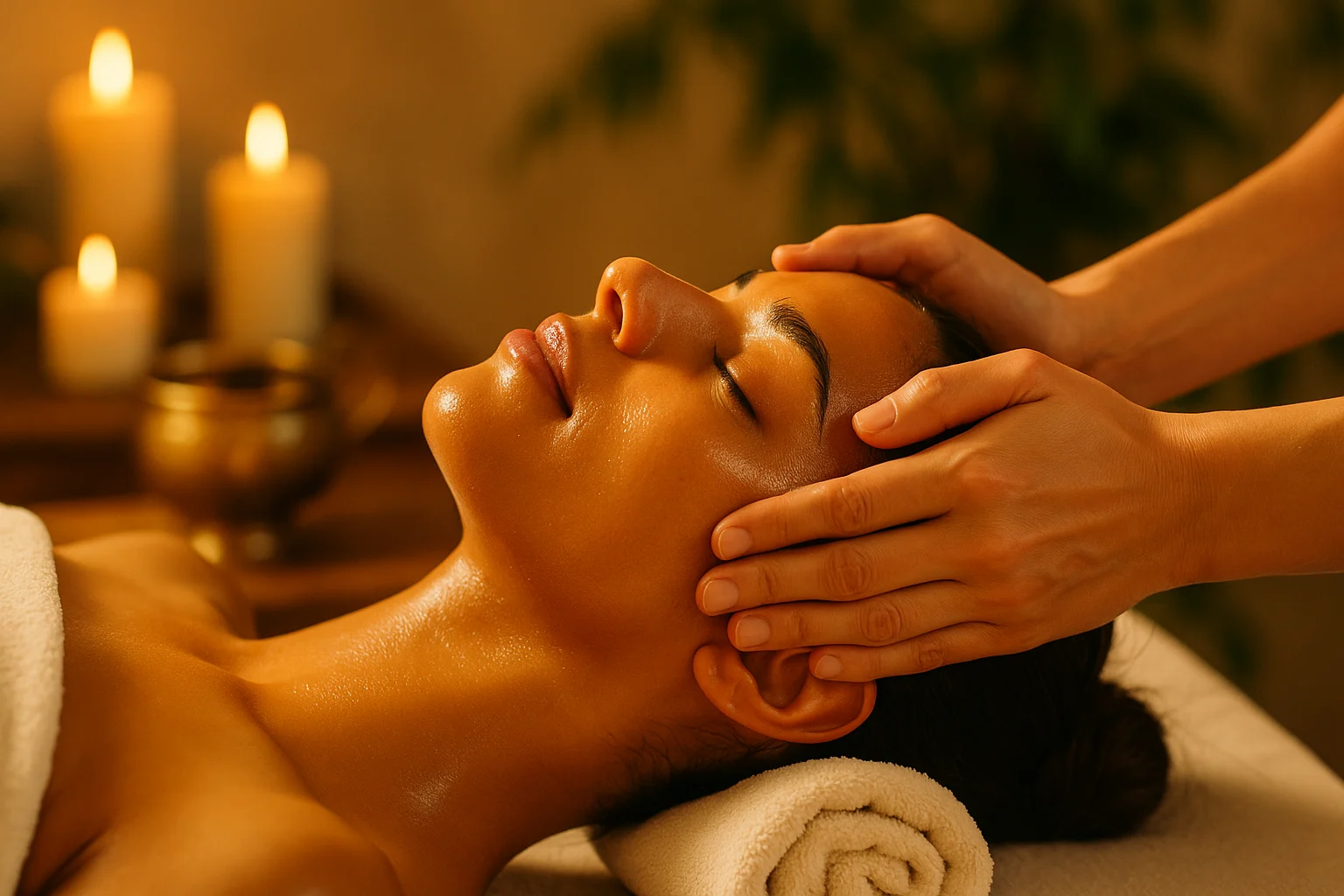
If you want a face-massage ritual that feels calming without turning into another 20-minute task, start here. Gentle should feel almost underwhelming. This 5-minute Ayurvedic facial massage uses a small amount of a skin-care product you already tolerate and light, slow strokes across the neck, jaw, cheeks, temples, and forehead. The goal is comfort and ritual—not forcing a lift, “draining” your face, or treating a skin, sinus, or headache problem.
This ritual is inspired by Ayurvedic self-care. You may see facial oil massage described as Mukha Abhyanga and paired with marma points in modern practice. If you want to see how it fits into a broader routine, visit Ayurvedic daily practices.
Jump to the 5-Minute MassageTable of Contents
- What Is Ayurvedic Facial Massage?
- Choose a Facial Oil or Moisturizer Your Skin Tolerates
- Set Up Your 5-Minute Ritual
- 5-Minute Ayurvedic Facial Massage: Step by Step
- Potential Benefits: What’s Realistic?
- How Often Should You Practice?
- Common Mistakes to Avoid
- Optional Ways to Personalize the Ritual
- Frequently Asked Questions
- Get the 10-Minute Chair Yoga Routine
What Is Ayurvedic Facial Massage?
In this guide, Ayurvedic facial massage means a gentle face-and-neck self-massage inspired by Ayurvedic self-care traditions, using a small amount of oil, moisturizer, or another leave-on product for comfortable glide. The National Center for Complementary and Integrative Health describes Ayurveda as an ancient Indian medical system and notes that scientific evidence for many Ayurvedic health uses is limited. This routine uses slow gliding strokes, small circles, and optional pauses around traditional marma points. Marma points belong to Ayurveda’s traditional framework; they are not a proven map for treating headaches, sinus problems, acne, or lymphatic conditions.
Keep expectations modest: use the ritual for gentle touch, a pause in your day, and a temporarily refreshed feel. Scientific evidence for lasting wrinkle reduction, “face lifting,” detoxification, or medical effects is limited.
Choose a Facial Oil or Moisturizer Your Skin Tolerates
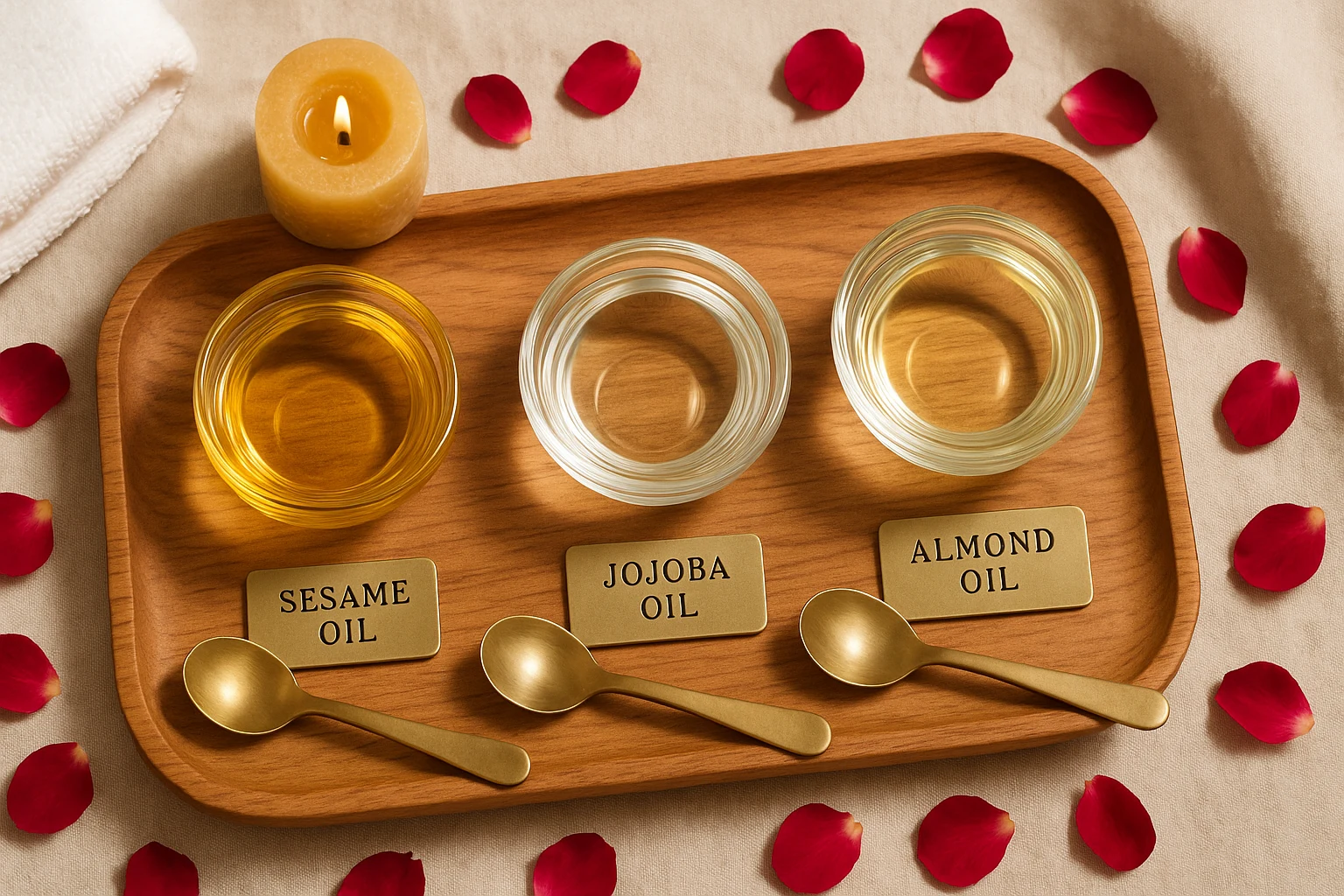
Ayurvedic traditions may match oils to dosha categories, but doshas are not the same thing as modern dermatology skin types. For home Ayurvedic face care, the practical starting point is simpler: use a small amount of a facial oil, moisturizer, or other leave-on product that already gives you comfortable slip without irritation. For this hands-only version, you do not need a roller, gua sha tool, or special Ayurvedic oil.
| Skin situation | Practical starting point | When to stop or reconsider |
|---|---|---|
| You already have a facial oil or moisturizer that works well | Use a small amount of that familiar product. You do not need a special Ayurvedic oil to practice the massage. | Stop if the massage itself causes burning, tenderness, or persistent redness. |
| Sensitive or reactive skin | Prefer a simple, fragrance-free product you already tolerate. | Do not continue through itching, swelling, stinging, or a rash. |
| Acne-prone skin | If oils tend to break you out, use a moisturizer or other product you already tolerate that provides enough slip rather than forcing a heavy oil. | Back off if new breakouts or irritation appear after adding the product or massage. |
| Active rash, open skin, significant irritation, or a recently treated area | Skip facial massage on that area and follow the guidance you were given for the skin problem or procedure. | Ask a dermatologist or other qualified clinician if you are unsure when massage is appropriate. |
New product? The American Academy of Dermatology recommends testing a new skin-care product on a small test spot twice daily for 7–10 days before broader use. If the test area becomes irritated, stop using the product.
Set Up Your 5-Minute Ritual
You do not need a spa setup. The useful preparation is simply clean skin, clean hands, enough slip to avoid dragging, and pressure light enough that your face still feels comfortable when you finish.
- Cleanse gently: remove makeup, sunscreen, and surface dirt, then pat dry.
- Warm the product in your palms: body warmth is enough; you do not need to heat oil separately.
- Use less than you think: start with a small amount or a thin layer and add more only if your fingers tug.
- Keep pressure light: the skin should glide rather than stretch sharply under your fingers.
- Skip tender areas: avoid broken skin, active irritation, and any spot that hurts when touched.
5-Minute Ayurvedic Facial Massage: Step by Step
Use slow, light pressure and enough product for comfortable glide. The timing is approximate, so do not rush to “finish” a zone, and skip any area that feels irritated or tender. Start the guide when you are ready; it moves to the next zone every 60 seconds, and you can pause or choose any zone at any time.
Ready for zone 1: Neck and Jaw.
0:00–1:00 — Neck and Jaw
- Place your palms at the sides of your neck and make a few slow, comfortable strokes toward the collarbones.
- Use two or three fingertips to make small circles at the jaw hinge.
- Glide from the center of the chin toward the ears without pressing into the jaw.
1:00–2:00 — Cheeks
- Glide from the center of the face outward toward the ears.
- Use small circles over the fleshy part of the cheeks.
- Keep the pressure light enough that the movement feels soothing rather than corrective.
2:00–3:00 — Mouth and Nose
- Trace small circles around the corners of the mouth and along the upper-lip area.
- Glide lightly along the sides of the nose and outward across the cheeks.
- Skip any area that is inflamed, sore, or actively breaking out.
3:00–4:00 — Eyes and Forehead
- Use your ring fingers around the orbital bone rather than rubbing the eyelids themselves.
- Sweep gently across the brow line and then outward across the forehead toward the temples.
- If the skin pulls, add a little more slip instead of increasing pressure.
4:00–5:00 — Temples and Finish
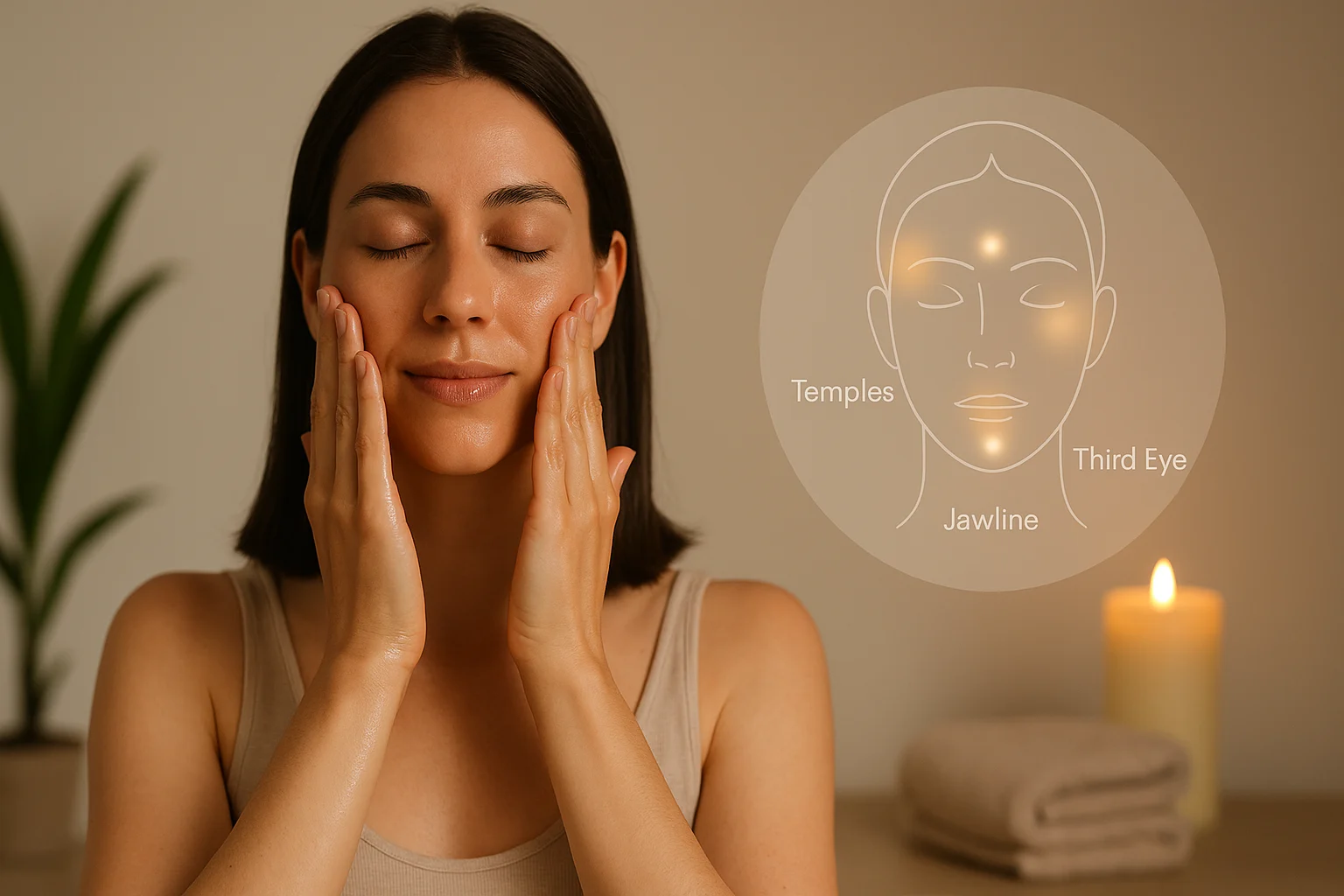
- Pause for a few slow circles at the temples. If marma-point practice is meaningful to you, use the pause as traditional context rather than a reason to press harder.
- Finish with a few light outward strokes across the face and down the sides of the neck.
- Blot away excess product with a soft cloth if needed; there is no need to keep massaging after the five minutes are up.
Potential Benefits: What’s Realistic?
A facial massage can make your skin look temporarily warmer or more flushed, and the product you use can leave the surface feeling softer. A small 2018 study in 12 participants found that five minutes with a facial massage roller increased facial skin blood flow for at least 10 minutes afterward. That supports a short-term circulation response from the roller study, but it does not prove lasting cosmetic change from hand massage.
Longer-term evidence is much thinner. A 2022 manual facial-massage pilot included only five healthy adults, which is far too small to support confident promises about lifting, tightening, fine lines, or lasting skin changes. If you want to look at the research directly, see the 2018 facial-roller study and the 2022 preliminary facial-massage study.
If you’re looking for a natural facial massage, keep the goal simple: comfortable skin, a few minutes of deliberate touch, and no need to chase a dramatic cosmetic change. Do not rely on it to treat acne, persistent swelling, headaches, sinus symptoms, sleep problems, or a medical skin condition.
How Often Should You Practice?
There is no evidence-based schedule for this ritual. If you enjoy it, repeat it only as often as your skin remains comfortable. Persistent redness, tenderness, itching, or more breakouts are reasons to reduce the frequency or stop.
More time is not automatically better. A gentle five minutes that your skin tolerates is more useful than turning the ritual into a long, aggressive massage because you are chasing faster results.
Common Mistakes to Avoid
- Pressing too hard: facial massage should not hurt, leave lasting redness, or make the skin feel raw.
- Trying a new oil and a new massage at the same time: if your skin reacts, you will not know which change caused it.
- Dragging around the eyes: use light pressure around the orbital bone and avoid rubbing the eye itself.
- Massaging irritated skin: skip active rashes, open skin, painful areas, and recently treated skin until it is appropriate to touch again.
- Using more product than you need: you need enough slip to avoid tugging, not a heavy coating.
- Chasing “detox” or a face-lift effect: longer, harder massage is not a shortcut to a medical or anti-aging result.
Optional Ways to Personalize the Ritual
Once the basic five-minute version feels easy, personalize the ritual without turning it into a bigger promise.
- Slow the breathing: pair each zone with a few unforced breaths if that helps the ritual feel calmer.
- If you want a longer ritual: repeat the same light-pressure sequence once. Treat the extra time as a preference, not a stronger treatment.
- Keep marma points in their traditional lane: use them as moments of attention or stillness, not as medical pressure points.
- Finish simply: blot excess product, continue with your normal skin-care routine if appropriate, and stop there.
Frequently Asked Questions
If your skin still feels comfortable after five minutes, you did enough. Let the ritual be a pause, not a project: light pressure, slow movement, and no need to chase a dramatic before-and-after result.
If short routines are easier for you to use consistently—and stiff mornings are another place you want a concrete plan—the free 10-minute chair-yoga routine is a natural next step.
Get the 10-Minute Chair Yoga Routine
Confirm to get the routine and yoga tips. Unsubscribe anytime.
Something went wrong. Please check your email address and try again.