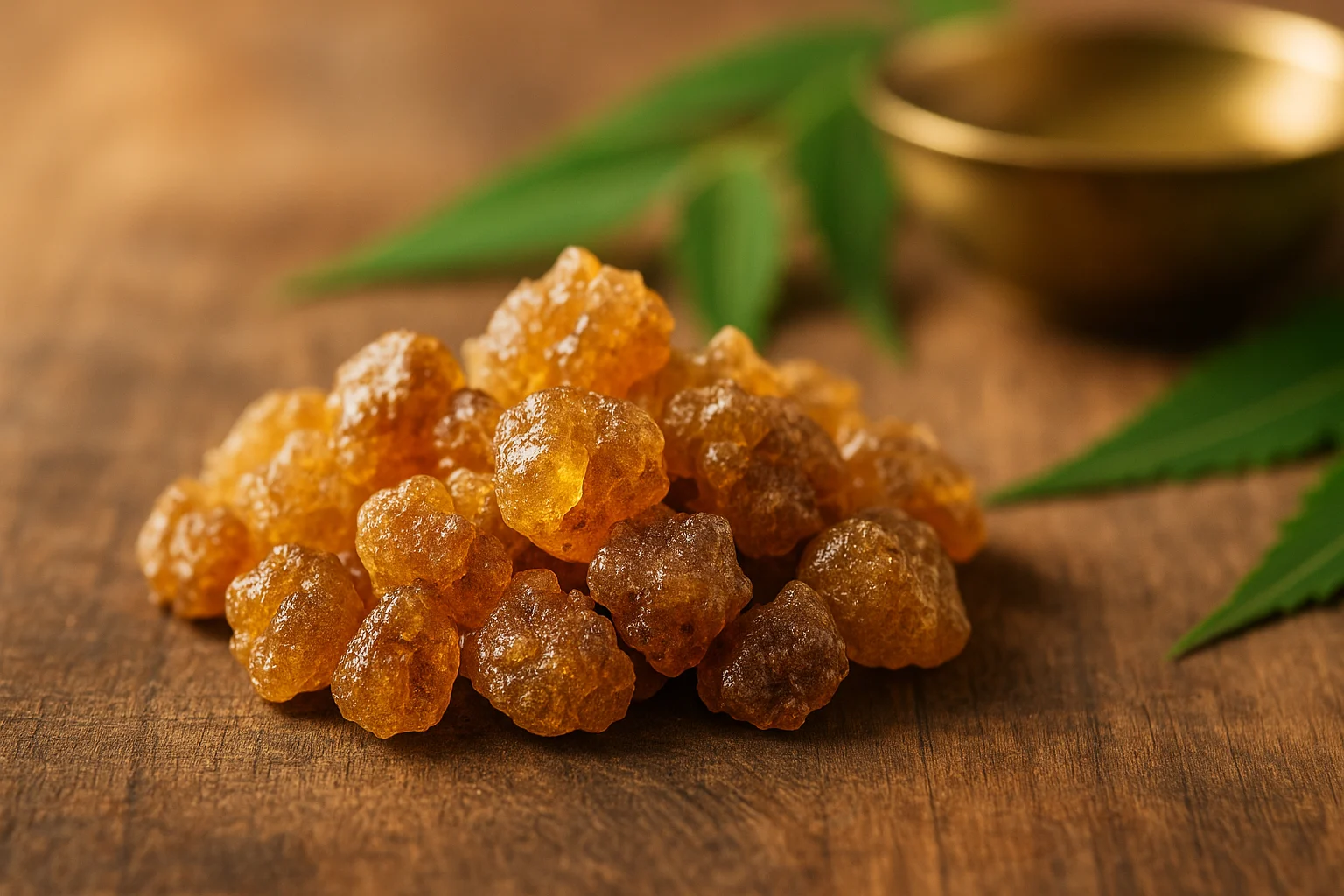
Guggul has a long history in Ayurveda, but many commonly claimed guggul benefits run ahead of the human evidence. Human evidence does not establish a reliable cholesterol or weight-loss benefit. Some findings also raise safety and medication-interaction questions.
This guide separates traditional use from what human studies actually support, then covers product quality, side effects, and interactions. For the broader Ayurvedic context around herbs, routines, food, and self-care, see our guide to Ayurvedic daily practices.
Table of Contents
- What Guggul Is and How Ayurveda Uses It
- What Human Research Says About Guggul Benefits
- Before You Take Guggul: Form and Product Quality
- Guggul Side Effects, Interactions, and Precautions
- Frequently Asked Questions About Guggul
- Should You Use Guggul for a Health Goal?
What Guggul Is and How Ayurveda Uses It
Guggul is the aromatic gum resin of Commiphora wightii; older medical and supplement sources often use the synonym Commiphora mukul. Plants of the World Online treats C. wightii as the accepted name. In Ayurveda, guggul has traditionally appeared in preparations for concerns such as lipids, joint discomfort, skin problems, and body weight. The resin contains many compounds, including phytosteroids called guggulsterones, but traditional use and chemical activity are not the same as proven clinical benefit.
What Human Research Says About Guggul Benefits
Online lists of guggul health uses often sound more settled than the research is. The most useful way to read the evidence is claim by claim: what has been tested in people, what comes mainly from laboratory or animal work, and what remains traditional rather than clinically established.
Cholesterol
Early studies reported cholesterol-lowering effects, but later controlled trials did not confirm a dependable benefit. In the 2003 U.S. randomized trial, LDL cholesterol rose by 4% in the standard-dose guggulipid group and 5% in the high-dose group while LDL fell 5% with placebo. Total cholesterol, HDL, and triglycerides did not improve significantly with guggulipid. That means guggul should not be presented as a cholesterol treatment or as a substitute for evidence-based lipid management.
If cholesterol is your reason: discuss the goal with a clinician rather than using guggul as a self-directed alternative to prescribed treatment.
Weight Loss and Metabolism
Strong human evidence that guggul itself causes meaningful weight loss is lacking. A 2021 placebo-controlled trial of Guggulu with Triphala found no advantage over placebo for BMI or waist circumference; because the trial tested a combination, it does not isolate guggul’s effect by itself. Claims that guggul raises metabolic rate are also not established in good human studies.
Thyroid, Hormones, and PCOS
Claims that guggul improves an underactive thyroid, “balances hormones,” or treats PCOS are not established by good human evidence. The NTP safety review notes thyroid stimulation in animal studies but not in human clinical studies. Laboratory research also shows that guggulsterones interact with estrogen, progesterone, and pregnane X receptors; this mechanistic finding is a reason for interaction caution, not proof of a hormone-balancing benefit.
For thyroid disease or PCOS, use condition-specific medical guidance rather than treating guggul as a substitute for diagnosis or evidence-based care.
Inflammation, Joints, Skin, and Acne
Laboratory and animal research has explored anti-inflammatory activity, but that is not the same as showing that guggul relieves joint or skin symptoms in people. Clinical evidence for arthritis and other inflammatory conditions remains limited, so these uses are better described as traditional or experimental rather than established benefits.
A very small 1994 clinical trial compared oral gugulipid with tetracycline in 20 people with nodulocystic acne. A study that small and old is not enough to establish guggul as an acne treatment. Traditional “blood-clearing” or “detox” language belongs to a traditional framework and should not be read as a modern claim that guggul removes toxins from the body.
Before You Take Guggul: Form and Product Quality
Because evidence for the common medical uses is uncertain, this article is not a dosing guide. Clinical studies have used different preparations and doses, and commercial products can vary in their actual guggulsterone content. Standardization describes composition; it does not prove that a product will improve cholesterol, weight, thyroid function, or another health outcome.
The NTP review also cites analyses in which some U.S. products contained substantially less guggulsterone than their labels claimed. If you are considering an oral product, bring the exact label and ingredient list to a clinician or pharmacist and follow the product label only if a qualified professional agrees it is appropriate for you.
| Form | What it is | What to keep in mind |
|---|---|---|
| Oral extract or tablet | A dietary supplement intended to be swallowed | Evidence for common health claims is uncertain; ingredient strength and formulation can vary. |
| Raw or incense resin | Aromatic resin used in traditional or ritual settings | Do not assume a product sold for burning is suitable or safe to ingest. |
Guggul Side Effects, Interactions, and Precautions
Reported adverse effects include stomach upset, loose stools, headache, and skin rash or other hypersensitivity reactions. Liver injury has also been reported in people taking products that contained guggul, although some reports involved multi-ingredient supplements, which makes the cause difficult to isolate.
The NTP review notes that guggul can affect platelet-related activity and drug-metabolizing pathways, while laboratory studies show activation of the pregnane X receptor and CYP3A genes. That creates a plausible interaction concern for some medicines even when a specific interaction has not been proven clinically. Tell your clinician or pharmacist about every supplement and medication you use before adding guggul.
Pregnancy and breastfeeding are clearer reasons to avoid self-experimentation: the NTP review cites WHO guidance that safety has not been established and recommends discontinuing use during pregnancy and lactation. If you have a liver, thyroid, bleeding, or hormone-sensitive condition, get individualized medical advice before using it.
For a concise clinical overview of adverse effects and interaction concerns, see Memorial Sloan Kettering’s guggul monograph.
Frequently Asked Questions About Guggul
Should You Use Guggul for a Health Goal?
If your goal is lower cholesterol, weight loss, thyroid support, PCOS treatment, or “hormone balance,” current human evidence does not support relying on guggul for that outcome. Its traditional Ayurvedic use is real, but it should not replace condition-specific care with better evidence.
If you are still considering an oral guggul product despite the uncertain evidence, review the exact label, your medications and supplements, and your reason for taking it with a qualified healthcare professional before you start. If your interest is incense or ritual use instead, keep products sold for burning separate from products intended for ingestion.